

Finish this quarter's review by working through eight things: reconcile every bank and credit card account, verify actual cash on hand, review accounts receivable aging and collections, check accounts payable and upcoming obligations, calculate burn rate and runway alongside your core KPIs, confirm payroll and tax liabilities are current, spot check internal controls, and document findings with assigned owners.
That is the whole job in one sentence. The rest of this guide breaks down how to execute each piece so you leave the meeting with decisions made, not just numbers reviewed.
- Reconcile bank and credit card statements against your books
- Verify cash position and compare it to forecast
- Run AR aging and flag collection risks
- Review AP and confirm nothing critical is coming due unnoticed
- Calculate burn rate, runway, and gross margin
- Confirm payroll tax deposits and benefit accruals are current
- Test a sample of controls (signatories, manual journal entries)
- Log action items with owners and deadlines
Lenders often look for a debt service coverage ratio near 1.25 before extending credit, and the IRS estimated payment schedule gives you a hard deadline to check against payroll tax liabilities during this same review.
Key Takeaways
A disciplined quarterly financial review works only when reconciliation happens first, key metrics get calculated consistently, and every finding gets a named owner and a deadline.
| Point | Details |
|---|---|
| Reconcile before anything else | Unreconciled accounts make every other number in the review unreliable. |
| Watch the 60-day AR bucket | More than 15% of receivables past 60 days signals a collections problem. |
| Runway beats revenue as a warning sign | Cash balance divided by burn rate tells you how many months you have to act. |
| Document and assign, don't just discuss | A short summary with named owners and deadlines is what makes action items actually happen. |
| AmCFO fits where the checklist gets hard | Bookkeeping, fractional CFO, and forensic accounting services match specific stages of this review. |
Table of Contents
- Documents to Gather Before Your Quarterly Financial Review Checklist
- Step-By-Step Quarterly Review Procedure
- Who Runs the Review and When It Should Happen
- The Metrics That Actually Tell You Something This Quarter
- Internal Controls and Compliance Checks Worth Running
- Turning Findings Into Tracked Action Items
- AmCFO's Template and Escalation Guidance for Quarterly Reviews
- Frequently Asked Questions
- Sources
Documents to Gather Before Your Quarterly Financial Review Checklist
Pull these before anyone sits down: profit and loss for the quarter and year to date, balance sheet, cash flow statement, bank and credit card statements, AR aging, AP aging, payroll register, tax payment history and upcoming estimates, budget versus actual report, your KPI dashboard, and any active loan statements or vendor contracts with renewal dates. A balanced quarterly packet typically covers the P&L, balance sheet, cash flow, budget variance, and AR aging at minimum.
Assign pull dates, not just pull tasks. Your bookkeeper should finish reconciliations about a week before the meeting; whoever owns forecasting updates projections two days out, once the reconciled numbers are locked.
- P&L (quarter + year to date) and balance sheet
- Cash flow statement and bank/credit card statements
- AR aging and AP aging reports
- Payroll register and tax payment history
- Budget vs. actual and KPI dashboard
- Loan statements and vendor contracts
Store everything in one shared folder with a consistent naming convention, like "2026-Q1-Review-[document type]," so nobody hunts for a file mid-meeting. AmCFO's guide on organizing financial records walks through a naming system that scales as your document volume grows.
Step-By-Step Quarterly Review Procedure
Run the meeting in this order. Reconciliation comes first because unreconciled accounts make every other number in the room unreliable.
1. Confirm bank and credit card reconciliation is complete. Ask the bookkeeper: does the reconciled cash balance match the bank statement to the penny? If not, stop and investigate before moving forward. Discrepancies left sitting for 60 to 90 days compound into material errors that show up in tax filings and cash forecasts later.
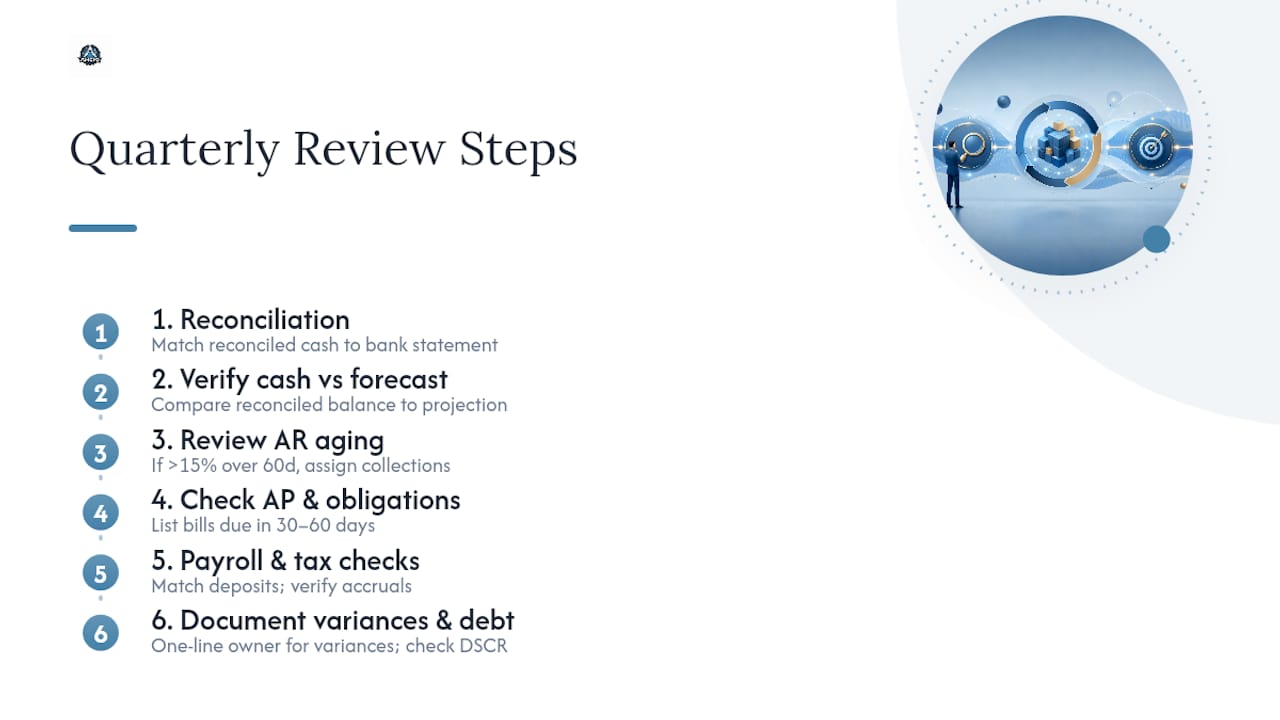
2. Verify actual cash position against forecast. Compare the reconciled cash balance to what you projected last quarter.
3. Review AR aging and assign collection actions. Most receivables should sit in the 0 to 30 day bucket. If more than 15% of AR is over 60 days, you have a collections problem that will hit cash within a quarter or two. Name the accounts, assign a collector, and set a follow-up date.
4. Check AP and upcoming obligations. Pull every bill due in the next 30 to 60 days, including loan payments and lease renewals. Confirm cash on hand covers them without straining payroll.
5. Confirm payroll and tax liabilities. Match payroll tax deposits against IRS deposit schedules and check benefit accruals for accuracy. This is also the point to flag upcoming estimated tax payments.
**6. Every flagged variance needs a one-line explanation and an owner.
7. Review debt service and leverage. If you carry a loan, confirm your debt service coverage ratio still clears the lender's covenant threshold. This matters even more in a quarter where revenue dipped.
Pro Tip: *Document every variance the moment you spot it, even the small ones.
Keep the meeting to 60 to 90 minutes with the owner or CEO, controller or bookkeeper, and whoever runs sales or operations in the room. Structure the agenda in that same order: reconciliation and cash, then AR/AP, then payroll and tax, then variance, then debt and next steps. Ending with strategy instead of starting with it, as one end-of-quarter framework recommends, keeps the room focused on numbers before opinions.
Who Runs the Review and When It Should Happen
The owner or CEO leads the meeting and makes final calls. The controller or bookkeeper presents reconciled numbers and reports. A fractional CFO, if you use one, interprets the numbers strategically and flags risks the owner might miss. Bring in an external tax advisor when estimated payments or entity structure questions come up.
- Owner/CEO: leads meeting, approves action items
- Controller/bookkeeper: presents reconciled financials
- Fractional CFO: interprets trends, flags risk, recommends action
- Tax advisor: joins when tax timing or liability questions surface
Schedule the review within the first 10 business days after quarter close, while the numbers are still fresh enough to act on. Sign off with a simple checklist: names, date, and confirmation that action items were assigned before anyone leaves the room.
The Metrics That Actually Tell You Something This Quarter
Burn rate, your monthly net cash outflow, tells you how fast you are spending relative to what is coming in. Divide your current cash balance by burn rate and you get runway, the number of months you can operate before running dry. Gross margin (revenue minus cost of goods sold, divided by revenue) shows whether your core business model still works at current pricing.
Days sales outstanding measures how long, on average, customers take to pay. Watch your AR aging buckets alongside it: more than 15% sitting past 60 days signals a collections issue before it becomes a cash issue. Debt service coverage ratio, net operating income divided by total debt payments, matters most if you carry a loan; lenders generally want to see it near 1.25 or higher.
- Burn rate: monthly cash outflow, tracked over rolling 3 months
- Runway: cash balance ÷ burn rate = months of operating cushion
- Gross margin: (revenue − COGS) ÷ revenue
- DSO and AR aging: watch the 61 to 90 and 90+ day buckets closely
- DSCR: net operating income ÷ total debt service, target near 1.25
Founders tend to care most about runway. Lenders care about DSCR. Investors want margin trends over multiple quarters. Knowing months of runway ahead of time turns a scary cash conversation into a planned one instead of a reactive scramble.
Internal Controls and Compliance Checks Worth Running
Segregation of duties matters more than most owners assume. If the same person who approves invoices also cuts the checks, you have a control gap worth closing before it becomes a problem. Review your bank signatory list and who has access to move money. Scan the vendor master file for duplicate entries or vendors that never got a formal setup review.
- Confirm no single person approves and pays without a second check
- Audit bank signatories and payment platform access quarterly
- Review vendor master file for duplicates or unfamiliar entries
- Reconcile payroll tax deposits against filed returns
- Flag unusually large manual journal entries for a second look
Watch for duplicate payments, vendor names nobody recognizes, and manual adjustments that lack backup documentation. A balance sheet review that includes liquidity, leverage, and inventory levels catches issues a P&L alone will miss.
Pro Tip: If the same unexplained variance shows up two quarters in a row, stop treating it as a rounding issue. That pattern is exactly when a forensic accounting review earns its cost.
Turning Findings Into Tracked Action Items
Write a short summary, two to three pages, covering key findings, variance explanations, decisions made, who owns each follow-up, and the deadline. This mirrors the format finance teams use for quarterly business reviews: numbers first, then decisions, then a documented action log.
Store the signed summary in the same shared folder as your source documents, and keep at least eight quarters on file. That history is what lets you spot a seasonal pattern instead of reacting to it as a surprise each time.
| Action Item | Owner | Deadline |
|---|---|---|
| Collect AR over 60 days | Controller | 2 weeks |
| Renegotiate vendor payment terms | Owner | 30 days |
| Update cash forecast | Fractional CFO | 5 days |
Schedule a 15 minute mid-quarter check-in on any item marked high priority. Mark items closed only once there is documented evidence, not just a verbal update.
AmCFO's Template and Escalation Guidance for Quarterly Reviews
A reusable packet keeps every quarter consistent: cover page with quarter and attendees, reconciliation summary, KPI dashboard, variance analysis, action log, and a signature block. AmCFO's guide on preparing a business financial review walks through building that packet from scratch if you are starting fresh this year.
- Cover page: quarter, attendees, date
- Reconciliation summary and cash position
- KPI dashboard with quarter-over-quarter trend
- Variance analysis with owner notes
- Action log and sign-off block
Pro Tip: Pre-flag variances you expect before the meeting starts, like a known seasonal dip or a planned marketing spend. It saves meeting time for the surprises that actually need discussion.
Call in outside help when the same discrepancy repeats for two quarters, when DSCR drops below your lender's covenant, or when a manual journal entry has no clear explanation. A fractional CFO can run the review process itself; a forensic accountant steps in when the numbers suggest something beyond a simple bookkeeping error.
A business owner's take on what changed
One AmCFO client credits the discipline of assigning a named owner to every action item, not just flagging problems, for catching a collections gap before it turned into a payroll shortfall. Documentation, not just discussion, made the difference.
Get Your Next Quarterly Review Off a Spreadsheet and Onto a System
If you are still rebuilding this checklist from scratch every 90 days, the real cost is not the template, it is the hours your controller spends reconstructing reconciliations that should already be current. AmCFO handles bookkeeping and reconciliation as an ongoing service, so the review packet is already assembled before the meeting starts instead of pulled together the night before.

For businesses that need someone in the room interpreting variances and DSCR trends rather than just reporting them, AmCFO's fractional CFO services plug directly into this checklist, running the review, flagging risk, and recommending the next move. If a quarter's numbers ever look off in a way that doesn't add up after two reviews, AmCFO's forensic accounting team can dig into what a standard reconciliation won't catch. Book a consultation to see which level of support fits where your business is right now.
Frequently Asked Questions
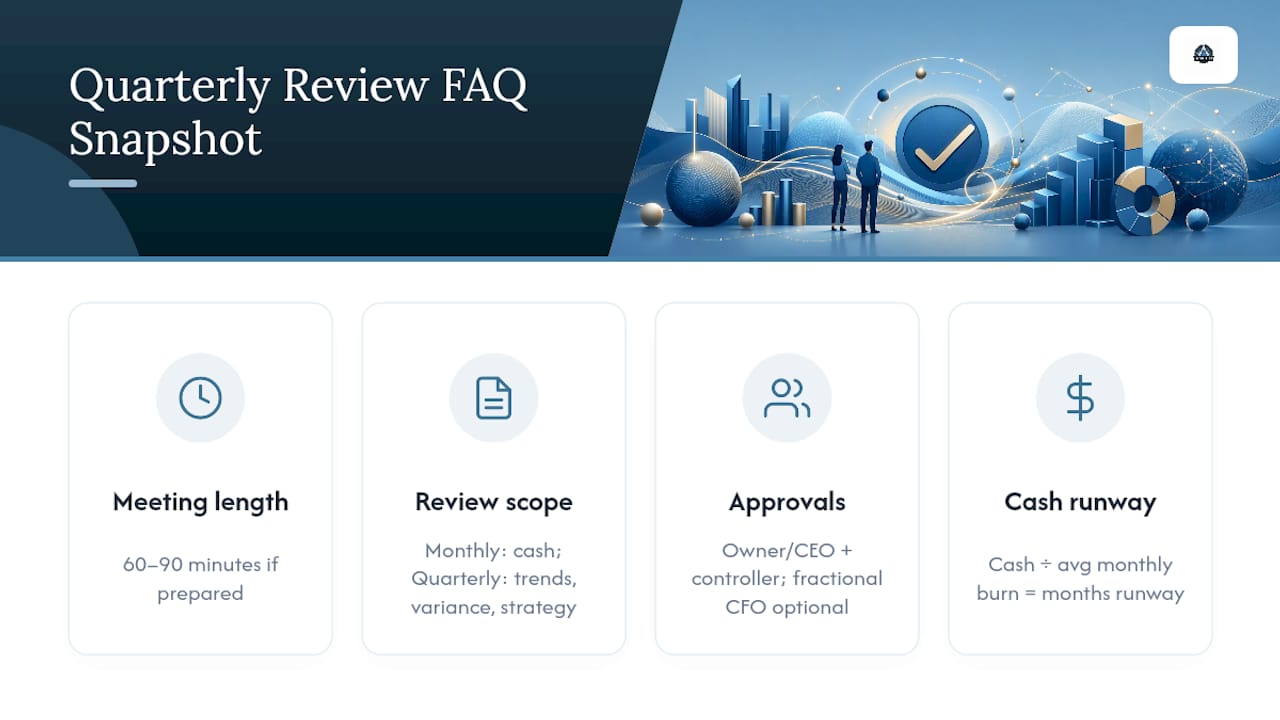
How long should a quarterly financial review meeting take? Most reviews run 60 to 90 minutes when the documents are prepared in advance. Meetings run longer only when reconciliation issues surface mid-discussion.
What's the difference between a monthly and quarterly financial review checklist? Monthly reviews catch immediate cash issues; a quarterly review adds trend analysis, variance investigation, and strategic decisions that a single month's data can't support.
Who should sign off on the quarterly review? The owner or CEO gives final sign-off, typically alongside the controller or bookkeeper who prepared the numbers and a fractional CFO if one is involved.
What's a reasonable AR aging red flag during a quarterly review?
How do I calculate cash runway during a quarterly review? Divide your current cash balance by your average monthly burn rate. The result tells you how many months you can operate at the current spending pace.
This article is general information, not a substitute for advice from a qualified financial advisor. Consult a qualified financial professional about your own circumstances before acting on anything here.
Sources
- 5-Point Monthly Financial Review Checklist for SMB Owners — CurrentCFO
- Quarterly Business Reviews: A Financial Checklist | Finntree Blog
- Quarterly Business Review Checklist: End-of-Quarter Audit | EntrepreneurBytes
- Your financial review checklist — Citi (PDF)