

Project accounting is the practice of tracking every dollar of cost, billing, and revenue against a single project instead of the business as a whole. It differs from financial accounting, which reports on the entire company over fixed periods, by treating each project as its own financial unit with its own budget, timeline, and profit picture. The payoff is direct. You see which projects actually make money, and you catch cost overruns while there's still time to fix them.
TL;DR:
- Accurate daily transaction coding and consistent allocation methods are essential to prevent errors and ensure meaningful project profitability reports.
- Revenue recognition methods like percentage-of-completion heavily influence cash flow and billing cycles, requiring careful selection based on project type.
- Regular WIP reconciliations at early project stages can catch coding errors or scope issues before they become costly to fix later.
- Automated project subledgers and detailed dashboards simplify real-time tracking of budget versus actual spend and resource utilization.
- Cultivating disciplined time entry and project code assignment consistently outperforms reliance solely on software sophistication.
Table of Contents
- What Project Accounting Basics Cover and When You Need Them
- How Does Project Accounting Work Step By Step?
- What Are the Core Principles of Project Accounting?
- How Does Revenue Recognition Work in Project Accounting?
- What Does a Project Accountant Actually Do?
- What Should You Look For in Project Accounting Tools?
- What Reports and KPIs Matter Most in Project Accounting?
- What Best Practices Prevent Project Accounting From Falling Apart?
- How Amcfo Approaches Project Accounting Setup
- The Part of Project Accounting Most Guides Get Wrong
- Ready to Set Up Project Accounting the Right Way?
- Sources
What Project Accounting Basics Cover and When You Need Them
Not every business needs project accounting. A retail shop selling the same product every day has little use for it. But the moment revenue and cost tie to a specific, time-bound piece of work with its own budget, project accounting becomes the tool that keeps you solvent.
Industries that lean on it heavily include construction, professional services firms (law, consulting, engineering), government contractors, software development shops, and media production companies, all of which track costs and revenue against individual contracts or jobs rather than against the calendar. A construction firm building three houses at once needs to know, at any moment, which house is bleeding money and which is on budget. A consulting firm juggling six client engagements needs the same clarity, just with labor hours instead of lumber.

The mechanism that makes this possible is the project code, sometimes called a job number or cost code. Every transaction, whether it's a timesheet entry, a vendor invoice, or a material purchase, gets tagged to a specific project. Those tagged transactions live in what's called a project subledger, a detailed record that maps every project transaction back to the general ledger so your company-wide books stay accurate while you still get project-level detail.
You probably need project accounting if:
- Projects run longer than a single accounting period (a month or quarter)
- Multiple people bill time or expenses to the same job
- You bid or quote work and need to know if the quote held up against actual costs
- You invoice clients based on project milestones or percentage of work completed
- Profitability varies significantly from one project to the next
If none of those apply, standard financial accounting is probably enough. If two or more do, you're already losing visibility without a project accounting structure in place.
How Does Project Accounting Work Step By Step?
Most project accounting processes follow the same six-stage flow, whether you're running a construction job or a six-month software build. This structure, outlined by NetSuite and echoed across the industry, breaks into initiation, budgeting, administration, allocation, maintenance, and analytics.
- Initiation. Define the project scope, assign an owner, and create the cost codes or work breakdown structure (WBS) that will categorize every future transaction. This is where you decide how granular you want tracking to be, by phase, by task, or by cost type.
- Budgeting. Build a baseline budget tied to the WBS. This baseline becomes the yardstick every future report measures against, so it needs to be realistic, not aspirational.
- Administration. Record transactions as they happen: timesheets, purchase orders, subcontractor invoices, and client billing. This is the daily grind of project accounting, and it's the stage most prone to breaking down if people don't code their time and expenses correctly.
- Allocation. Split costs into direct (labor, materials, equipment tied straight to the project) and indirect (overhead, shared equipment, administrative support). Indirect costs get spread across projects using an allocation base, usually labor hours or direct cost dollars.
- Maintenance. Reconcile work-in-progress (WIP) figures against actuals on a regular cycle, catching any transactions that were miscoded or missed. This is also where you make adjustments for change orders or scope shifts.
- Analytics. Run reports comparing budget to actual, review margin trends, and flag projects that need corrective action, whether that's rescoping, renegotiating, or simply tightening spend controls.
The cadence matters more than the sophistication. A small business running monthly WIP reconciliations with a spreadsheet will outperform one running a $50,000 system nobody updates.
What Are the Core Principles of Project Accounting?
Four principles hold the whole system together, and skipping any one of them is usually what causes project accounting to fail in practice.
- Accuracy. Numbers only matter if they're right. Miscoded time entries or delayed invoice postings quietly corrupt every report downstream.
- Transparency. Project stakeholders, not just the finance team, need visibility into where a project stands financially.
- Consistent allocation. Overhead and shared costs get spread using the same method every time, so projects can be compared fairly against each other.
- Reporting frequency. Monthly is standard; weekly is common on fast-moving or high-risk projects.
The objectives these principles serve are cost control, accurate profitability measurement, billing that matches the work actually delivered, and protecting cash flow so the business isn't financing client work out of its own pocket.
Direct costs are the easy part: labor hours, materials, subcontractor fees, anything you can point to a specific project and say "that's theirs." Indirect costs are trickier. Rent, utilities, admin salaries, and shared equipment all support multiple projects at once, so they need an allocation base, most commonly direct labor hours, direct labor cost, or total direct cost, to split fairly.
Pro Tip: Pick one allocation base for indirect costs and stick with it across every project for at least a full fiscal year. Switching methods mid-year makes profitability comparisons between projects meaningless, even if each individual calculation is technically correct.
How Does Revenue Recognition Work in Project Accounting?
The method you choose to recognize revenue changes when profit shows up on your books, and it can shift by months depending on which one you pick.
The most widely used approach for longer projects is percentage-of-completion, which recognizes revenue in proportion to work finished rather than waiting until the whole job wraps. Three common variants exist:
- Cost-to-cost: revenue recognized equals costs incurred divided by total estimated costs, multiplied by total contract value. If you've spent a portion of the estimated total cost on a contract, you'd recognize revenue proportionally.
- Effort-expended: uses labor hours or units of effort instead of dollars, useful when labor, not materials, drives project cost.
- Units-of-delivery: revenue recognized as physical units are completed and delivered, common in manufacturing and infrastructure projects with clearly defined deliverables.
Completed-contract method holds all revenue and cost recognition until the project finishes entirely. It's simpler, but it can create wild swings in reported profit from one period to the next, since a company might show near-zero revenue for months and then a huge spike at completion. Smaller contractors and short-duration projects still use it because the administrative burden of continuous tracking outweighs the benefit.
Installment or sales basis recognition shows up in a narrower set of cases, typically longer-term sales arrangements where cash collection is uncertain enough that revenue gets recognized as payments come in rather than as work is performed. It's the exception, not the default, in most project-based businesses.
The method you pick doesn't just affect your income statement. It changes your billing cadence too. A cost-to-cost project usually bills in step with recognized revenue, while a completed-contract project often bills on fixed milestones regardless of underlying cost accumulation. Get this mismatched, and you can end up profitable on paper while critically short on cash.
What Does a Project Accountant Actually Do?
A project accountant's job splits roughly into three buckets: transactional work, analysis, and advisory work. The role is often described as a gatekeeper and advisor, someone who reports financial status, investigates variances between planned and actual spend, and advises project teams on the financial consequences of decisions before they're made, not after.
Day-to-day, that means:
- Posting transactions correctly against project and cost codes
- Reviewing time and expense entries for accuracy before they hit the books
- Running variance analysis between budgeted and actual spend
- Reconciling work-in-progress balances each reporting period
- Reviewing draft client invoices against contract terms before they go out
The advisory side is where the role earns its keep. When a project manager wants to add scope without adjusting the budget, the project accountant is the one who flags the margin impact before the client agrees to anything. That means the role also functions as a liaison, translating project-manager-speak into finance-speak and vice versa, sitting between the project management office, individual project managers, and the central accounting team. A good project accountant catches a budget problem in week three of a twelve-week project, not in week eleven when there's nothing left to do about it.
What Should You Look For in Project Accounting Tools?
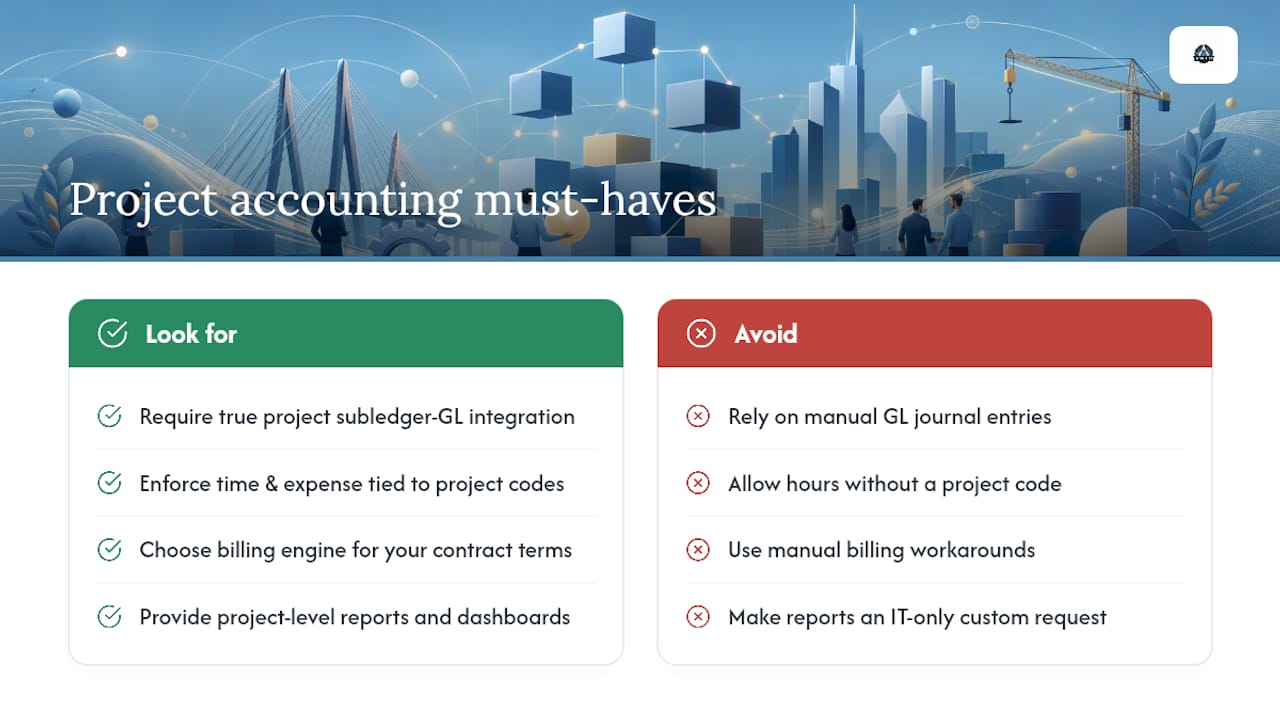
Software choice matters less than most vendors want you to believe. What matters is whether the system has four specific capabilities, regardless of brand.
Project subledger and GL integration. The system needs a true subledger that ties every project transaction back to your general ledger automatically, not through manual journal entries someone has to remember to make each month.
Time and expense capture tied to project codes. Look for approval workflows built into time entry, not bolted on afterward. If employees can submit hours without a project code attached, you will spend hours every month chasing down unassigned time.
A billing engine that handles your actual contract terms. Fixed fee, time and materials, milestone billing, percentage-of-completion, whatever mix your contracts use, the system should support it without manual workarounds. It should also handle WIP adjustments when billed amounts and recognized revenue diverge.
Reporting and dashboards built for project-level questions. Budget versus actual by project, resource utilization, and profitability by client or project type should be a few clicks away, not a custom report request to IT.
Systems like Microsoft's Business Central offer purpose-built reports such as Project Actual to Budget and Project WIP to G/L, which illustrate the kind of report names and figures a functional project accounting setup should produce regardless of which platform you use. Smaller businesses often start this same discipline inside QuickBooks using classes or project tags before ever needing a dedicated project accounting platform.
What Reports and KPIs Matter Most in Project Accounting?
A handful of reports do most of the heavy lifting, and you don't need dozens of dashboards to run a healthy project accounting practice.
- Budget versus actual, broken out by cost category, is the single most useful report for catching overruns early.
- Project profitability shows margin by project, letting you see which types of work are actually worth pursuing again.
- Project WIP to general ledger reconciles what's been earned but not yet billed, or billed but not yet earned, catching the gap before it becomes a cash flow surprise.
- Resource utilization tracks how much of a team's billable time actually lands on client work versus overhead tasks.
- Invoicing status flags projects where billing has fallen behind the work performed.
Tightening the billing cycle and improving invoice accuracy through pre-validated charge capture frees up cash that would otherwise sit trapped in unbilled work, sometimes for weeks longer than necessary. Watch for variance signals like a project sitting at 40% of budget spent but only 25% complete on schedule; that gap is an early warning, not a footnote. The corrective step is almost always the same: pause, rescope or rebudget, and communicate the change to the client before the gap widens further.
What Best Practices Prevent Project Accounting From Falling Apart?
Most project accounting failures trace back to a handful of setup mistakes made in the first week of a project, not to anything that happens later.
- Build the project code and WBS structure before work starts, not after the first invoice comes in. Retrofitting cost codes onto transactions that already happened is slow and error-prone.
- Decide your revenue recognition method and overhead allocation base before the kickoff meeting. Changing either mid-project distorts every comparison you try to make later.
- Make time and expense entry mandatory and tied to approvals. Late or missing time data is one of the most common reasons percentage-of-completion estimates end up wrong, since you can't calculate cost-to-cost accurately without complete cost data.
- Set a fixed monthly cadence for WIP reconciliation and rolling forecasts. Quarterly reconciliation catches problems too late to act on them.
Pro Tip: Run your first WIP reconciliation at the 25% completion mark of any new project, not at month end by calendar coincidence. Catching a coding error or missed invoice early in a project's life is far cheaper than untangling six months of miscoded transactions later.
Getting the cost-code structure and estimation right at the outset also prevents the scope creep and billing disputes that tend to surface only when a project is already halfway through and margin has already leaked away. Businesses working in procurement-heavy or tender-based industries can find additional grounding in procurement and tendering practices that shape how project costs get estimated before a contract is even signed.
How Amcfo Approaches Project Accounting Setup
Amcfo builds project accounting structures the way the checklist above describes, starting with the QuickBooks setup itself. That means mapping cost codes to a clean chart of accounts, tagging transactions correctly from day one, and building the WBS before the first invoice goes out rather than reconstructing it later.
From there, the work becomes a cadence: monthly WIP reconciliations, rolling forecasts updated as actuals come in, and dashboards that show budget versus actual by project without anyone needing to build a custom report. Clients typically see two concrete shifts once this is in place: they know which projects are actually profitable months sooner than before, and invoicing catches up to work performed instead of trailing behind it by weeks. The accounting and bookkeeping foundation supports this directly, and it pairs naturally with budgeting and forecasting guidance for businesses juggling multiple concurrent projects.
The Part of Project Accounting Most Guides Get Wrong
Most explanations of project accounting spend all their energy on methodology, cost-to-cost formulas, WBS diagrams, allocation bases, and almost none on the discipline required to keep the inputs clean. That's backward. The math behind percentage-of-completion is not hard. What's hard is getting every project manager and every subcontractor to code their time correctly, every week, without exception.
I'd argue the conventional advice oversells the software and undersells the habit. A business running project accounting on a spreadsheet with disciplined monthly WIP reviews will beat a business running expensive software with sloppy time entry, every time. If you're setting this up for the first time, prioritize the cost-code structure and the reconciliation cadence before you shop for tools. Get the habit right first. The system you eventually choose to support it matters far less than most vendors would have you believe.
— Angelica
Ready to Set Up Project Accounting the Right Way?
If you've read this far and recognized your own business in the budgeting gaps, delayed invoicing, or fuzzy profitability numbers described above, the fix isn't another spreadsheet template. It's a bookkeeping foundation built around project codes from the start. Amcfo sets up that structure directly inside QuickBooks, so you get project-level cost tracking without hiring an internal controller to manage it.

A typical engagement starts with accounting and bookkeeping setup or cleanup: mapping cost codes, tagging historical transactions, and building the WBS structure your projects actually need. From there, fractional CFO support layers in monthly WIP reconciliations, rolling forecasts, and dashboards that show which projects are protecting your margin and which ones are quietly eating it. If you're not sure which service fits your current setup, the accounting packages overview breaks down what's included at each tier. Book an initial conversation and bring your last three project invoices. That's usually enough for Amcfo to spot where the biggest visibility gap sits.
Sources
- Project accounting | Microsoft Dynamics 365
- Project Accounting Concepts and Business Calculations | NetSuite
- What Is Project Accounting? Principles, Methods & More | ProjectManager
- What Is Project Accounting? Get Started With This Guide | Deltek
This article is general information, not a substitute for advice from a qualified financial advisor. Consult a qualified financial professional about your own circumstances before acting on anything here.