

Most small businesses pay a $40 to $180 monthly base fee plus $4 to $12 per employee per month for outsourced payroll, with full-service plans and PEO bundles running higher. A quick rule of thumb: if your current in-house payroll time and software already cost more than $8 to $15 per employee per month, outsourcing likely saves money. A 5-person shop typically lands around $80 to $240 a month total; a 25-employee company often pays $250 to $700.
TL;DR:
- Smaller businesses typically pay between $40 and $180 monthly plus $4 to $12 per employee for payroll outsourcing, with larger companies facing higher costs based on complexity.
- The most common pricing models include base fee plus per-employee charges, per-run billing, and percentage-of-payroll fees, each affecting total costs differently based on payroll frequency and multi-state factors.
- The service tier chosen should reflect business size and complexity, with self-service suitable for under 10 employees and full-service or PEO options better for firms with more employees or multi-state operations.
- Hidden fees such as surcharges, year-end form charges, and off-cycle run costs can significantly increase the final bill, so detailed, itemized quotes are essential.
- For companies with fewer than 75 employees, outsourcing usually remains more cost-efficient than hiring an in-house payroll specialist once benefits, system costs, and risk are factored in.
Table of Contents
- How Payroll Outsourcing Cost Actually Gets Calculated
- Which Service Tier Fits Your Business (and What It Costs)
- What Actually Moves Your Quote Up or Down
- The Hidden Fees That Quietly Double Your Bill
- Outsourcing vs. Hiring In-House: Where the Break-Even Sits
- How to Pick a Payroll Vendor Without Overpaying
- Switching Providers Without Missing a Payday
- Why the Cheapest Quote Rarely Wins
- Get a Second Set of Eyes on Your Payroll Numbers
- Sources
- FAQ
How Payroll Outsourcing Cost Actually Gets Calculated
Every payroll quote you get boils down to one of three pricing structures, and knowing which one you're looking at changes how you compare vendors.
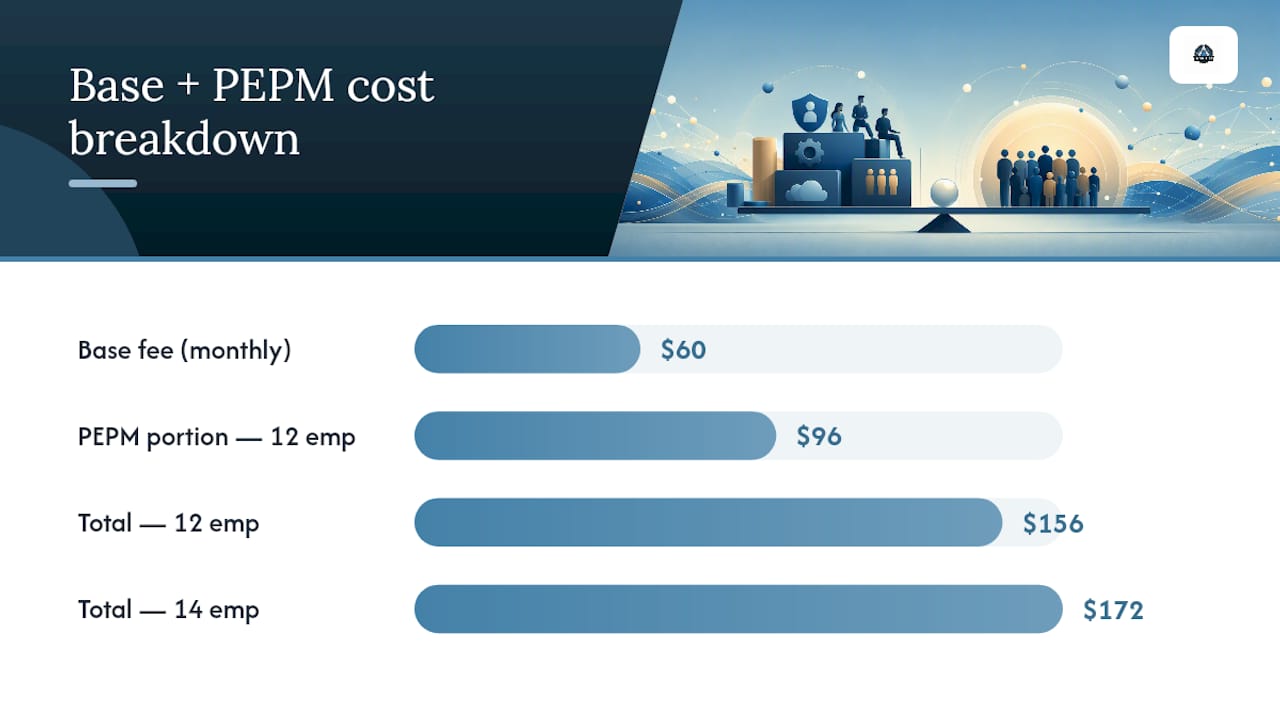
The most common model is base fee plus per-employee-per-month (PEPM). A provider charges a flat monthly platform fee, then tacks on a per-head charge. Say the base runs $60 and the PEPM sits at $8. For 12 employees, that's $60 plus (12 x $8), or $156 a month. Add two people next quarter and your bill rises to $172. This structure scales predictably, which makes budgeting straightforward for payroll service cost planning.
The second model is per-payroll-run pricing, where you're billed each time payroll processes rather than monthly. Typical per-run fees range $4 to $15 per employee per run, according to Sage's payroll cost breakdown. Here's where frequency matters enormously: a 15-person company on biweekly payroll runs 26 times a year, while the same company on weekly payroll runs 52 times. That difference alone can double your annual processing spend even though headcount never changed.
The third model, common with PEOs, charges a percentage of total payroll, usually between 2% and 12%, or a flat PEPM in the $79 to $210 range covering bundled HR and benefits administration, per the Hrcosts.
- Base + PEPM: predictable, scales with headcount, easiest to budget.
- Per-run: cheaper for infrequent payroll, expensive for weekly cycles.
- PEO percentage: higher sticker price, but bundles compliance and benefits work you'd otherwise pay for separately.
Which Service Tier Fits Your Business (and What It Costs)
Payroll outsourcing splits into three tiers, and the price gap between them reflects how much liability and labor the provider actually absorbs.
- Self-service software runs $4 to $12 PEPM with a low or nonexistent base fee. You still own tax filing accuracy and compliance decisions. This tier fits solo owners and micro businesses under 10 employees who want automation without paying for a human safety net.
- Full-service payroll typically costs $15 to $25 PEPM plus a mid-range base fee, often $50 to $150 a month. The provider files your federal and state payroll taxes and generally guarantees accuracy, which shifts real liability off your desk. This is the sweet spot for most businesses between 10 and 75 employees.
- PEO or co-employment runs $79 to $210 PEPM or 2% to 12% of gross payroll. Benefits administration, workers' comp, and HR compliance ride along with payroll processing, according to Hr. This suits companies that want to offer enterprise-grade benefits without building an HR department.
Headcount and complexity should drive the decision more than price alone. A 6-person consulting firm rarely needs PEO-level bundling. A 60-person company juggling multi-state hires and a benefits renewal every year usually saves more in avoided HR overhead than it spends on the higher PEPM.
What Actually Moves Your Quote Up or Down
Vendors don't price payroll off a single number. Several variables stack on top of the base rate, and understanding them helps you read a quote instead of just reacting to the bottom line.
- Headcount and growth trajectory. More employees means more PEPM charges, but rapid growth also triggers new state tax registrations if you're hiring across state lines.
- Payroll frequency. Weekly payroll can more than double per-employee processing cost compared to semi-monthly cycles when a provider bills per run, a pattern confirmed in Sage's pricing research.
- Multi-state complexity. Each new state often means a separate SUTA account and a filing surcharge, sometimes $10 to $25 per state per month.
- Employee mix. Contractors, tipped workers, union employees, and benefits-eligible staff each add reporting requirements that can raise the quote.
- Add-ons. Garnishment processing, off-cycle runs, and accounting or time-tracking integrations are frequently billed separately.
Pro Tip: Before requesting quotes, list every state you have employees in and flag anyone paid outside a standard W-2 salary structure. Vendors price around these details, and surfacing them upfront gets you a quote that won't change three weeks into onboarding.
The Hidden Fees That Quietly Double Your Bill
Headline PEPM rates rarely tell the whole story. ExpertMarket's research on payroll pricing found that multi-state surcharges, year-end form fees, and per-run charges routinely push total spend well past the advertised rate.
Here's how fast this adds up: a company on weekly payroll with a $6 per-run fee per employee and 20 employees pays $120 every single week just in run charges, or roughly $6,240 a year, on top of the base PEPM. Switch to biweekly and that number drops to about $3,120.
- Ask for W-2 and 1099 pricing in writing. Year-end forms often cost $5 to $10 per form and get billed separately from your monthly rate.
- Get per-state surcharges itemized. If you have employees in four states, ask what each one costs individually, not as a bundled estimate.
- Negotiate a cap on off-cycle run fees, or ask if bundled year-end processing is included in a higher tier.
- Watch for vague contract language like "additional fees may apply." That phrase alone is a signal to request a sample 12-month invoice based on your actual employee profile before signing anything.
Outsourcing vs. Hiring In-House: Where the Break-Even Sits
Comparing outsourcing to hiring a payroll specialist means looking past salary alone. A full-time payroll administrator typically costs $50,000 to $65,000 in salary, plus benefits (often another 20% to 30%), payroll software licensing, and the ongoing liability of in-house tax filing errors.
- Salary plus benefits for one payroll hire: roughly $60,000 to $85,000 annually.
- Add software, training, and continuing education for tax law changes.
- Add the cost of correcting filing errors, which falls entirely on you without a provider's compliance guarantee.
The break-even point for hiring in-house commonly sits above 75 to 100 employees. Below that threshold, outsourcing, even full-service, usually wins on total cost once you count benefits, systems, and compliance risk together. The math shifts earlier if you're running weekly payroll across multiple states, since that complexity adds cost to both options but hits an internal hire's bandwidth harder.
How to Pick a Payroll Vendor Without Overpaying
Choosing the right option comes down to matching service level to your actual complexity, then forcing vendors to answer specific questions before you sign anything.
Start with these selection criteria: Does the provider assume tax filing liability, or just process numbers? Does it integrate with your accounting software and time-tracking tools? What are the support channels, and is there a named account contact or a ticket queue? Does the vendor reference SOC or ISO security standards? What's the realistic implementation timeline?
Then send this exact list to every vendor you're evaluating:
- What's the monthly base fee, and what's included in it?
- What's the PEPM rate, and does it change by employee count tier?
- What are per-state surcharges, itemized by state?
- What do W-2 and 1099 forms cost at year-end?
- What's the off-cycle run fee, and is there a cap?
- What transition assistance is included, and is there a setup fee?
- Can you provide a sample contract and a sample 12-month invoice based on our headcount?
Forbes Advisor's research on vendor pricing recommends insisting on line-item answers for every one of these. A vendor that refuses to itemize is a red flag, and so is bundled pricing with no clear liability language for tax filing errors.
Pro Tip: Ask every vendor the identical seven questions in the identical order and put the answers side by side in a spreadsheet. Quotes that look similar on the surface often reveal a $50 to $100 monthly gap once hidden fees are lined up next to each other.
If you're under 10 employees with a simple single-state payroll, self-service software with a fractional bookkeeper reviewing filings is often enough. Between 10 and 75 employees, full-service is typically the minimum viable tier. Above that, or with heavy multi-state exposure, a PEO or a fractional CFO managing vendor oversight makes more sense.
Switching Providers Without Missing a Payday
Transitioning payroll vendors involves predictable one-time costs and a sequence that protects your compliance history.
- Budget for setup fees. Data cleanup, historical wage imports, and state re-registration can add $200 to $500 in one-time charges depending on complexity.
- Assign an owner for each migration step, typically HR or finance, so nothing falls through during handoff.
- Run two parallel test payrolls before fully switching, comparing gross-to-net calculations line by line against your old system.
- Confirm year-end continuity. If you switch mid-year, make sure the new provider can produce combined W-2s reflecting both providers' records.
- Retain at least three years of payroll records independently of either vendor's platform, since access to historical data can lapse after a provider relationship ends.
For a fuller walkthrough of sequencing and timeline ownership, see this step-by-step guide to switching payroll providers.
Why the Cheapest Quote Rarely Wins
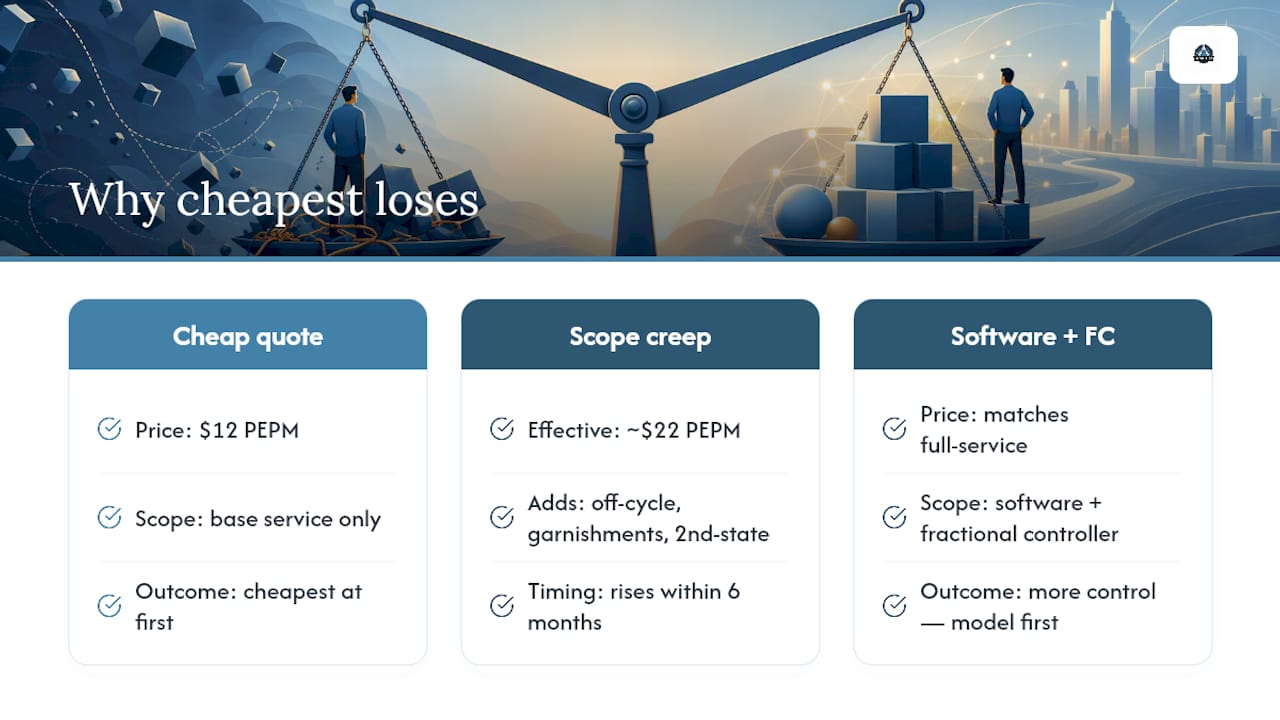
Most owners shopping for payroll outsourcing anchor on the PEPM number and stop there. That's the wrong lens. A fractional CFO looks at payroll outsourcing the same way we look at any recurring vendor contract: as a cash-flow line item that needs a break-even model, not just a monthly quote.
The mistake we see most often is scope creep. A business signs at $12 PEPM, then adds off-cycle runs, garnishment processing, and a second state registration within six months, and suddenly the effective rate is closer to $22 PEPM. The fix is simple: model your actual 12-month payroll behavior, including seasonal hires and bonus runs, before comparing quotes. Software paired with a fractional controller can also match full-service vendor costs while keeping more control in-house, a trade-off worth running the numbers on before assuming outsourcing is automatically cheaper.
— Angelica
Get a Second Set of Eyes on Your Payroll Numbers
Comparing vendor quotes is one thing. Knowing whether the winning number actually fits your cash-flow picture is another. A fractional CFO lens can help translate vendor proposals into real break-even math specific to your headcount, pay frequency, and growth plans, instead of leaving you to compare PEPM rates in a vacuum; see this Managed IT Services for Small Businesses: A Practical Guide for a relevant analogy on assessing outsourced vendor contracts and SLAs.

If you're juggling multi-state payroll, trying to compare three vendor quotes that all bundle fees differently, or simply want someone reviewing the contract before you sign, Amcfo's bookkeeping and accounting services fold payroll oversight into your ongoing financial picture. For businesses that need a broader view of how payroll costs affect forecasting and vendor negotiation, Amcfo's fractional CFO services provide that oversight without a full-time hire. Reach out to get your current payroll quote reviewed against your actual numbers before you commit to a provider.
Sources
- Hrcosts
- Hr
- Payroll Service Cost Guide – Forbes Advisor
- Average prices for outsourcing payroll | ExpertMarket
FAQ
How much should I charge for my payroll services?
If you're a bookkeeper or accountant offering payroll as an add-on, most independent providers price between $4 and $12 PEPM plus a $40 to $100 base fee, roughly matching software-tier market rates.
How much does it cost to outsource HR per employee?
Bundled HR and payroll through a PEO typically runs $79 to $210 per employee per month, or 2% to 12% of gross payroll, since HR functions like benefits administration ride along with processing.
How much do CPAs typically charge for payroll services?
CPA firms handling payroll alongside bookkeeping often charge in the full-service range of $15 to $25 PEPM plus a base fee, reflecting the added tax filing liability they assume.
How much do major payroll providers cost?
Large payroll platforms commonly start around $40 to $60 in base fees plus $4 to $22 per employee per month depending on the plan tier, with full-service and add-on features pushing costs toward the higher end of that range.
Is outsourcing payroll cheaper than hiring someone in-house?
For most businesses under 75 to 100 employees, outsourcing is typically cheaper than a full-time payroll hire once you count salary, benefits, software, and error risk together.