

The most common corporate tax planning mistakes are mixing personal and business finances, missing quarterly estimated payments, misclassifying workers, waiting until December to plan, and ignoring entity structure. Fix them in this order: open a dedicated business account today, reconcile your books through last month, confirm your next estimated payment date, pull your prior-year return, and schedule a call with a tax advisor or fractional CFO.
Start here this week:
- Separate personal and business accounts if you haven't already.
- Reconcile your books through the most recent month.
- Confirm your next estimated tax payment due date and calculate what you owe.
- Gather last year's return, your year-to-date P&L, and any 1099s or W-2s.
- Book a 30-minute call with a CPA or fractional CFO.
Mistakes with the biggest near-term cash or audit impact:
- Missing estimated payments (immediate penalty + interest)
- Worker misclassification (back taxes, penalties, and potential audit)
- No documentation for deductions (disallowance in examination)
- Unfiled state returns after crossing economic nexus thresholds
- Missing the retirement contribution window at year-end
Key Takeaways
Fixing the most common corporate tax planning mistakes requires clean books, quarterly action, and professional guidance before problems compound into penalties.
| Point | Details |
|---|---|
| Separate finances first | Open a dedicated business account and reconcile books before any tax strategy work. |
| Quarterly payments matter | Missing estimated payments triggers penalties even when you get a refund; use Form 1040-ES and the safe harbor rule. |
| IRS penalties are steep | The accuracy-related penalty is 20% of underpayments found in examination; transfer pricing failures can reach 40%. |
| Year-round planning wins | Last-minute planning closes the window on retirement contributions, depreciation elections, and income timing. |
| Amcfo provides the fix | Amcfo's bookkeeping cleanup, tax coordination, and fractional CFO services address the root causes of recurring tax errors. |
Table of Contents
- 1. Mixing personal and business finances
- 2. Missing or miscalculating quarterly estimated tax payments
- 3. Misclassifying employees as independent contractors
- 4. Waiting until tax season to plan
- 5. Choosing the wrong entity or never revisiting it
- 6. Overlooking retirement contributions and tax-deferred tools
- 7. Deducting expenses without documentation or strategy
- 8. Poor timing of income and expenses
- 9. Failing to plan for exit, sale, or succession
- 10. Ignoring tax credits, multi-state nexus, and transfer pricing
- What these mistakes actually cost you
- A year-round tax planning timeline that actually works
- When to bring in a tax professional or fractional CFO
- Why tax provision accuracy is a competitive advantage
- An editorial perspective on what actually goes wrong
- Amcfo helps you fix these problems before they compound
- Sources
1. Mixing personal and business finances
When personal and business transactions run through the same account, your books become a reconstruction project every tax season. Deductions get missed, personal expenses get claimed incorrectly, and any IRS examination becomes far more invasive than it needs to be.
Why it matters: Commingled finances are one of the top triggers flagged in IRS Audit Techniques Guides. They also erode the liability protection that an LLC or corporation is supposed to provide.
How to fix it: Open a dedicated business checking account and a business credit card. Run every business transaction through those accounts only. If you've been mixing funds, a bookkeeping cleanup is the first step before any tax strategy conversation.
Pro Tip: If your books are more than two months behind, fix that before worrying about advanced tax strategies. Accurate records are the foundation everything else rests on. See common small business accounting challenges for a practical starting point.
2. Missing or miscalculating quarterly estimated tax payments
The IRS expects most business owners and self-employed individuals to pay taxes as they earn income, not just at filing. Miss a payment or underpay, and you owe a penalty even if you get a refund at year-end.
Self-employment tax alone adds 15.3% to your total tax burden before federal income tax. Many owners calculate their estimated payments based on last year's income and forget that a strong quarter can push them into a higher bracket mid-year.
How to fix it: Use Form 1040-ES to calculate and submit quarterly payments. Review your revenue each quarter and adjust the next payment if income has shifted materially.
Pro Tip: The safe harbor rule lets you avoid underpayment penalties by paying at least 100% of last year's tax liability (110% if your prior-year AGI exceeded $150,000). That's your floor, not your target.
3. Misclassifying employees as independent contractors
Calling someone a contractor when the IRS would classify them as an employee is one of the most expensive mistakes a business can make. Back payroll taxes, interest, and penalties can reach years into the past, and the IRS uses a multi-factor behavioral and financial control test, not just your contract language.
Why it matters: Worker misclassification triggers payroll tax assessments, potential failure-to-deposit penalties, and sometimes state labor department investigations running concurrently. The exposure compounds fast.
How to fix it: Apply the IRS common-law test before classifying any worker. If you control how and when the work is done, they're likely an employee. When in doubt, file Form SS-8 for an IRS determination, or consult a business consulting professional before the relationship starts.
4. Waiting until tax season to plan
Year-end planning is better than no planning, but many of the best opportunities close before December 31. Equity compensation timing, retirement contributions, charitable giving strategies, and depreciation elections all require decisions made during the year, not after it ends.

Financial planners and CPAs consistently identify last-minute planning as the single most costly mistake business owners make. By the time you're sitting across from your accountant in January, the window for most moves has already closed.
How to fix it: Build a quarterly tax review into your calendar. Treat it like a board meeting: 30 minutes, current financials in hand, one agenda item being tax exposure for the next 90 days.
5. Choosing the wrong entity or never revisiting it
An LLC taxed as a sole proprietor made sense at $80,000 in revenue. At $400,000, the self-employment tax hit alone may justify an S-corp election. Entity structure is not a set-it-and-forget-it decision, and the wrong structure costs real money every year.
Why it matters: Entity choice affects self-employment tax, qualified business income (QBI) deductions, retirement plan options, and exit tax treatment. A business that has grown significantly since formation is almost certainly leaving money on the table.
How to fix it: Review your entity structure whenever revenue crosses a meaningful threshold, when you add partners or investors, or when you're planning a sale. A tax planning strategy review with a fractional CFO or CPA should include entity analysis as a standing agenda item.
6. Overlooking retirement contributions and tax-deferred tools
A SEP-IRA, Solo 401(k), or defined benefit plan can shelter a substantial portion of business income from current-year taxes. Many owners skip these vehicles entirely or contribute far below the limit.
For 2026, the IRS raised the 401(k) contribution limit to $24,500, and the IRA limit to $7,500. A Solo 401(k) can allow contributions up to $70,000 when employer and employee contributions are combined, depending on income. That's a significant deduction most small business owners never fully use.
How to fix it: Calculate your maximum allowable contribution in Q3 so you have time to fund it before year-end. If you don't have a plan set up, a Solo 401(k) or SEP-IRA can often be established and funded before the filing deadline.
7. Deducting expenses without documentation or strategy
The IRS doesn't disallow deductions because you didn't spend the money. It disallows them because you can't prove you did, or because the expense lacks a clear business purpose. Meals, travel, home office, and vehicle expenses are the most frequently challenged categories.
The IRS draws a clear line between a legitimate business and a hobby. If an activity doesn't show a profit motive, deductions can be denied entirely, and the burden of proof sits with you.
How to fix it: Keep receipts, log business purpose at the time of the expense, and use accounting software that attaches documentation to each transaction. A deduction you can't defend in an examination is a deduction you shouldn't claim.
8. Poor timing of income and expenses
Recognizing $200,000 in revenue in December when you could defer it to January can push you into a higher bracket unnecessarily. Conversely, accelerating deductible expenses into the current year reduces taxable income now. Bonus depreciation under current law lets businesses deduct a large percentage of qualifying asset costs in the year of purchase rather than depreciating them over years.
Why it matters: Income and expense timing is one of the highest-leverage, lowest-cost tax moves available. It requires no new spending, just coordination between your operations and your tax advisor.
How to fix it: Review your revenue pipeline and major planned purchases in October and November. Decide whether to accelerate or defer based on your projected bracket for the current and following year. Check the current bonus depreciation rules under H.R. 1, as rates and phase-outs have shifted in recent legislative cycles.
9. Failing to plan for exit, sale, or succession
Step-up in basis strategies, installment sales, qualified small business stock (QSBS) exclusions, and carryforward utilization all require planning that starts years, not months, before a transaction.
Why it matters: Carryforward losses that expire unused, basis that wasn't tracked, and entity structure that wasn't optimized for sale are permanent losses. You can't go back and fix them after the deal closes.
How to fix it: If a sale or transition is on a 3–5 year horizon, start the conversation now. A fractional CFO can map your current basis, identify carryforwards, and model the after-tax proceeds under different deal structures before you're in a negotiation.
10. Ignoring tax credits, multi-state nexus, and transfer pricing
The R&D tax credit, Work Opportunity Tax Credit (WOTC), and energy-related credits are routinely overlooked by small and mid-size businesses. Meanwhile, companies selling across state lines often trigger filing obligations they don't know about, and businesses with related-party transactions frequently lack the documentation to defend their pricing.
Post-Wayfair, economic nexus rules mean that crossing a state's sales threshold creates a filing obligation even if you don't have a physical office there. Unfiled state returns accrue interest from the original due date. Voluntary disclosure programs can limit lookback exposure, but only if you act before an examination begins.
For businesses with intercompany transactions, transfer pricing documentation must be contemporaneous and benchmarked to arm's-length standards.
How to fix it: Run a nexus review annually. Claim every credit your activity qualifies for. If you have related-party transactions, document them now.
What these mistakes actually cost you
The financial consequences of common tax planning mistakes aren't abstract. The IRS accuracy-related penalty under IRC §6662 is 20% of the underpayment discovered in an examination. For transfer pricing documentation failures, that rate can reach 40% for gross valuation misstatements. Add interest accruing from the original due date, and a fixable error becomes an expensive one fast.
Key penalty rates to know:
- 20% accuracy-related penalty on underpayments found in examination (IRC §6662)
- 40% gross valuation misstatement penalty for transfer pricing documentation failures
- 15.3% self-employment tax on net earnings, on top of income tax
- State penalties and interest accruing from original filing due dates on unfiled returns
One critical timing point: companies that identify errors and file amended returns before an IRS examination begins can often reduce or eliminate accuracy-related penalties. Self-correction has real value, but only before the IRS comes to you.
State exposure compounds the picture. Post-Wayfair economic nexus rules mean a company with no physical presence in a state can still owe years of back returns once a threshold is crossed. Voluntary disclosure programs exist specifically to limit that lookback, but they require proactive action.
Pro Tip: Run a quick internal triage: pull your last three years of returns and flag any year with a material change in revenue, new states where you sold, or intercompany transactions. Those are your highest-exposure areas. Quantify the potential penalty before deciding whether to self-correct.
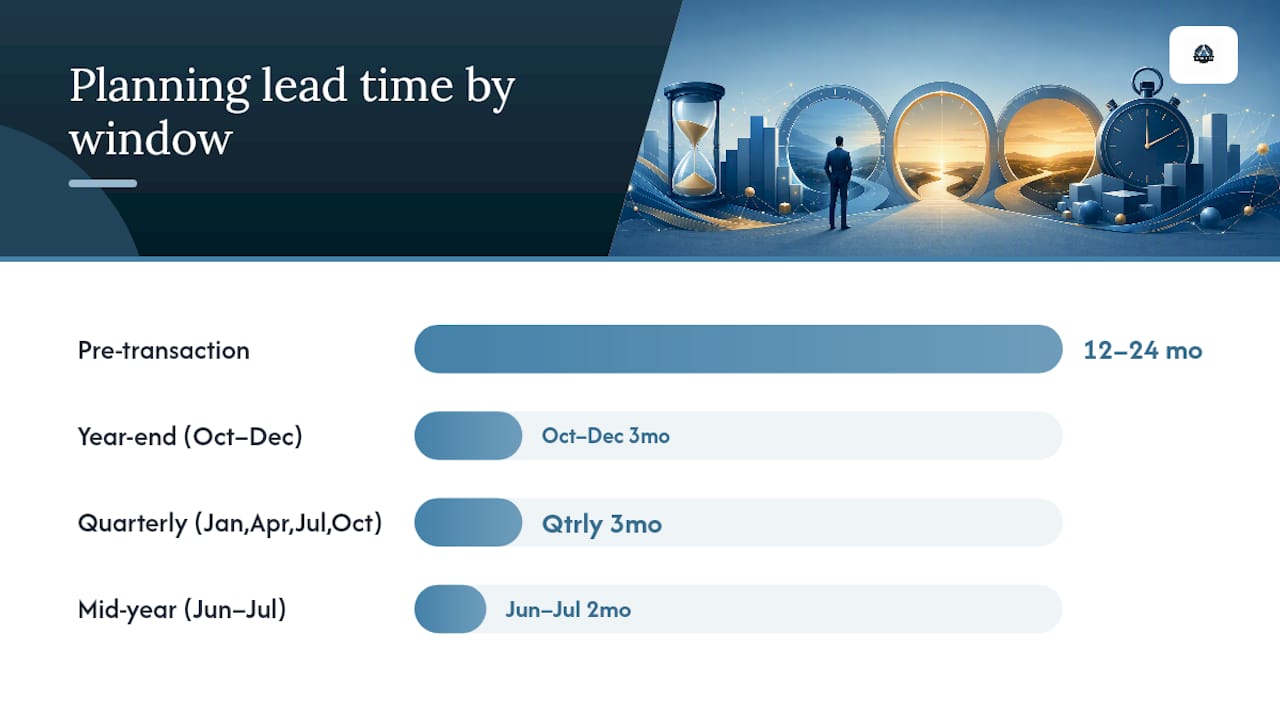
A year-round tax planning timeline that actually works
Tax planning done reactively costs more than tax planning done on a calendar. Here's how to structure it.
Quarterly (January, April, July, October):
- Calculate and submit estimated tax payments
- Close the prior quarter's books and reconcile accounts
- Review payroll classifications and any new contractor relationships
- Monitor retirement contribution pace against annual limits
Mid-year (June–July):
- Compare year-to-date revenue to prior-year projections
- Adjust withholding or estimated payments if income has shifted
- Review cost basis on any equity or asset positions
- Make early charitable giving decisions if applicable
Year-end (October–December):
- Finalize depreciation and bonus depreciation elections
- Fund retirement accounts before the contribution deadline
- Decide on income deferral or acceleration based on bracket projection
- Review inventory, bonus timing, and any planned asset purchases
Pre-transaction (12–24 months before a sale or M&A event):
- Document basis on all assets and equity positions
- Identify and schedule carryforward losses for use
- Conduct a multistate nexus and transfer pricing review
- Engage a fractional CFO or M&A tax advisor early
| Action | Urgency | Primary Impact |
|---|---|---|
| Separate accounts and reconcile books | Immediate | Compliance, audit defense |
| Confirm estimated payment schedule | Immediate | Cash flow, penalty avoidance |
| Worker classification review | Within 30 days | Payroll tax, penalty exposure |
| Entity structure analysis | Within 90 days | Self-employment tax, QBI |
| Retirement plan setup or funding | By year-end | Income reduction, deferred savings |
| Nexus and transfer pricing review | Within 90 days | State and federal audit risk |
When to bring in a tax professional or fractional CFO
DIY tax planning works until it doesn't. These are the situations where the cost of professional help is almost always less than the cost of getting it wrong.
Red flags that should trigger a professional call:
- You're selling in multiple states and haven't done a nexus review
- You have cross-border transactions or related-party pricing
- You've filed amended returns more than once in three years
- You hold significant equity compensation or concentrated positions
- You're within five years of a planned business sale or transition
- Your revenue has grown more than 30% year-over-year
Documents to bring to the first meeting:
- Year-to-date P&L and balance sheet
- Payroll register and all 1099s and W-2s issued
- Prior two years of tax returns
- Any transfer pricing or intercompany agreements
- Carryforward loss schedules
- A list of states where you have customers or employees
Questions worth asking your advisor:
- What's my current audit risk profile, and which line items are most exposed?
- Are my entity structure and payroll setup optimized for my current revenue level?
- What credits am I likely missing given my industry and activity?
- How should I time income and expenses for the rest of this year?
- What do I need to do now if I'm planning to sell in the next three to five years?
Use the financial records checklist to organize your documents before the meeting. A prepared client gets more out of every hour with their advisor.
Why tax provision accuracy is a competitive advantage
Under-resourced tax teams spend 54% of their time on reactive compliance work, according to the State of the Corporate Tax Department report. That leaves less than half their capacity for the strategic work that actually moves the business forward: M&A support, expansion modeling, forecasting, and proactive planning.
The compounding effect matters. Every error that requires rework delays financial close, slows forecasting, and pulls advisors away from higher-value work. An organization that fixes its data and controls doesn't just reduce penalties; it frees up capacity to support the decisions that drive growth.
The practical fix is simpler than most teams expect: centralize the data flow that feeds your provision calculations. When the source data is clean and consistent, errors surface before filing rather than during examination.
Pro Tip: If your books are being rebuilt at year-end rather than maintained throughout the year, you're not doing tax planning. You're doing tax archaeology. Fix the data environment first, then build strategy on top of it.
An editorial perspective on what actually goes wrong
The gap between what business owners think their tax exposure is and what it actually is tends to be widest in three areas: worker classification, state nexus, and retirement contributions. These aren't exotic planning failures. They're recurring, fixable problems that show up in businesses of every size.
The worker classification issue is particularly frustrating because it's often invisible until it isn't. A company that has been treating field workers as 1099 contractors for five years may have no idea it's sitting on a six-figure payroll tax liability until an audit or a disgruntled worker files a complaint. By then, the voluntary disclosure window has closed.
Retirement contributions are the opposite problem: the opportunity is right there, the IRS has raised the limits, and most owners still contribute far below the maximum because no one ran the numbers and made the ask. A Solo 401(k) funded to the limit can reduce taxable income by tens of thousands of dollars in a single year. That's not a planning trick. It's a basic use of the rules as written.
The deeper issue is that most small businesses treat tax planning as a once-a-year event rather than a year-round discipline. The businesses that consistently pay less in taxes aren't doing anything exotic. They're maintaining clean books, reviewing their position quarterly, and making decisions with their tax advisor before the window closes, not after.
Amcfo helps you fix these problems before they compound
Most of the mistakes in this article share a common root: financial data that isn't clean, organized, or reviewed often enough to catch problems in time. That's exactly what Amcfo addresses.

Amcfo provides bookkeeping, accounting, and fractional CFO services that directly address the mistakes covered here: bookkeeping cleanup for mixed finances and missing records, tax coordination to keep estimated payments on track, payroll review to catch misclassification before it becomes an audit, and ongoing fractional CFO support for entity structure, exit planning, and year-round tax strategy. For businesses with complex or historical errors, Amcfo's forensic accounting service can reconstruct records and quantify exposure before you engage with the IRS.
The next step is a scoped diagnostic call. Bring your last two years of returns, your current P&L, and a list of states where you have customers. Amcfo will identify your highest-exposure areas and recommend a prioritized fix sequence. Reach out at Amcfo to get started.
Sources
- The real cost of corporate income tax errors - and why accuracy wins (Thomson Reuters)
- IRC §6662 (Cornell Law School)
- 7 Common Tax Planning Mistakes To Fix Before 2026, According to a CFP (Nasdaq)
- Corporate Tax Compliance: Fix It Before the Penalty Doubles (Daeryun Law)
This article is general information, not a substitute for advice from a qualified financial advisor. Consult a qualified financial professional about your own circumstances before acting on anything here.