

Running a growing business without strong financial leadership is like flying without instruments. You might stay in the air for a while, but eventually the turbulence gets expensive. Most small to mid-sized business owners know they need strategic financial guidance, but a full-time CFO with a $250,000-plus salary is simply out of reach. This hire fractional CFO guide walks you through everything you need to know: when the timing is right, how to prepare, where to find great candidates, and how to measure whether the engagement is actually working.
Table of Contents
- Key takeaways
- When your business actually needs a fractional CFO
- Preparing your business before you hire
- How to find and hire the right fractional CFO
- Common pitfalls in the fractional CFO relationship
- Measuring the impact of your fractional CFO
- My honest take on hiring a fractional CFO
- Ready to work with a fractional CFO?
- FAQ
Key takeaways
| Point | Details |
|---|---|
| Know your timing | Revenue between $1M and $3M is typically when fractional CFO expertise starts paying off. |
| Understand the cost advantage | Fractional CFOs cost 60-80% less than full-time hires, with monthly retainers starting around $3,000. |
| Prepare your systems first | Clean books and basic compliance frameworks let a fractional CFO focus on strategy from day one. |
| Vet candidates thoroughly | Industry experience, interview questions, and trial periods separate great fits from costly mismatches. |
| Track real outcomes | Monitor cash flow, profitability, and fundraising results to verify your fractional CFO is delivering value. |
When your business actually needs a fractional CFO
Most business owners wait too long. They assume a fractional CFO is a luxury reserved for companies that have already figured everything out. In reality, the businesses that benefit most are the ones still in the thick of figuring it out.
Here are the clearest signals that you are ready:
- Revenue is climbing but profit feels invisible. You are generating $1M or more but cannot clearly explain where the money is going or why margins are shrinking.
- Cash flow surprises you regularly. Unexpected shortfalls, late payroll scares, or surprise tax bills are not bad luck. They are a systems problem.
- You are preparing to raise funding. Investors expect clean financial models, GAAP-compliant reporting, and a credible forecast. Most founders cannot build those alone.
- You are making major decisions without real data. Pricing changes, new hires, and expansion plans based on gut feel carry avoidable risk.
- Your accountant handles compliance but not strategy. Compliance and strategy are two different jobs. If no one is doing the strategy part, you have a gap.
For SaaS companies specifically, fractional CFO readiness tends to arrive around $1.5M to $3M in annual recurring revenue, when Series A preparation becomes urgent and investor scrutiny increases fast.
The timing advantage is real. Bringing in a fractional CFO before a crisis means they can build systems proactively rather than fix damage reactively. That shift alone saves money, time, and relationships.
Pro Tip: If you have recently lost a deal or a financing opportunity because your financials were not organized enough to present confidently, that is your clearest signal to act now.
Preparing your business before you hire
Hiring a fractional CFO before your internal systems are ready is like hiring a head chef before you have a kitchen. They will spend their limited hours on setup work that your team could have handled, and you will pay premium rates for basic tasks.
Before you start the search, make sure these foundations are in place:
For best results, businesses should have automated revenue recognition, consistent bookkeeping, and GAAP-compliant reporting operational before a fractional CFO engagement begins. If yours are not there yet, a bookkeeping and accounting cleanup is the right first step. Amcfo's accounting and bookkeeping services are specifically designed to get businesses to that baseline.
Once your systems are in order, define the scope of the role clearly. Fractional CFO work falls into three broad categories:
| Engagement type | Best for | Typical hours per month |
|---|---|---|
| Monthly retainer | Ongoing advisory and reporting | 10 to 30 hours |
| Hourly rate | Flexible, project-light support | As needed |
| Project-based | Fundraising prep, audits, or restructuring | Defined by deliverable |
Typical engagements run between 10 and 30 hours per month, scaling up during high-stakes periods like fundraising rounds or fiscal year-end. Knowing which model fits your budget and needs before you start interviewing saves significant back-and-forth.

Pro Tip: Write a one-page brief outlining your top three financial priorities for the next 12 months. Sharing it in every interview quickly filters out candidates whose experience does not match your actual problems.
How to find and hire the right fractional CFO
This is where most business owners either rush or freeze. They either hire the first person who sounds confident or delay for months waiting for a perfect referral. Neither works well. A structured process gets you to the right person faster.
Step 1: Source candidates from the right places. Start with your network: your attorney, CPA, or banker likely knows experienced financial executives who consult part-time. Platforms that specialize in senior financial talent also list vetted fractional CFO candidates. Professional associations and LinkedIn are useful for finding industry-specific experience. If you want to understand what a fractional CFO does before you start interviewing, that context helps you ask better questions.
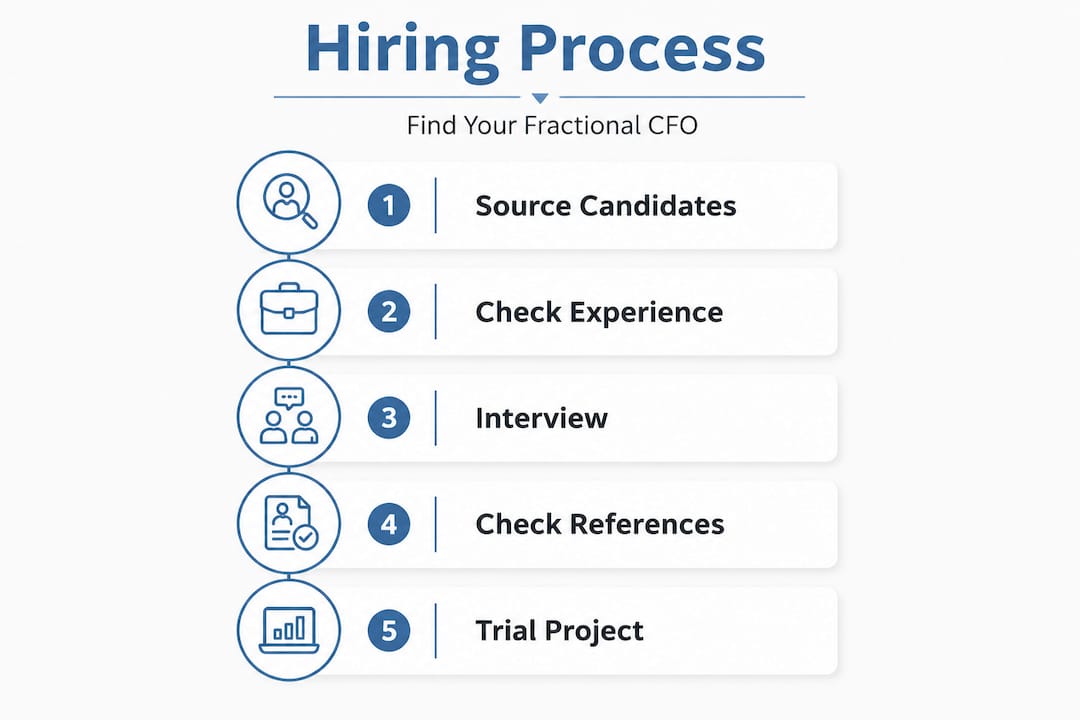
Step 2: Evaluate experience and industry fit. Generic financial expertise is less valuable than experience with your type of business. A fractional CFO who has guided five e-commerce companies through scaling will add more immediate value to your Shopify brand than someone whose background is in healthcare compliance. A structured hiring process that prioritizes financial leadership experience, industry alignment, and cultural fit dramatically improves the odds of a successful engagement.
Step 3: Use targeted interview questions. Ask candidates to walk you through a specific situation where they improved cash flow or prepared a company for a financing event. Vague answers about "strategic oversight" without concrete examples are a warning sign. Strong candidates give you numbers, timelines, and outcomes.
Step 4: Check references with intention. Ask the reference not just whether they would rehire the person, but how the fractional CFO handled a situation where they disagreed with leadership. The answer tells you a great deal about their communication style and willingness to speak up.
Step 5: Run a paid discovery engagement. Before committing to a retainer, offer a 30-day paid engagement to solve a defined problem. It gives you both a low-pressure way to assess fit without a long-term commitment on day one.
Common pitfalls in the fractional CFO relationship
Even great hires fail when the working relationship is poorly structured. Here is what goes wrong most often and how to prevent it:
- No defined scope. When a fractional CFO is hired with a vague mandate to "help with finances," they often default to whatever is most visible, which may not be your biggest need. Define deliverables before signing anything.
- Too many bosses. A fractional CFO reporting to five people will receive five conflicting sets of priorities. Assign one internal point of contact for the relationship.
- Treating them like a vendor instead of a partner. Fractional CFOs who are excluded from strategic discussions often produce technically accurate but contextually irrelevant work. Include them in decisions early, not just for after-the-fact reporting.
- No performance rhythm. Without regular check-ins tied to defined metrics, it is easy to feel like you are paying for something but not sure what you are getting. Set monthly review meetings with an agenda tied to your priorities.
- Scaling engagement incorrectly. Many business owners lock into a fixed hours commitment that does not flex. During fundraising or rapid growth, you may need 30 hours a month. During quieter periods, 10 is plenty. Structure your agreement to allow that flexibility.
The benefits of hiring a fractional CFO compound over time, but only when the relationship is treated as a true partnership rather than an outsourced task.
Measuring the impact of your fractional CFO
You should know within 90 days whether the engagement is working. Here is what to track:
| Metric | What to look for | How to measure |
|---|---|---|
| Cash flow stability | Fewer surprises, stronger runway | Monthly cash flow statement |
| Gross and net margin | Improving or at least explained | P&L review against prior periods |
| Fundraising speed | Faster investor responses, cleaner diligence | Time from first meeting to term sheet |
| Financial reporting quality | Reports delivered on time and used by leadership | Timeliness and decision-making data |
Businesses that use fractional CFO services effectively see a 3 to 5 times return on their investment in the $1M to $3M revenue range. Companies preparing for funding rounds specifically report 30 to 40 percent faster financing outcomes when their fractional CFO builds investor-ready reporting and financial models.
Adjust your engagement terms based on what the data shows. If your cash flow has stabilized and reporting is running smoothly, you may need fewer advisory hours and more execution support. If a growth initiative is creating new complexity, expand the scope before it becomes a problem.
My honest take on hiring a fractional CFO
I have seen dozens of business owners go through this process, and the pattern is consistent. The ones who wait until there is a financial emergency get the least value from a fractional CFO. They are paying someone to put out a fire that good planning would have prevented entirely.
The businesses that get 5x ROI from fractional CFO services treat the engagement as a forward-looking investment, not a reactive fix. They bring the CFO into strategic conversations early, give them real data to work with, and hold them accountable to outcomes rather than just deliverables.
The other thing I hear often is that business owners expect a fractional CFO to also handle day-to-day accounting. That is not what they do best. Their value is in interpreting the numbers and turning them into decisions, not producing the numbers themselves. If your bookkeeping is a mess, fix that first. Then bring in the CFO-level thinking.
Treating your fractional CFO like a true financial partner, rather than a consultant you check in with quarterly, is what separates the businesses that transform their financial outcomes from the ones that feel like nothing really changed.
— Angelica
Ready to work with a fractional CFO?
If this guide has clarified your next step, Amcfo can help you move from reading to results.

Amcfo's fractional CFO services are built specifically for growing businesses that need strategic financial leadership without the cost of a full-time executive. Whether you need help preparing for a funding round, building financial models, cleaning up your books, or creating the reporting systems that give you real clarity, Amcfo brings the experience and flexibility to match your business stage. You can start with a focused engagement and scale from there. Explore how Amcfo supports businesses like yours at amcfo.com.
FAQ
What does a fractional CFO actually do?
A fractional CFO provides strategic financial leadership on a part-time or project basis, covering areas like cash flow management, financial modeling, fundraising preparation, and board-level reporting. They interpret your financial data and translate it into decisions that move the business forward.
How much does a fractional CFO cost?
Fractional CFOs typically charge monthly retainers of $3,000 to $15,000 or hourly rates between $175 and $450, making them 60 to 80 percent less expensive than a full-time CFO hire.
When should I hire a fractional CFO?
The strongest signal is when your revenue is growing but your financial clarity is not. For most businesses, this happens in the $1M to $3M revenue range, especially when fundraising, scaling operations, or managing tightening margins.
How do I find a qualified fractional CFO?
Start with referrals from your CPA, attorney, or banker, then use platforms that specialize in senior financial talent. Prioritize candidates with direct experience in your industry and always run a paid trial engagement before committing to a retainer.
How long does a typical fractional CFO engagement last?
Most engagements run month-to-month on a retainer or scale with business need, ranging from 10 to 30 hours per month. Early-stage work focuses on system setup and compliance; later work shifts to strategic planning and investor-facing reporting.