

To evaluate software for financial teams, match the platform to your FP&A maturity, prove it on your actual general ledger during a short proof-of-concept period, then score finalists with a weighted rubric tied to time-to-value and total cost of ownership. That sequence beats demo-driven buying every time.

Start here: Extract two closed months of GL data, pick three pre-agreed test scenarios (board package rebuild, budget-vs-actual drill-down, rolling reforecast), and run every shortlisted vendor through the same tests before any purchase decision.
Solution categories to consider:
- Spreadsheet-native layer (e.g., tools built on Excel): fastest adoption, lowest admin overhead, best for Excel-first teams
- Modern web FP&A platforms: structured collaboration, multi-entity support, mid-market sweet spot
- Enterprise CPM platforms: unified consolidation engines, extensible dimensionality, built for complex multi-entity organizations
- ERP planning modules: tightly integrated with source-system data, best when the ERP is already the system of record
Three non-vendor anchors worth naming up front: Amcfo for advisory and POC facilitation support; SOC 2 as the baseline security certification to require from every vendor; and GAAP / ASC 606 as the reporting standards your chosen platform must support without workarounds.
Table of Contents
- What should you define before you talk to any vendor?
- What core capabilities should you score every vendor on?
- How do common vendors map to use cases and team types?
- How do you run a rigorous evaluation from RFP to decision?
- How do you build a realistic total cost of ownership?
- What integration and data governance work should you do before vendor conversations?
- What should you expect from implementation timelines and adoption?
- Which platform fits your team size and FP&A maturity?
- When does fractional CFO support beat buying software?
- What should you do this week to start the evaluation?
- How does financial software evaluation connect to business strategy?
- How should you reassess financial software after go-live?
- How do you evaluate vendor support and ongoing service quality?
- What mistakes do finance teams make most often during software evaluation?
- Key Takeaways
- The human factor most evaluation guides ignore
- Amcfo can accelerate your evaluation and POC
- Useful sources and further reading
What should you define before you talk to any vendor?
Scope creep and vendor-selection bias both start the same way: a team walks into demos without a written problem statement. Fix that first.
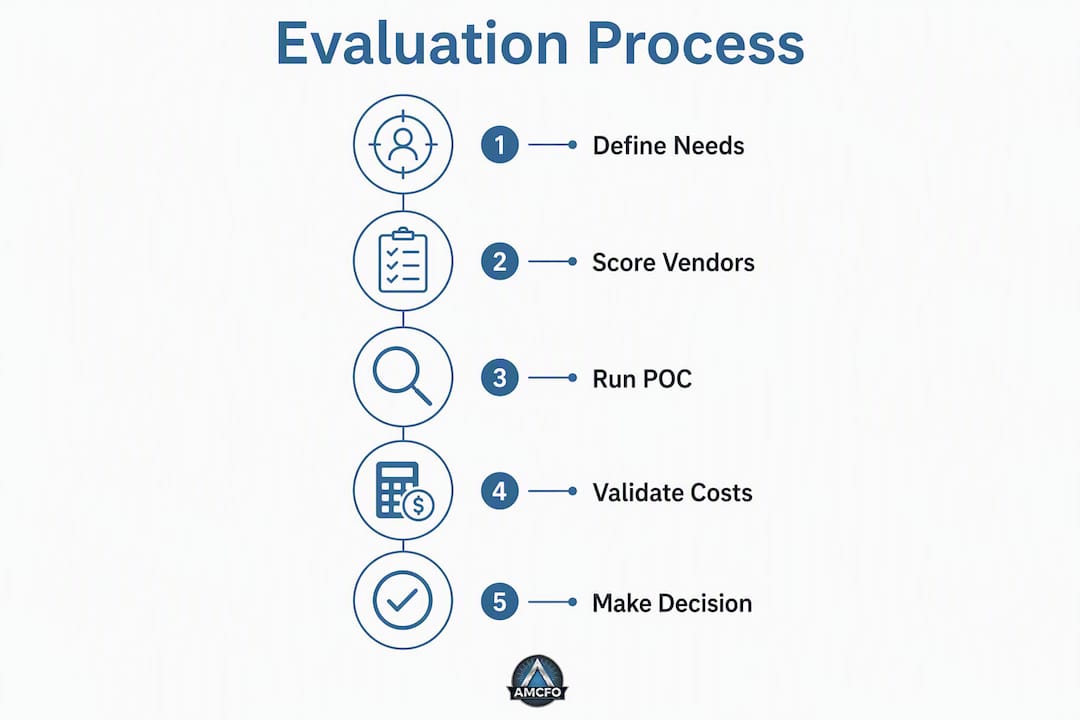
Write a one-page problem statement that ties directly to business outcomes. Not "we need better reporting" but "our monthly close takes 11 days and board packages require 40 analyst-hours to rebuild from scratch." Specific numbers make the POC pass/fail criteria obvious later.
Map requirements by use case, not by feature checklist:
- Board package rebuild: how many entities, what currency translations, what approval workflow?
- Variance analysis: drill-down to transaction level or cost-center summary?
- Rolling forecast: driver-based or line-item? How many scenarios simultaneously?
- Consolidation: intercompany eliminations, minority interest, statutory vs. management reporting?
Identify every stakeholder and data owner before the first vendor call. Finance owns the requirements; IT owns the integration architecture; the CFO or controller owns the success metrics. Agree on those metrics in writing: hours saved per close cycle, days cut from the reforecast cycle, error rate reduction, and target payback period.
Governance items to lock in before any demo:
- GL mapping and chart-of-accounts structure
- Data latency tolerance (real-time vs. nightly batch is a material architectural difference)
- Integration dependencies: ERP, HRIS, CRM, billing system
- User roles and permission model
- Audit trail and data retention requirements under your compliance obligations
What core capabilities should you score every vendor on?
The goal is a weighted scorecard, not a feature checklist. These are the axes that materially affect selection and TCO.
FP&A functional capabilities:
- Driver-based forecasting and scenario modeling (how many concurrent scenarios? how easy to update drivers?)
- Budgeting workflow and departmental collaboration (guided input, approval routing, version control)
- Financial consolidation (intercompany eliminations, currency translation, minority interest)
- Variance analysis with drill-down to source transactions
- Ad-hoc reporting and self-service dashboards for non-finance viewers
Technical and operational axes:
- Integration depth: native ERP/GL connectors vs. API vs. CSV import; who owns the mapping and maintenance?
- Data model: OLAP cube, relational, or spreadsheet-native — each has different flexibility and performance trade-offs at scale
- Auditability: can you trace every number back to its source transaction?
- Performance: how does the platform behave with three years of daily actuals loaded?
Usability and adoption:
- Excel friendliness: native Excel interface, add-in, or web-only? Spreadsheet-native tools consistently show faster adoption and lower first-year admin costs for Excel-first teams
- Analyst productivity: how long does it take a new analyst to build a model from scratch?
- Viewer self-service: can a department head pull their own variance report without analyst help?
Security and controls:
- SOC 2 Type II certification (require the report, not just the badge)
- ISO 27001 certification for enterprise buyers
- Role-based permissions, row-level security, and audit logs
- Data retention and backup policies
Automation and AI:
In 2026, expect signal detection, anomaly flagging on actuals vs. forecast, and assisted reconciliation from most mid-market and enterprise platforms. Planful's Predict engine, for example, flags unusual variances and identifies off-trend forecasts. Weight AI capabilities modestly unless your team has the process maturity to act on the signals — a tool that surfaces anomalies your team ignores adds no value.
How do common vendors map to use cases and team types?
The market breaks into four categories. Every named platform fits one of them.
Spreadsheet-native layer:
- Vena Solutions: built on Excel; your team works in familiar spreadsheet interfaces with Vena providing the data model and version control underneath. Lowest adoption barrier for Excel-centric finance teams. Consolidation and scenario modeling are less sophisticated than dedicated web platforms.
- Datarails: Excel-native FP&A layer that consolidates data from multiple sources while preserving the spreadsheet workflow analysts already know.
Mid-market web FP&A:
- Planful: strong consolidation engine, collaborative budgeting workflow, and the Predict AI signal-detection layer. Best for mid-market companies with multi-entity consolidation needs.
- Workday Adaptive Planning (Adaptive): intuitive interface, strong integration with Workday HCM, solid mid-market FP&A. Natural fit if your organization already runs Workday.
- Prophix: mid-market CPM with budgeting, forecasting, and consolidation. Often cited for ease of implementation relative to enterprise platforms.
- Cube: spreadsheet-connected FP&A that sits between native Excel tools and full web platforms; good for teams that want structure without abandoning their Excel models entirely.
- Sage Intacct: cloud accounting and financial management with planning capabilities; strong fit for professional services and nonprofits already on the Intacct GL.
- QuickBooks: entry-level accounting and basic reporting; appropriate for small teams where the primary need is GL accuracy and cash flow visibility, not FP&A depth.
- Zoho Analytics: BI and analytics layer with financial reporting capabilities; suits teams that need dashboards and data visualization more than planning workflow.
- ThoughtSpot: AI-powered analytics with natural-language querying; best as a reporting and analytics layer on top of an existing data warehouse, not a standalone FP&A platform.
Enterprise CPM:
- Anaplan: HyperBlock modeling engine handles virtually any planning scenario at scale. Implementation timelines run several months and costs can be substantial. Overkill for most mid-market buyers.
- OneStream: unified consolidation engine with extensible dimensionality; chosen by enterprise teams that need a single platform for statutory close, management reporting, and planning.
- Oracle Hyperion / Essbase: legacy enterprise CPM with deep OLAP modeling; still running in many large organizations, but new implementations are rare given Oracle's push toward cloud EPM.
ERP planning modules:
- NetSuite (Oracle NetSuite Planning & Budgeting): tightly integrated with the NetSuite ERP; best when NetSuite is already the GL and the team wants planning without a separate data integration layer.
A word on scale mismatches: deploying an enterprise CPM for a five-person finance team is a governance and adoption risk, not a sign of ambition. Equally, a spreadsheet-native tool will hit its ceiling when you add a fourth entity or need statutory consolidation. Match the platform to where your team is today, not where you hope to be in five years. And never let demo polish drive the decision. Vendor demos are theater; the POC on your real data is the only honest test.
How do you run a rigorous evaluation from RFP to decision?
A six-step evaluation framework produces better outcomes than demo-driven buying. Here is how to run it.
The six steps:
- Define the problem and success metrics — write the one-page problem statement with quantified outcomes (close days, analyst hours, error rate).
- Map requirements by use case — board package, variance analysis, rolling forecast, consolidation. Each use case gets its own pass/fail criteria.
- Shortlist 2–4 vendors by architecture fit — eliminate any vendor whose data model conflicts with your ecosystem before scheduling demos. Limiting finalists to three improves decision quality and prevents analysis paralysis.
- Model 3-year TCO — platform fee, implementation, connectors, and ongoing admin time. See the pricing section below.
- Run a time-boxed POC on real data — two closed months of actuals, three pre-agreed test scenarios, pass/fail criteria defined before the POC starts.
- Score finalists with a weighted rubric and reference checks — call two references at your company size and ask specifically about implementation timeline accuracy and post-go-live support.
Weighted scorecard dimensions:
| Dimension | Weight (Excel-first team) | Weight (Mid-market FP&A) | Weight (Enterprise CPM) |
|---|---|---|---|
| Integration depth | High | High | High |
| Time-to-value / adoption | Very High | High | Medium |
| Excel friendliness | Very High | Medium | Low |
| Consolidation capability | Low | High | Very High |
| Scenario modeling depth | Medium | High | Very High |
| Security (SOC 2, ISO) | Medium | High | Very High |
| TCO (3-year) | High | High | High |
| Vendor support & partner ecosystem | Medium | High | Very High |
Demo script and POC test scenarios:
Your demo script should require vendors to walk through your actual use cases, not their standard pitch deck. Three POC scenarios that surface real friction:
- Scenario 1 — Board package rebuild: load two closed months of actuals, produce a P&L and balance sheet in your standard format, with drill-down to cost center. Pass: completed in under two hours by one analyst. Fail: requires vendor professional services to configure.
- Scenario 2 — Budget-vs-actual variance analysis: run a full BvA with drill-down to transaction level for one entity. Pass: analyst can navigate without vendor assistance. Fail: requires custom report build.
- Scenario 3 — Rolling reforecast: update three driver assumptions and regenerate a 12-month forecast. Pass: under 30 minutes. Fail: requires IT involvement.
Trust validation steps per buyer guide frameworks: request SOC 2 Type II reports, ask for the implementation partner list and check partner references independently, and confirm the vendor's documented implementation timeline against references at your company size.
How do you build a realistic total cost of ownership?
Most vendors do not publish transparent pricing. Decomposing quotes into four components is the only way to compare fairly.
The four TCO components:
- Platform fee: annual subscription, seat-based or module-based. Get the all-in number including any data-volume or entity-count tiers.
- Implementation and onboarding: vendor professional services or third-party implementation partner. Mid-market ERP projects commonly run $450,000 or more and frequently exceed initial budget without tight scoping.
- Third-party connectors and custom integration: native connectors are often free; custom API work or middleware adds cost.
- Ongoing admin and support: who maintains the data model, user permissions, and connector mappings after go-live?
Line items teams routinely miss:
- Internal FTE time during implementation (typically 0.25–0.5 FTE for mid-market web platforms in the first year)
- Change management: training, documentation, and the productivity dip during cutover
- Rework when the POC surfaces data quality issues that require GL cleanup before go-live
- Consultant fees if the internal team lacks the bandwidth to own the implementation
Sample TCO structure for comparing finalists:
| Cost component | Vendor A | Vendor B | Vendor C |
|---|---|---|---|
| Year 1 platform fee | [from quote] | [from quote] | [from quote] |
| Implementation / onboarding | [from quote] | [from quote] | [from quote] |
| Integration / connectors | [estimate] | [estimate] | [estimate] |
| Internal FTE time (Year 1) | [0.25–0.5 FTE] | [0.25–0.5 FTE] | [0.25–0.5 FTE] |
| Change management | [estimate] | [estimate] | [estimate] |
| Year 2–3 platform fee | [from quote] | [from quote] | [from quote] |
| 3-year total | [sum] | [sum] | [sum] |
Fill this table with real numbers from vendor quotes and internal estimates before any scoring session. A platform with a lower subscription fee but a heavier implementation burden often costs more over three years than the premium option with a faster go-live.
What integration and data governance work should you do before vendor conversations?
Architecture mismatches discovered during a POC are expensive. Pre-eliminate vendors whose data model conflicts with your ecosystem before you schedule a single demo.
Integration checklist:
- Native ERP/GL connectors: does the vendor support your specific ERP version, or does it require a middleware layer?
- API maturity: REST API with documented endpoints, or a proprietary connector that only the vendor's PS team can configure?
- Sync frequency: scheduled nightly batch, near-real-time, or manual CSV upload? Your data latency tolerance drives this.
- CSV backstop: if the API fails, can analysts load data manually without breaking the model?
- Mapping ownership: who maintains the field-level mapping between your GL and the platform's data model after go-live?
Data model trade-offs:
OLAP cube architectures (common in Hyperion/Essbase and some enterprise CPM platforms) deliver fast query performance on pre-aggregated dimensions but require careful dimension design upfront and can be rigid when the business adds new reporting hierarchies. Relational models offer more flexibility but can slow down at scale without proper indexing. Spreadsheet-native architectures preserve analyst familiarity but may struggle with large data volumes or complex consolidation logic.
Master data hygiene before the POC:
Clean your chart of accounts before you load data into any vendor's sandbox. Duplicate accounts, inconsistent cost-center codes, and unmapped intercompany transactions will surface as POC failures that look like vendor problems but are actually data problems. Fix them first and the POC runs faster and produces cleaner results.
Pro Tip: Pre-eliminate any vendor whose architecture is fundamentally inconsistent with your data ecosystem before scheduling demos. A vendor running a pure OLAP cube on a team whose GL produces flat relational exports will require significant transformation work that rarely shows up in the demo.
What should you expect from implementation timelines and adoption?
Set expectations before you sign. Timeline bands vary significantly by platform category.
Typical go-live timelines:
- Spreadsheet-native tools (Vena, Datarails, Cube): days to weeks for initial setup; first board package often within 30 days
- Mid-market web FP&A (Planful, Adaptive, Prophix): 6–16 weeks depending on integration complexity and consolidation scope
- Enterprise CPM (Anaplan, OneStream): 12–24 weeks minimum; complex multi-entity deployments run longer
- ERP planning modules (NetSuite Planning & Budgeting): 8–16 weeks if the ERP data is clean; longer if GL cleanup is required first
Key adoption checkpoints to track:
- Data sync validated: actuals match the GL to the penny
- Board package rebuilt in the new platform: finance team can produce it without vendor assistance
- First reforecast completed: analysts update drivers and regenerate the forecast independently
- Department manager self-service: at least one non-finance user pulls their own variance report
Common pitfalls that delay go-live:
- Under-budgeted admin time: the platform needs someone to own it post-go-live, and that person is usually already fully allocated
- Missing data owners: no one accountable for GL mapping maintenance means the connector breaks and no one fixes it quickly
- Skipping the POC: teams that buy on demo alone discover integration friction after the contract is signed
- Scope expansion mid-implementation: adding a new entity or reporting requirement after kickoff typically adds weeks and cost
First 90–180 day success checklist:
- Weekly data sync accuracy check (actuals vs. GL)
- Monthly close completed fully in the new platform by day 60
- At least 80% of planned users actively logging in by day 90
- First post-go-live reforecast completed without vendor PS involvement
- Admin FTE burden tracked and compared to the TCO model assumption
Which platform fits your team size and FP&A maturity?
Three buyer profiles cover most situations. Match yourself to one before shortlisting vendors.

Profile 1: Excel-native small team (1–3 finance staff, single entity)
Signals: all planning lives in Excel, no dedicated FP&A platform, close takes more than five days, board packages are manually assembled. The right move is usually a spreadsheet-native layer (Vena, Datarails, Cube) or a lightweight mid-market platform. Weight adoption and time-to-value above everything else in the scorecard. Spreadsheet-native tools deliver faster adoption and lower admin overhead because analysts work in interfaces they already know. Delay buying if your chart of accounts is a mess or your GL has more than six months of unreconciled items. Fix the data first.
Profile 2: Mid-market FP&A team scaling planning (3–10 finance staff, 2–10 entities)
Signals: Excel is breaking under multi-entity consolidation, reforecast cycles take more than two weeks, board packages require multiple analysts. Planful, Adaptive, Prophix, or Sage Intacct (if already on Intacct) are the natural shortlist. Weight consolidation capability, integration depth, and 3-year TCO. Accelerate the purchase decision when you face audit pressure, investor reporting requirements, or a new entity acquisition that makes manual consolidation untenable.
Profile 3: Enterprise consolidation buyer (10+ finance staff, 10+ entities, statutory reporting)
Signals: multi-currency statutory consolidation, complex intercompany eliminations, regulatory reporting across jurisdictions. Enterprise CPM platforms (OneStream, Anaplan) or Oracle's cloud EPM suite are the right category. Enterprise platforms prioritize unified consolidation engines and extensible dimensionality for exactly this use case. Weight security certifications, implementation partner ecosystem, and vendor financial stability heavily. Budget 12–24 weeks for go-live and plan for a dedicated platform admin role.
The clearest signal to delay any purchase: manual workarounds and reconciliation errors do not yet cost more than the software and its implementation. If the current process is painful but functional, fix the process first and buy the platform when the math clearly favors it.
When does fractional CFO support beat buying software?
Software solves a process problem only when the process is defined. When it is not, the platform becomes an expensive way to automate confusion.
The pattern that shows up repeatedly in fractional CFO engagements: a mid-market team buys a capable FP&A platform, spends 14 weeks on implementation, and then discovers that the underlying planning process was never documented well enough to configure the tool correctly. The platform goes live, adoption stalls at 40%, and the team reverts to Excel within six months. The subscription runs for two more years.
The counter-pattern: a small team with a messy GL and no formal budgeting process brings in fractional CFO support for 60 days. The engagement produces a clean chart of accounts, a documented close process, and a one-page requirements brief. They then run a two-week POC with a spreadsheet-native tool and go live in three weeks. Payback inside four months.
Premature migration to a dedicated platform before the process is ready causes governance failures and low adoption. The software is not the problem; the sequence is.
When fractional CFO support is the faster path:
- The team cannot articulate what the software needs to produce (no defined outputs, no success metrics)
- The GL has not been reconciled in more than 90 days
- There is no internal owner for the implementation
- The finance team is fewer than two people and the primary need is accurate reporting, not planning sophistication
When software is the right investment:
- Manual consolidation across three or more entities consumes more than 40 analyst-hours per close
- Investor or board reporting requires scenario modeling the team cannot produce in Excel within a reasonable timeframe
- Audit findings or compliance requirements demand an auditable, traceable planning system
Pro Tip: Pair a short fractional-CFO engagement (4–8 weeks) with the POC. The fractional CFO maps requirements, cleans the GL sample data, and facilitates the POC test scenarios. This cuts the typical POC timeline in half and dramatically improves adoption readiness because the team owns the requirements before the vendor conversation starts.
What should you do this week to start the evaluation?
The verdict is short: run a time-boxed POC on your real GL data, score finalists with a weighted rubric, and target payback inside 12–18 months. Everything else in this guide supports those three steps.
Immediate action items:
- Assemble the evaluation team: CFO or controller, one senior FP&A analyst, IT or data owner, and one department-head stakeholder
- Extract two closed months of GL data: actuals from a recent period that includes a close cycle, exported in whatever format your ERP produces
- Write the one-page problem statement: quantified outcomes only — close days, analyst hours, error rate, reforecast cycle time
- Shortlist 2–4 vendors by architecture fit: eliminate any vendor whose data model conflicts with your GL structure before scheduling demos
- Define three POC test scenarios with pass/fail criteria: board package rebuild, BvA drill-down, rolling reforecast — criteria agreed before the POC starts
- Schedule POC kickoffs within 30 days: a POC that does not start within 30 days of shortlisting rarely happens
Build a simple decision memo after the POC that records each vendor's scorecard results, the 3-year TCO comparison, and the expected 12–18 month payback metric. That memo is what you present to the CFO or board for sign-off, and it is what protects the team if the decision is questioned later.
How does financial software evaluation connect to business strategy?
A software decision that is not anchored to a business goal is a technology project, not a finance investment. The distinction matters because technology projects get cut when budgets tighten; finance investments tied to measurable outcomes do not.
Before finalizing any vendor shortlist, map each evaluation criterion back to a strategic priority. If the company's primary goal is geographic expansion, multi-currency consolidation and statutory reporting capability should sit at the top of the scorecard. If the priority is investor readiness, scenario modeling depth and audit-trail quality matter more than Excel friendliness. If the goal is operational efficiency, time-to-close and analyst productivity metrics drive the weighting.
The integrated financial planning discipline makes this connection explicit: the planning platform should produce the outputs that feed strategic decisions, not just automate the outputs that finance already produces. That means the evaluation team needs at least one conversation with the CEO or COO about what financial information they actually use to make decisions, and whether the current process delivers it.
One practical test: ask every vendor to show you how their platform produces the three reports your CFO uses most often. If the vendor cannot demonstrate those specific outputs in the POC, the platform does not fit your strategic reporting needs regardless of its feature count.
How should you reassess financial software after go-live?
Buying the platform is not the end of the evaluation. The first 12–18 months post-go-live are when the real cost and value picture becomes clear, and most teams do not have a formal process for capturing it.
Set a 90-day review checkpoint with the same success metrics you defined before the POC. Measure actual close days against the baseline, actual analyst hours per board package, and actual adoption rate (active users divided by licensed users). If any metric is moving in the wrong direction at 90 days, the cause is almost always one of three things: data sync issues, insufficient training, or a configuration that does not match the actual workflow.
At 12 months, run a formal TCO reconciliation. Compare actual platform fees, actual implementation costs, actual internal FTE time, and actual consultant spend against the TCO model you built during evaluation. The gap between modeled and actual TCO is the most useful input for the next evaluation cycle and for negotiating renewal terms.
At 18–24 months, reassess fit. Has the business added entities, changed its reporting structure, or moved to a new ERP? Any of those changes can invalidate the original architecture choice. A platform that was right at implementation may need to be replaced or supplemented as the business scales. Treat the reassessment as a mini-evaluation: same problem statement format, same scorecard, updated TCO model.
How do you evaluate vendor support and ongoing service quality?
The support model is often the last thing evaluated and the first thing that matters after go-live.
Ask every vendor three specific questions during the sales process: What is the average response time for a P1 (system-down) issue? Who is the named support contact after the implementation team rolls off? What does the implementation partner ecosystem look like, and can you speak to two partners who have implemented for a company at your size?
Check third-party reviews on G2 and Capterra specifically for post-go-live support quality, not overall rating. A platform with a 4.5-star overall rating but consistent complaints about support responsiveness after the first year is a different risk profile than one with a 4.2-star rating and strong support reviews. Gartner Peer Insights reviews for the financial planning software category are particularly useful for enterprise buyers because reviewers are verified and the review structure captures implementation experience separately from product satisfaction.
Ask for a sample SLA document before signing. Vendors who hesitate to provide one are telling you something about how they handle support commitments. And confirm whether the implementation partner carries their own support obligations or whether all post-go-live issues route back to the vendor.
What mistakes do finance teams make most often during software evaluation?
The most expensive mistake is buying the best demo. Vendors optimize their demos for polish, not for your workflow. The board package that looks effortless in a vendor demo often requires three hours of configuration work to produce on your actual GL structure. The POC exists to surface exactly that gap.
Over-indexing on feature lists is the second most common error. True cost of ownership includes ongoing admin time and change management, which typically exceeds the subscription cost in the first 18 months for mid-market web platforms. A platform with 40 features your team will never use is not a better platform; it is a more expensive one.
Three other patterns worth naming:
- Skipping reference checks: calling two customers at your company size takes two hours and surfaces implementation timeline accuracy, support quality, and adoption reality that no demo or G2 review will tell you
- Letting IT drive the architecture decision: IT should validate integration feasibility, not rank vendors. The finance team's workflow requirements and adoption likelihood should drive the final score
- Signing before the POC: a vendor who resists a time-boxed POC on your real data is signaling that their platform performs better on curated demo data than on production GL exports. That is a disqualifying signal
The teams that make the best software decisions treat the evaluation as a finance project, not a procurement project. They define success metrics before the first vendor call, they run a scripted POC, and they score finalists on weighted criteria tied to business outcomes. The teams that make the worst decisions let the most enthusiastic internal champion and the most polished demo drive the choice.
Key Takeaways
The single most reliable way to evaluate software for financial teams is to run a time-boxed POC on your real GL data, score finalists on a weighted rubric, and target payback inside 12–18 months.
| Point | Details |
|---|---|
| POC on real GL data | Run every finalist through three pre-agreed test scenarios using two closed months of actuals before signing. |
| Match platform to maturity | Spreadsheet-native tools win on adoption for Excel-first teams; enterprise CPM is for complex multi-entity consolidation buyers. |
| Model 3-year TCO | Include platform fee, implementation, connectors, and 0.25–0.5 FTE internal admin time; subscription cost alone understates true spend. |
| Limit finalists to 2–4 vendors | Constraining the shortlist improves decision quality and prevents analysis paralysis during scoring. |
| Amcfo fractional CFO support | Amcfo can map requirements, clean GL sample data, and facilitate the POC to cut evaluation time and improve adoption readiness. |
The human factor most evaluation guides ignore
Most software evaluation guides treat the decision as a rational optimization problem: score the features, model the TCO, pick the winner. That framework is correct and necessary. It is also incomplete, because the decision gets made by people inside an organization with politics, competing priorities, and a CFO who may have already decided which vendor they prefer before the evaluation starts.
The POC requirement is not just a technical safeguard. It is a political one. When the evaluation team runs a scripted POC on real data with pre-agreed pass/fail criteria, the decision becomes defensible to every stakeholder, including the ones who did not get their preferred vendor. The scorecard is the record. Without it, the decision defaults to whoever argued most persuasively in the last meeting.
Securing an executive sponsor before the evaluation starts is the single most underrated success factor. Not a champion who likes the idea of new software, but a sponsor who has committed to clearing calendar time for the POC kickoff, attending the finalist scorecard review, and signing the decision memo. Evaluations without that sponsor tend to stall between the demo stage and the POC because no one has the authority to move the team past competing priorities.
One pattern that comes up in practice: a finance team runs a thorough evaluation, picks the right platform on the scorecard, and then loses momentum during implementation because the executive sponsor moved on to a different initiative. The implementation drags, the internal champion burns out, and the platform goes live six months late with half the planned configuration. The software was not the problem. The organizational scaffolding around it was.
The teams that get the most from their FP&A platforms are the ones that treated the evaluation as the beginning of an organizational change project, not the end of a procurement process.
Amcfo can accelerate your evaluation and POC
Running a rigorous FP&A software evaluation while managing a full close cycle is genuinely difficult. The requirements mapping, GL cleanup, POC facilitation, and TCO modeling all take time that most finance teams do not have in reserve.
Amcfo's fractional CFO services are built for exactly this situation. A short engagement (typically 4–8 weeks) covers requirements mapping tied to your actual business outcomes, GL data preparation for the POC, facilitation of the three test scenarios across your shortlisted vendors, and a 3-year TCO model you can present to the CFO or board. The result is a faster POC, a cleaner scorecard, and a finance team that owns the requirements before any vendor conversation starts.
Amcfo also provides accounting and bookkeeping support to handle GL cleanup and reporting continuity during the evaluation period, so the close cycle does not slip while the team is focused on vendor selection. If the POC surfaces data integrity issues that need remediation before go-live, that work is already in scope.
To start, book a scoping call at amcfo.com and describe your current planning process, your entity count, and your target go-live window. Amcfo will scope the engagement and outline the POC facilitation approach within one week.
Useful sources and further reading
The sources below are the most useful vendor-agnostic references for finance teams running a formal software evaluation.
- Aleph FP&A software evaluation guide: the most detailed publicly available framework for the six-step evaluation process, POC design, and TCO modeling. Referenced throughout this article.
- James Analytics FP&A tool selection framework: practical guidance on shortlisting, the three-vendor rule, and trust validation steps including reference checks and security certifications.
- DualEntry ERP selection framework: covers ERP selection with specific attention to implementation cost expectations and the risk of premature migration.
- FinanceCopilot OneStream review: detailed analysis of enterprise CPM capabilities for consolidation-driven buyers.
- Gartner Peer Insights — Financial Planning Software: verified enterprise buyer reviews with implementation experience ratings; useful for shortlist validation.
- G2 and Capterra: filter reviews by company size and look specifically at post-go-live support ratings, not overall scores.
- CFO Shortlist EPM Buyer's Guide: architecture-level analysis of OLAP vs. relational vs. spreadsheet-native platforms; useful for pre-eliminating vendors before demos.