

For most U.S. businesses, the critical 2026 federal deadlines include shifted dates for partnerships and S corporations, standard April 15 for C corporations and sole proprietors, and estimated payments spaced throughout the year into early 2027. If you can't file on time, submit Form 7004 or Form 4868 to extend your filing deadline, but pay your best estimate of what you owe anyway. Extensions buy you time to file, never time to pay.
TL;DR:
- Business owners managing partnerships or S corps must file Form 1065 or 1120-S by March 16, 2026, with an extension to September 15, but late K-1s can cause owners to miss personal filing deadlines.
- C corporations have a standard due date of April 15, 2026, with an extension to October 15, yet unpaid taxes from April 15 start accruing interest and penalties regardless of extension status.
- Sole proprietors and single-member LLCs must file Schedule C with Form 1040 by April 15, 2026, and can extend to October 15, but late K-1s from pass-through entities can leave insufficient time for tax reconciliation.
- Estimated taxes for 2026 are due quarterly on April 15, June 15, September 15, and January 15, with partial extension options if the full year's tax is paid by February 1, 2027.
- Filing deadlines can shift if they fall on weekends or holidays, requiring businesses to verify dates through IRS calendars and confirm state-specific extension and payment rules separately.
Table of Contents
- Business Tax Deadlines 2026: The Full Calendar at a Glance
- Entity-Specific Deadlines: What Partnerships, C Corps, and Sole Proprietors Owe
- When Are the 2026 Estimated Tax Payment Deadlines?
- Payroll and Information Return Deadlines: W-2, 1099-NEC, and Deposits
- What Happens If You Miss a Deadline?
- Fiscal-Year Filers: Translating Calendar Deadlines to Your Tax Year
- How to Use IRS Tax Calendars and Tools Without Missing Anything
- State and Local Business Tax Deadlines for 2026
- Key IRS Forms by Business Entity Type for 2026
- An Advisor's Take: Prioritizing Your Pre-Deadline Checklist
- Get Ahead of 2026 Deadlines Before They Get Ahead of You
- Sources
- FAQ
Business Tax Deadlines 2026: The Full Calendar at a Glance
Every filing date below assumes a calendar-year business. If your fiscal year doesn't end December 31, skip ahead to the fiscal-year section, because your due dates shift accordingly.
The table below covers the returns that trip up the most business owners: the ones where the original due date and the extended due date live months apart, and where missing the first one triggers penalties that a simple extension filing would have avoided.
Notice the March 16 date instead of the traditional March 15. That's not a typo. March 15, 2026, lands on a Sunday, and under IRC 7503, any deadline falling on a weekend or legal holiday automatically shifts to the next business day. The same rule can move any date on this table if it happens to fall on a Saturday, Sunday, or federal holiday in a given year, so always double check against the current IRS Tax Calendar rather than assuming last year's dates repeat exactly.
A few quick actions worth locking in now, before any deadline gets close:
- File Form 7004 electronically by the original due date if you need more time on a business return.
- Pay your estimated tax liability by the original due date even if you're extending the paperwork.
- Confirm your state's extension rules separately. Federal relief doesn't automatically cover state filings.
- Set calendar reminders two weeks ahead of each date, not on the date itself, to leave room for last-minute document gathering.
Entity-Specific Deadlines: What Partnerships, C Corps, and Sole Proprietors Owe
Your entity type determines both your form and your risk profile if you're late. Here's how the three most common structures break down for 2026.
Partnerships and S corporations
Calendar-year partnerships file Form 1065, and S corporations file Form 1120-S, both due March 16, 2026. Miss that date without an extension, and the penalty structure gets ugly fast: the IRS charges a per-partner or per-shareholder penalty, currently accruing monthly, for each owner on the return. A five-partner firm that files three months late isn't looking at one penalty. It's looking at that penalty multiplied by five owners for each month it's late.
Filing Form 7004 pushes your deadline to September 15, 2026. That's an automatic extension once the form is accepted electronically, no explanation required. But the extension only buys time to file the informational return. Since partnerships and S corps are pass-through entities, the tax liability flows to the owners' personal returns, so the real financial pressure sits on when K-1s arrive. Late-filed 1065s or 1120-Ss mean late K-1s, which means owners scrambling to finish their own Form 1040 by April 15 without complete information.
C corporations
C corps file Form 1120, due April 15, 2026 for calendar-year filers. Form 7004 extends the filing deadline to October 15, 2026. Unlike pass-through entities, the corporation itself owes the tax, so there's no owner-level K-1 timing issue to manage. But the payment obligation is unforgiving: interest and the failure-to-pay penalty start accruing on April 15 regardless of when the actual return gets filed, if any balance remains unpaid.
Sole proprietors and single-member LLCs
If you run an unincorporated business or a single-member LLC that hasn't elected corporate treatment, your business income reports on Schedule C attached to your personal Form 1040, due April 15, 2026. Form 4868 extends that to October 15, 2026. If you also hold an interest in a partnership or S corp, watch for K-1 timing. A K-1 that arrives in late September, right before your extended personal deadline, leaves almost no room for error in reconciling your own return.
Pro Tip: A federal extension covers federal forms only. Many states require a separate extension request or automatically decouple from the federal timeline, and states with franchise taxes or elective pass-through entity taxes often set their own payment dates that have nothing to do with April 15 or March 16. Check every state where your business has a filing obligation, not just your home state.
When Are the 2026 Estimated Tax Payment Deadlines?
Calendar-year businesses and pass-through owners pay estimated tax on four dates in the 2026 cycle:
- April 15, 2026 — first-quarter payment
- June 15, 2026 — second-quarter payment
- September 15, 2026 — third-quarter payment
- January 15, 2027 — fourth-quarter payment
These dates come directly from the 2026 Form 1040-ES instructions, and they apply to sole proprietors, partners, and S corp shareholders who receive pass-through income without withholding. One quirk worth knowing: if you file your full 2026 return and pay any remaining balance by February 1, 2027, you can skip the January 15 payment entirely.
Income that swings sharply during the year, seasonal revenue, a big contract that closes in Q3, doesn't fit neatly into four equal payments. That's where the annualized income installment method comes in. It lets you calculate each quarter's payment based on income actually earned in that period rather than a flat quarter of your annual estimate, but using it requires filing Form 2210 with your return, as detailed in Publication 505.
Farmers and fishermen get a different exception entirely: they can skip quarterly payments altogether and either pay their full estimated tax by January 15, 2027, or file their complete return and pay in full by March 1, 2027.
Whatever method you use, EFTPS payments must be scheduled at least one calendar day before the due date, so don't wait until 11 p.m. on the deadline to log in and submit.
Payroll and Information Return Deadlines: W-2, 1099-NEC, and Deposits
Employers juggle two separate timelines: when documents go out to workers and contractors, and when they get filed with the government. These dates don't always match, and confusing them is one of the most common ways small businesses trigger unnecessary penalties.
W-2s go to employees and get filed with the Social Security Administration by January 31, 2026, both on the same date. Form 1099-NEC follows the identical January 31 deadline for both the recipient copy and IRS filing, unlike some other 1099 variants that allow a later IRS filing date if you're filing on paper versus electronically.
Payroll tax deposits run on a separate clock entirely, governed by the semiweekly or monthly deposit schedule assigned to your business based on prior lookback-period liability. A few specifics that catch owners off guard:
- The $100,000 next-business-day rule applies if your accumulated payroll tax liability hits that threshold on any day during a deposit period. You must deposit by the next business day, no exceptions.
- Semiweekly depositors generally have until the following Wednesday or Friday to deposit taxes withheld, depending on which days of the week wages were paid.
- Timely deposits throughout the quarter can extend your Form 941 filing deadline to the 10th day of the second month after the quarter ends, instead of the standard end-of-month-following-quarter date.
- Form 940 (FUTA) is due January 31, 2026, for the prior year, with a February 10 extension available if all FUTA tax was deposited on time.
Full deposit tables and schedule rules live in Publication 15 and Pub. 509. If you're managing payroll in-house without a dedicated system tracking your lookback period, a payroll compliance checklist is worth running through before Q1 closes.
What Happens If You Miss a Deadline?
An extension changes your filing date. It does nothing to your payment date, and that distinction costs business owners real money every year.
- File Form 7004 or Form 4868 electronically by the original due date. Once accepted, the extension is automatic. Save the electronic acceptance confirmation as proof; don't rely on memory or a sent-mail folder.
- Pay a reasonable estimate of what you owe on the original due date, even while filing an extension. The IRS doesn't require a perfect number, just a good-faith effort based on available information.
- Understand the two separate penalties. Failure-to-file typically runs steeper than failure-to-pay, so filing the extension itself, even with an imperfect payment, protects you from the harsher penalty.
- Know that interest accrues regardless. Even with a timely extension and a good-faith payment, any shortfall between your estimate and your actual liability accrues interest until paid, as Taxstra's extension guidance lays out.
- Remember per-owner penalties for pass-throughs. A late partnership or S corp return without an extension multiplies the penalty across every partner or shareholder, not just once for the entity.
Pro Tip: Filing Form 7004 electronically and paying a conservative estimate alongside it is usually cheaper than gambling on exact numbers later. If your K-1 timing is uncertain, a rough overpayment now beats a penalty notice in eight months.
Fiscal-Year Filers: Translating Calendar Deadlines to Your Tax Year
If your business doesn't run on a calendar year, none of the dates above apply directly to you, but the underlying formula does.
C corporations owe Form 1120 by the 15th day of the fourth month after their fiscal year ends. Partnerships and S corporations owe their returns by the 15th day of the third month after year-end. A business with a June 30 fiscal year-end, for example, would owe its partnership or S corp return by September 15, and a C corp return by October 15, using that same formula rather than the calendar-year dates in the tables above.
One exception worth flagging: C corporations with a June 30 fiscal year-end have historically been subject to different transition rules than other fiscal-year corporations, a leftover from earlier law changes, so confirm your specific due date against current Pub. 509 guidance rather than assuming the standard formula applies without exception.
The weekend and holiday shift rule under IRC 7503 applies to fiscal-year filers exactly as it does to calendar-year ones. If your computed due date lands on a Saturday, Sunday, or federal holiday, it automatically rolls to the next business day, the same mechanism that pushed the 2026 pass-through deadline from March 15 to March 16.
How to Use IRS Tax Calendars and Tools Without Missing Anything
Pull the right calendar first. Publication 509 actually contains three separate calendars: the General Tax Calendar, the Employer's Tax Calendar, and the Excise Tax Calendar. Most businesses need at least two of the three, since payroll obligations and income tax obligations run on different tracks.
- Download Pub. 509 and mark every original due date relevant to your entity type and payroll status.
- File extensions (Form 7004 or Form 4868) electronically through your tax software or preparer, and save the acceptance confirmation immediately.
- Schedule EFTPS or IRS Direct Pay transactions at least one business day ahead of any due date; EFTPS in particular requires lead time and won't process same-day requests reliably.
- If mailing anything, remember the postmark date generally counts as the filing date, but USPS processing delays mean a mailbox drop on the deadline itself carries real risk.
Pro Tip: Keep a dedicated folder, digital or physical, with every extension confirmation and payment receipt for the year. If the IRS questions timing later, having the acceptance timestamp on hand settles the dispute in minutes instead of weeks.
State and Local Business Tax Deadlines for 2026
Federal deadlines get most of the attention, but state obligations often move independently, and assuming your state mirrors the IRS calendar is a common, costly mistake.
Franchise taxes, annual report fees, and state income tax filings frequently carry their own due dates that don't align with March 16 or April 15. Some states require estimated payments on a different quarterly schedule than the federal system. Others impose elective pass-through entity taxes, a workaround some states created for the federal SALT deduction cap, with their own separate payment and election deadlines that partnerships and S corps must track alongside their federal Form 1065 or 1120-S filings.
California is a useful illustration of how granular this gets: corporations there face a distinct set of state filing deadlines that run parallel to, but separate from, the federal calendar, including its own extension mechanics.
If your business operates in multiple states, treat each state's revenue department website as a required stop, not an afterthought. A federal extension via Form 7004 or Form 4868 does not automatically extend any state filing or payment obligation. Some states grant automatic extensions that piggyback on the federal one; others require a separate state-specific form entirely. Building a state-by-state deadline list alongside your federal calendar, before the year starts getting busy, is the only reliable way to avoid a surprise state penalty notice arriving months after you thought everything was handled.
Key IRS Forms by Business Entity Type for 2026
Matching the right form to your entity structure sounds basic until you're staring at a stack of paperwork in March wondering which one actually applies to you.
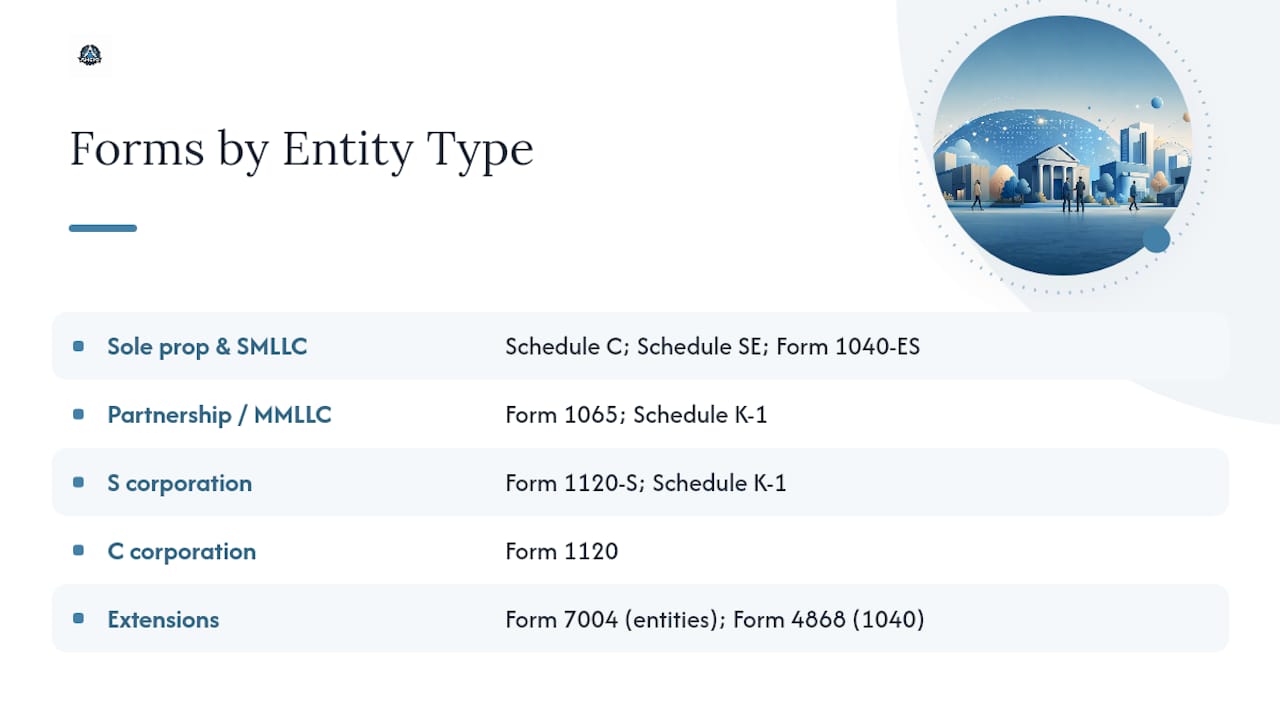
Sole proprietors and single-member LLCs report business activity on Schedule C, attached to Form 1040. If self-employment tax applies, Schedule SE comes along with it. Quarterly estimates run through Form 1040-ES.
Partnerships and multi-member LLCs file Form 1065, an informational return, with each partner receiving a Schedule K-1 reporting their share of income, deductions, and credits to carry onto their personal return.
S corporations file Form 1120-S, also informational, with Schedule K-1 issued to each shareholder for the same purpose.
C corporations file Form 1120, the return that actually calculates and reports the corporation's own tax liability, since C corps pay tax at the entity level rather than passing it through to owners.
Every entity type extending its deadline uses Form 7004, except individuals extending Form 1040, who use Form 4868 instead. Payroll-related entities also need Form 941 (quarterly) or Form 944 (annual, for smaller employers) and Form 940 for federal unemployment tax. Keeping a one-page reference of which forms apply to your specific structure, reviewed each January before deadline season ramps up, saves the scramble of figuring it out form-by-form under time pressure.
An Advisor's Take: Prioritizing Your Pre-Deadline Checklist
Most businesses don't miss deadlines because they don't know the dates. They miss them because nobody owns the checklist, and by the time someone notices a gap, the original due date has already passed.
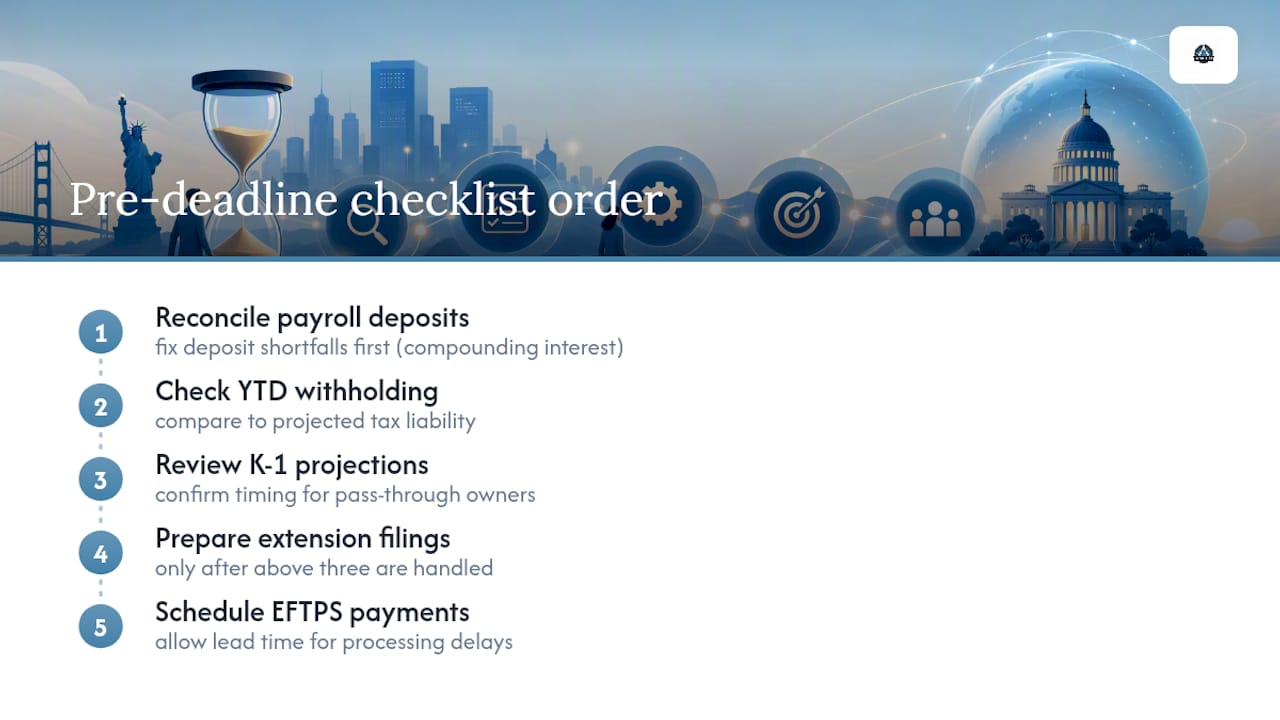
Here's the order that actually matters, based on what tends to break first: reconcile payroll deposits before anything else, because deposit shortfalls compound with interest faster than almost any other liability on this list. Next, check year-to-date withholding against projected tax liability, since surprises here drive the estimated payment miscalculations that trigger underpayment penalties. Then review K-1 projections for any pass-through interests, because owners waiting on K-1s to finish their own returns need realistic timing expectations, not optimistic guesses. Only after those three are handled does it make sense to prepare extension filings, and finally, schedule EFTPS payments with enough lead time to avoid processing delays.
A few situations reliably signal it's time to bring in outside help rather than manage this internally: filing across multiple states, complex K-1 distributions with uncertain timing, real exposure to per-owner partnership penalties, repeated payroll deposit shortfalls, or simply not having the internal bandwidth to run this checklist properly every quarter. Bookkeeping cleanup, QuickBooks support, payroll support, and tax coordination services exist specifically for businesses where the calendar is clear but the execution keeps slipping. Reviewing your tax planning strategy before Q1 closes tends to catch problems while there's still time to fix them cheaply.
— Angelica
Get Ahead of 2026 Deadlines Before They Get Ahead of You
This service offers an alternative to scrambling through tax season alone. Instead of piecing together deadlines from IRS PDFs and hoping your bookkeeping is clean enough to support an accurate estimate, you get fractional CFO oversight built into the engagement from day one, plus bookkeeping, payroll, and tax coordination handled by people who track these dates for a living.

If your payroll deposits have slipped, your K-1 timing is uncertain, or you're simply not confident your Q3 estimated payment reflects reality, that's exactly what Amcfo's fractional CFO services are built to catch before it becomes a penalty notice. The team also handles accounting and bookkeeping cleanup for businesses that need clean books before an extension deadline, and ongoing strategic growth consulting for owners who want more than a once-a-year scramble. Reach out now to schedule a review of your current filing status and payment schedule while there's still runway before the next deadline.
FAQ
What Is the IRS Filing Deadline for an LLC?
Single-member LLCs file with their personal return by April 15, 2026. Multi-member LLCs taxed as partnerships file Form 1065 by March 16, 2026, with an extension available to September 15, 2026 via Form 7004.
What Are the Estimated Tax Deadlines for 2026?
Estimated payments are due April 15, June 15, and September 15, 2026, with the fourth payment due January 15, 2027. Filers who submit their full return and payment by February 1, 2027, can skip that final installment.
Is There an IRS Extension for Businesses in 2026?
Yes. Form 7004 grants an automatic extension for most business returns, typically six months, while individuals and sole proprietors use Form 4868. Neither extends the deadline to pay any tax owed.
What Is the S Corp Tax Deadline for 2026?
Calendar-year S corporations file Form 1120-S by March 16, 2026. Filing Form 7004 by that date extends the paperwork deadline to September 15, 2026, though any tax liability passed to shareholders is still expected to be addressed on their personal returns by April 15.
Where Can I Verify Exact Business Tax Deadlines for 2026?
The IRS Tax Calendar and Publication 509 are the authoritative sources for confirming current-year dates, since weekend and holiday shifts under IRC 7503 can move deadlines slightly from what you might expect based on prior years.