

If you sell online in the United States, you owe sales tax the moment you have "nexus" in a state, whether that's a warehouse, an employee, or simply enough sales volume there. That threshold traces directly back to the Supreme Court's Wayfair decision, which killed the old rule that you needed a physical location to owe tax. Your next move is simple: pull last year's sales by state, compare them against each state's threshold, and register anywhere you've crossed the line.
TL;DR:
- Crossing the sales or transaction threshold in a state triggers sales tax obligations regardless of physical presence, with many states adopting higher limits for certain high-volume regions.
- Amazon FBA storage in a state creates physical nexus in that location, often without direct sales, so inventory reports must be monitored alongside sales data monthly.
- Marketplace facilitator laws generally handle tax collection on third-party platforms, but sellers must verify platform coverage and retain documentation to prove compliance.
- Digital products, bundled items, and shipping charges have inconsistent taxability rules across states, requiring careful classification and regular updates to your taxability matrix.
- Regular, automated checks of sales against current thresholds, proper bookkeeping, and proactive registration help prevent costly audits, penalties, and interest from unregistered nexus.
Table of Contents
- How Ecommerce Sales Tax Works: Nexus, Taxable Sales, and Sourcing
- Nexus and Economic Thresholds After Wayfair: Concrete Rules and Monitoring
- Marketplace Facilitator Laws and Your Obligations as a Marketplace Seller
- Which Sales Are Taxable and What's Commonly Exempt?
- How to Calculate and Collect the Right Amount at Checkout
- Registering, Filing, and Remitting: What the Process Actually Looks Like
- Finding Your State's Current Thresholds and Registration Rules
- Compliance Best Practices That Actually Reduce Risk
- What Happens If You've Missed Registrations: Audits, Penalties, and Fixes
- How Amcfo Helps Sellers Turn This Into a Repeatable Process
- Get Your Nexus Exposure Mapped Before It Becomes a Filing Problem
- Where to Verify These Rules Yourself
- Sources
How Ecommerce Sales Tax Works: Nexus, Taxable Sales, and Sourcing
Sales tax and use tax are two sides of the same coin. Sales tax is what you, the seller, collect at checkout and remit to the state. Use tax is what a buyer owes when they purchase something tax free (often from an out-of-state seller) and use it in their home state. States created use tax specifically to catch the transactions sales tax couldn't reach before Wayfair, so if you don't collect sales tax somewhere, your customer may technically owe use tax instead. That doesn't let you off the hook if you have nexus, but it explains why states have been so aggressive about closing the gap.
Nexus is the legal connection between your business and a state that obligates you to collect tax there. It comes in a few forms:
- Physical nexus — an office, warehouse, employee, or inventory (including goods stored in an Amazon FBA warehouse) physically located in the state.
- Economic nexus — crossing a state's sales dollar or transaction count threshold, even with zero physical presence.
- Marketplace nexus — selling through a platform that itself creates registration questions in certain states.
- Affiliate nexus — having in-state affiliates or referral partners who drive sales to your store.
Once you know where you have nexus, sourcing rules determine which tax rate applies. Most states use destination sourcing, meaning you charge the rate where the buyer receives the item, not where your business sits. That single rule is why address-level accuracy matters so much: a buyer three blocks apart in the same city can fall under different city, county, or special district rates. Get the address wrong and you either overcharge a customer or under-remit to the state, both of which create headaches during a filing review. Local and district taxes stack on top of the state rate, so a checkout calculation that only applies a flat state percentage will be wrong in thousands of jurisdictions across the country.
Nexus and Economic Thresholds After Wayfair: Concrete Rules and Monitoring
South Dakota v. Wayfair, decided in 2018, threw out the old physical-presence standard and let states tax remote sellers based purely on economic activity in that state. That single opinion is the reason every ecommerce seller in the country now needs a nexus monitoring process, not just sellers with warehouses or offices.
Most states settled on a familiar formula: $100,000 in sales or 200 transactions in the prior or current calendar year. But treating that as a universal number is a mistake that trips up a lot of growing sellers. Several high-volume states set the bar much higher:
- California, New York, and Texas: $500,000 in sales, with no separate transaction count trigger in most cases.
- Alabama: $250,000 in sales.
- Most remaining states: the standard $100,000/200-transaction pattern.
Quick reference: A seller doing $600,000 a year almost entirely in California, New York, and Texas might have zero economic nexus obligations outside those three states, while a seller doing $150,000 spread evenly across 30 states could owe registration in a dozen of them.
Crossing a threshold doesn't mean you're free to stop collecting the moment sales dip back below it. Many states apply what's called trailing nexus, requiring you to keep filing for a defined period, sometimes the remainder of the current year plus the following year, even after your sales fall under the line. Sellers who quietly deregister the month their numbers drop are a common audit trigger.
FBA inventory complicates this further. Storing product in an Amazon fulfillment center creates physical nexus in whatever state that warehouse sits in, regardless of your sales volume there. Amazon moves inventory between fulfillment centers without much seller input, so a business can wake up with nexus in a state it never intentionally shipped anything from. Combine your direct-to-consumer sales data with your FBA inventory reports monthly; that's the only reliable way to see your full nexus footprint rather than half of it.
Marketplace Facilitator Laws and Your Obligations as a Marketplace Seller
Nearly every state with a sales tax now has a marketplace facilitator law, which shifts the legal duty to collect and remit tax from the individual seller to the platform itself, think Amazon, Etsy, Walmart Marketplace, or eBay. In practice, this means the marketplace calculates, collects, and remits sales tax on your behalf for orders placed through that channel, and you don't have to configure tax settings for those sales.
That doesn't mean marketplace sellers are entirely off the hook. Here's what still applies to you:
- Confirm the platform is actually collecting in every state where you have nexus. Most large marketplaces cover all applicable states automatically, but smaller or niche platforms sometimes only collect in a subset of them.
- Retain documentation proving which orders were marketplace-collected. If a state auditor asks why you didn't remit tax on certain sales, you need records showing the platform handled it, not a memory of "Amazon takes care of that."
- Check whether marketplace sales count toward your own economic nexus threshold. Many states include them in the calculation even though the marketplace, not you, collected the tax, which means you could still trigger a registration or filing requirement in a state solely from marketplace volume.
- File informational returns where required. A handful of states ask registered sellers to report marketplace-collected sales separately, even when no additional tax is due.
State rules vary enough on these points that the Streamlined Sales Tax marketplace facilitator resource is worth bookmarking, since it tracks which states include marketplace sales in nexus calculations and which require separate seller registration despite marketplace collection.
Which Sales Are Taxable and What's Commonly Exempt?
Physical goods are taxable in most states by default, but exemptions vary widely enough that a national seller can't apply one rule everywhere. Groceries are exempt or taxed at a reduced rate in the majority of states. Clothing is fully exempt in a few states (Pennsylvania and Minnesota, for example) and only exempt below certain price points in others. Prescription drugs are almost universally exempt; over-the-counter medications frequently are not.
Digital products and software-as-a-service are where things get genuinely inconsistent. A downloaded ebook might be taxable in one state, exempt in another, and taxed only if it comes with print rights in a third. SaaS is taxed in some states as a service, in others as tangible personal property equivalent, and left completely untaxed in a meaningful chunk of the country. If your product catalog includes digital downloads, subscriptions, or software access, don't assume your physical-goods tax settings apply, they usually don't.
- Bundled products (a taxable item packaged with an exempt one) are often taxed at the rate of the primary or predominant item, but a few states tax the entire bundle at the taxable rate regardless of the mix.
- Shipping charges are taxable in many states when the shipment includes taxable goods, and exempt in others, particularly when itemized separately from the product price.
- Services attached to a sale (installation, customization) sometimes carry their own taxability rules independent of the product itself.
Resale certificates matter here too. If you buy inventory wholesale and the vendor doesn't charge you tax because you plan to resell it, you need a valid resale certificate on file for that purchase. Keep them organized by state and vendor, because an auditor who finds an untaxed wholesale purchase with no certificate on file will typically assess tax, penalties, and interest as if you were the end consumer.
Pro Tip: Build a simple taxability matrix for your SKU catalog once, tagging each product line as fully taxable, exempt, or state-dependent. Revisit it twice a year; state exemption lists change more often than most sellers realize.
How to Calculate and Collect the Right Amount at Checkout
Address-level sourcing is the backbone of accurate ecommerce sales tax collection. A rate calculated from a five-digit zip code alone can be wrong, because city, county, and special taxing district boundaries frequently cut through a single zip code. The full street address, not just the zip, determines the correct combined rate in most destination-sourcing states.
Shipping and handling charges add another layer of complexity. Some states tax the full charge, including shipping, whenever the shipment contains a taxable item. Others exempt shipping entirely if it's separately stated on the invoice rather than bundled into the item price. A seller who ships nationally needs a system that applies the correct shipping-tax rule per state automatically, because manually tracking 40-plus different rules per order is not realistic at any real sales volume.
A few operational edge cases trip up even experienced sellers:
- Discounts reduce the taxable base in most states, so tax should calculate on the post-discount price, not the original list price.
- Refunds require you to reverse the exact tax amount originally collected, not recalculate it at current rates, which can differ if a rate changed between the sale and the return.
- Rounding rules differ slightly by state (some round to the nearest cent per line item, others per invoice), which rarely matters for a single order but can create small reconciliation discrepancies at scale.
This is where automation earns its keep. Tax engines like Stripe Tax plug into checkout flows, calculate the correct address-level rate in real time, and track your sales against each state's economic nexus threshold so you get an alert before you cross it rather than after. That threshold monitoring feature is arguably more valuable than the rate calculation itself, because most sellers don't miss a registration on purpose, they miss it because nobody was watching the number.
Automation reduces rate errors, but it doesn't eliminate your bookkeeping responsibilities. You still need to reconcile what your tax engine reports as collected against what your merchant platform (Shopify, WooCommerce, BigCommerce) shows in gross sales, and against what you actually remit on your state returns. A mismatch between those three numbers, even a small one, is exactly the kind of discrepancy that turns a routine filing review into a full audit. Reconcile monthly rather than waiting until filing deadlines force the issue.
Registering, Filing, and Remitting: What the Process Actually Looks Like
Registering for a sales tax permit happens directly through each state's Department of Revenue, and the process is usually free, though a small number of states charge a nominal registration fee. You'll typically need your EIN, business formation documents, an estimate of expected taxable sales in that state, and the date you established nexus there. States including Colorado publish clear online registration portals, and most others follow a similar structure.
- Determine your effective registration date. This is usually the date you crossed the threshold or established physical nexus, not the date you get around to filing paperwork.
- Register through the state DOR portal, providing your business details and expected sales volume; most states issue a permit number within days for online applications.
- Set your filing frequency based on volume. States assign monthly, quarterly, or annual filing based on your sales volume in that state, and they'll notify you if your frequency changes as your sales grow or shrink.
- File returns on time even when you owe zero tax. A surprising number of sellers stop filing "zero returns" once a slow month hits, which almost always triggers a delinquency notice.
- Remit collected tax and reconcile it against your books monthly rather than only at filing time, so discrepancies get caught while they're still small and explainable.
The most common mistakes are entirely avoidable: missing a required zero return, filing in the wrong jurisdiction because a business address and a nexus-triggering warehouse address differ, and letting filing frequency changes slip by unnoticed after a growth spurt.
Pro Tip: Set a recurring calendar reminder tied to each state's specific due date, not a generic "sales tax day." Due dates range from the 15th to the last day of the month depending on the state, and a single missed deadline can trigger a penalty even when the tax itself was calculated correctly.
Finding Your State's Current Thresholds and Registration Rules
No article, this one included, can responsibly print a complete 50-state table of thresholds, filing frequencies, and marketplace rules and expect it to stay accurate. States adjust thresholds, add exemptions, and update marketplace policies regularly enough that a static table goes stale within a year. What you actually need is a repeatable process for pulling current numbers yourself, and it takes less time than most sellers expect.
Start with the handful of high-impact states most ecommerce sellers hit first because of population size and sales volume:
- California: $500,000 in sales, no separate transaction count test.
- New York: $500,000 in sales combined with more than 100 transactions.
- Texas: $500,000 in sales, no transaction count test.
- Alabama: $250,000 in sales, notably lower than the big-state pattern.
- Most other states: the standard $100,000 in sales or 200 transactions, whichever comes first.
Those five data points cover a large share of national ecommerce revenue for most sellers, since California, New York, and Texas alone represent a substantial chunk of US online retail spending. But don't stop there if you sell nationally; a seller with steady sales across 25 or 30 states needs the full picture, not just the big five.
Searching state DOR sites efficiently
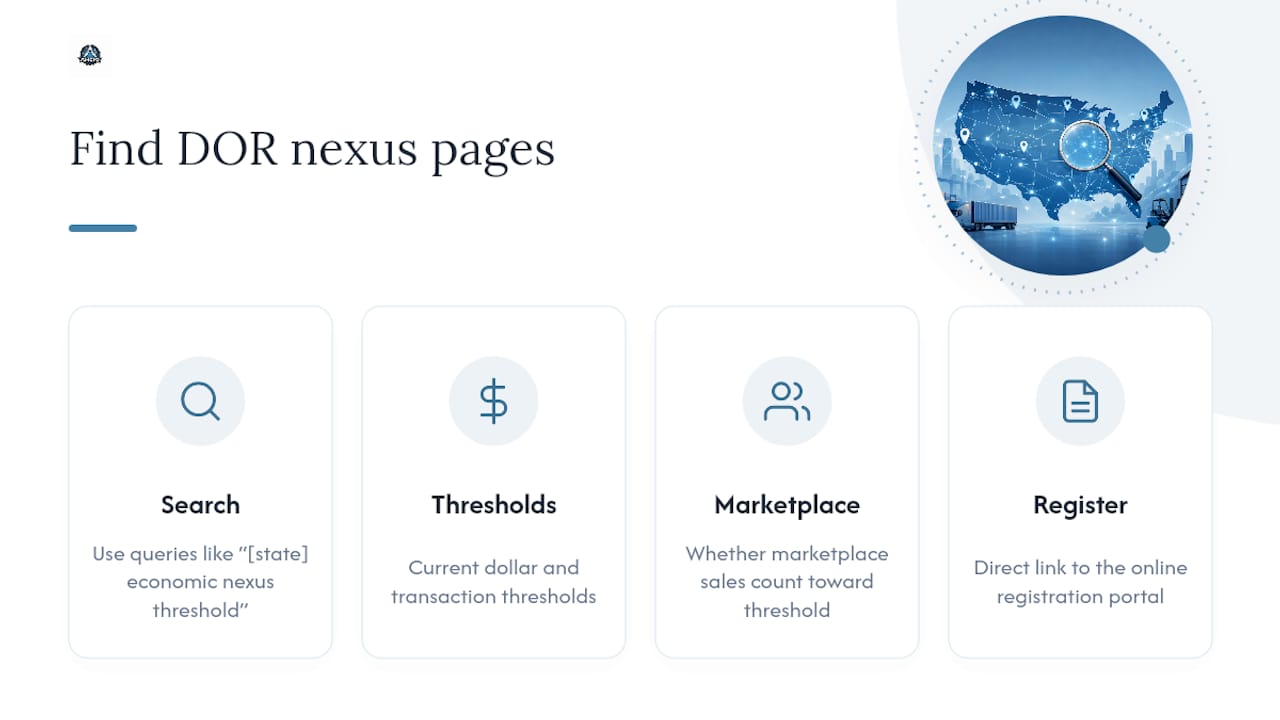
Every state's Department of Revenue (sometimes called Department of Taxation or Comptroller's office) publishes its own nexus and registration guidance, and the search terms that get you there fastest are consistent across states. Try combinations like "[state name] economic nexus threshold," "[state name] remote seller registration," and "[state name] marketplace facilitator." These terms consistently surface the correct DOR page rather than a third-party summary that may already be outdated.
When you land on the right page, look for three things specifically: the current dollar and transaction thresholds, whether marketplace sales count toward your own threshold calculation, and the direct link to the online registration portal. Bookmark that specific page rather than a general homepage, since DOR sites reorganize periodically and a saved search is more durable than a saved URL in some cases.
Third-party guides, including retailer resources like Shopify's ecommerce sales tax guide, are genuinely useful for understanding concepts and getting oriented quickly. Treat them as a starting point for education, though, and always verify the actual number against the state's own DOR page before you register or stop collecting somewhere. A guide published even six months ago may not reflect a threshold a legislature adjusted this year.
Building a monitoring cadence that actually works
A one-time nexus check the year you launch isn't sufficient once your business grows past its first year or two. Set a recurring cadence, monthly for fast-growing sellers, quarterly at minimum for everyone else, where you pull year-to-date sales by state and compare them against current thresholds. That single habit, checked consistently, prevents the vast majority of surprise multi-state exposure sellers discover during an audit years later.
Compliance Best Practices That Actually Reduce Risk
Good sales tax hygiene isn't complicated, but it requires consistency more than expertise. A handful of practices, done monthly rather than annually, close most of the gaps that turn into real exposure.
- Run a monthly nexus scan across all sales channels combined, direct site, marketplaces, and FBA inventory locations, so you catch threshold crossings the same month they happen rather than a quarter later.
- Tag every SKU with a taxability code at the product level so your checkout calculates correctly by default instead of relying on someone remembering an exception at order time.
- Collect and store exemption and resale certificates in a centralized, searchable location the moment a wholesale or exempt transaction happens, not months later when an audit letter arrives.
- Use a voluntary disclosure agreement if you discover you've had unregistered nexus in a state for a while; most states offer a multistate voluntary disclosure program that limits how far back they can assess tax and often waives penalties in exchange for you coming forward first.
- Bring in a bookkeeper or fractional CFO once your state count climbs past a handful, since manual tracking that worked fine at three states typically breaks down around eight or ten.
Pro Tip: Common bookkeeping issues you can spot early include chart-of-accounts entries that lump all sales tax collected into one line regardless of state, and merchant reports that don't separate marketplace-collected tax from direct-site collected tax. Both patterns make monthly reconciliation nearly impossible and are worth fixing before they compound. Sellers who've let their books drift often find that a common accounting challenge like this one is the root cause of a much bigger tax mess later.
What Happens If You've Missed Registrations: Audits, Penalties, and Fixes
Unpaid sales tax accrues penalties and interest the same way unpaid income tax does, and the clock generally starts from the original due date, not the date a state discovers the gap. States commonly trigger audits from data-matching programs (comparing your marketplace-reported sales against your registered filings), customer complaints, or simply noticing a business with significant marketplace or shipping volume into their state that never registered.
- Penalties typically range from a percentage of unpaid tax per month late, compounding until resolved or capped by statute.
- Interest accrues separately from penalties and generally isn't waivable even when penalties are.
- Multi-year exposure across several states can accumulate into a liability far larger than most sellers estimate when they first discover the gap.
This is exactly the situation voluntary disclosure agreements exist to soften. A VDA typically limits the lookback period a state can assess, often to three or four years instead of an unlimited historical review, and frequently waives penalties entirely in exchange for the seller registering and remitting proactively rather than waiting to get caught.
A practical first step: export your sales by ship-to state going back three to four years, map each state against its historical threshold for that period, and identify where you likely had unregistered nexus. That reconciliation exercise gives you (or the accountant you bring in) a realistic exposure estimate before you approach any state, which matters because forensic accounting work on historic financial exposure is exactly the kind of engagement worth handing to a professional rather than estimating from memory.
How Amcfo Helps Sellers Turn This Into a Repeatable Process
Most ecommerce sellers we talk to don't have a sales tax problem so much as a bookkeeping visibility problem. They genuinely don't know their sales-by-state breakdown well enough to answer the nexus question with confidence. Amcfo starts every ecommerce compliance engagement with a nexus scan: pulling multi-channel sales data, mapping it against current thresholds, and flagging where registration is likely already overdue.
From there, the fix usually runs through a QuickBooks cleanup, since disorganized sales tax accounts (all states lumped into one liability line, marketplace tax mixed with direct-site tax) are the single biggest red flag we see before a client discovers real exposure. Once the books are clean, ongoing monitoring replaces the reactive scramble. For sellers managing nexus across a dozen or more states, a fractional CFO retainer routinely costs less than the penalties and interest from even one missed registration, and it catches the next threshold before you cross it rather than after.
— Angelica
Get Your Nexus Exposure Mapped Before It Becomes a Filing Problem
Amcfo is the alternative to guessing your way through multi-state compliance: instead of piecing together thresholds from blog posts and hoping your bookkeeper catches a registration deadline, you get a dedicated team that already tracks this for a living.

Amcfo's accounting and bookkeeping services include the exact reconciliation work this article walks through: sales-by-state tracking, tax account cleanup in QuickBooks, and monthly reconciliation between your merchant platform, tax engine, and filed returns. For sellers who've outgrown a bookkeeper but aren't ready for a full-time controller, fractional CFO services add the forecasting and strategic oversight to keep multi-state growth from outpacing your compliance capacity. If you're not sure where your business currently stands, request a bookkeeping health check and nexus review through Amcfo's main site and get a clear answer on where you're exposed before your next filing deadline hits.
Where to Verify These Rules Yourself
For the legal foundation behind economic nexus, read the Supreme Court's own Wayfair opinion directly rather than a secondhand summary. For marketplace facilitator specifics by state, the Streamlined Sales Tax marketplace resource tracks state-by-state variation. Always register and file through your state's own Department of Revenue portal, using Colorado's as one example of the format most states follow. For ongoing threshold tracking, the economic nexus threshold guide offers a useful dynamic reference, and the company formation resources at Bright Capital America are worth a look if a new registration also means establishing a new business entity in that state.
This article is general information, not a substitute for advice from a qualified financial advisor. Consult a qualified financial professional about your own circumstances before acting on anything here.
Sources
- Economic Nexus Thresholds By State 2026: Complete Guide
- Marketplace facilitator information (Streamlined Sales Tax/marketplace chart)
- Multistate voluntary disclosure program (Multistate Tax Commission)