

Accounts reconciliation is the process of comparing your general ledger balance against an outside source, like a bank statement or subledger, to prove that balance is accurate and properly classified. Done consistently, it catches errors before they compound, flags fraud early, and keeps your monthly close from turning into a scramble. NetSuite and Investopedia both treat it as a foundational control, and at Amcfo we'd add a third point: it's the cheapest insurance policy your books will ever carry.
- Confirms the balance on your books is real, not just recorded
- Surfaces timing gaps, duplicate entries, and posting mistakes before they snowball
- Builds the paper trail auditors and lenders expect to see
Companies that reconcile on a regular cadence avoid the pileup of unresolved errors that slows down financial close and makes year-end audits painful.
Key Takeaways
Reliable financial statements depend on reconciling every major account against an outside source, on a set cadence, with unresolved items aged and escalated before they compound.
| Point | Details |
|---|---|
| Reconciliation proves two things | It confirms a balance is valid and that transactions sit in the right account. |
| Documentation review is the gold standard | Auditors prefer line-by-line matching over estimate-based analytics for high-risk accounts. |
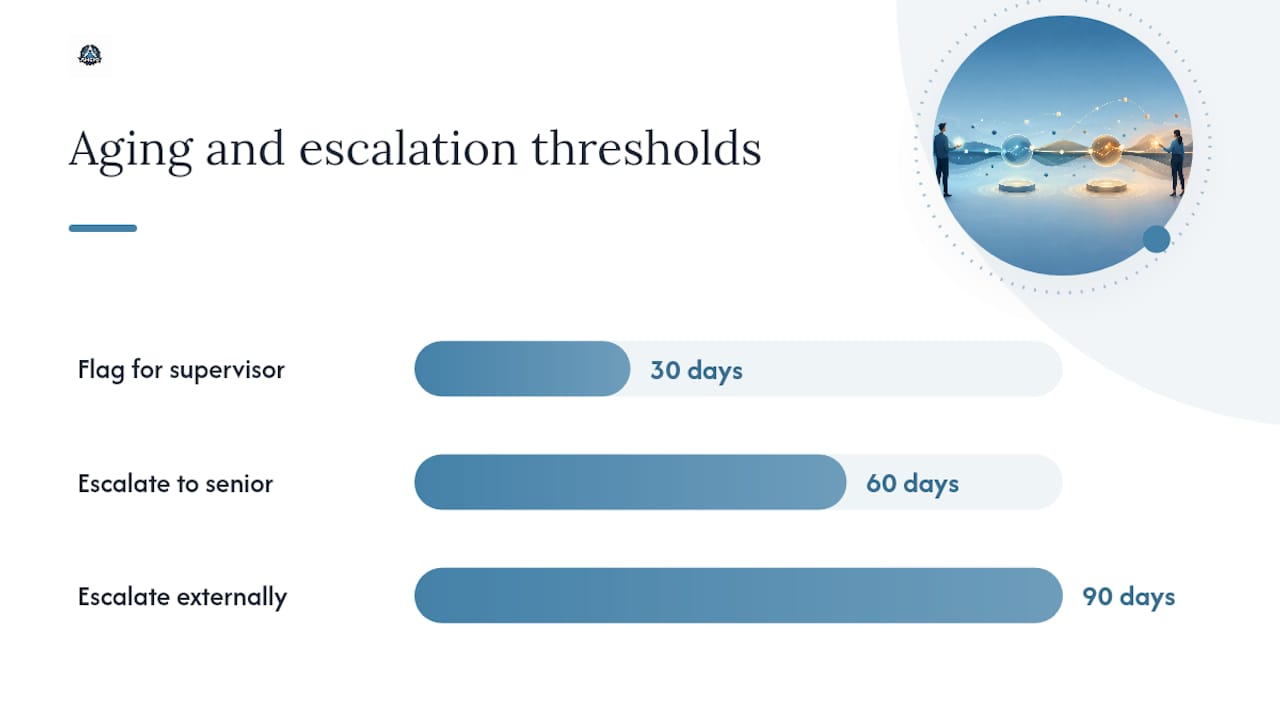
| Age your reconciling items | Flag anything unresolved past 30 days, escalate past 60 to 90 days. |
| Automate matching, not judgment | Software speeds up exception flagging, but a person still investigates and signs off. |
| Amcfo scopes support to your close | Bookkeeping, reconciliation execution, and fractional CFO review are available as your volume and complexity grow. |
Where to Go for Deeper Guidance
- Investopedia covers the fraud-prevention case for reconciliation and general procedure.
- AccountingTools breaks down documentation versus analytics methods in more technical depth.
- NetSuite explains reconciliation within the context of accounting software and automation.
- Workday frames reconciliation as an internal control tied to audit readiness.
- Sage lists common account types and best practices for segregation of duties.
Table of Contents
- What Does Accounts Reconciliation Prove?
- Documentation Review vs. Analytics Review: Which Method Should You Use?
- What Are the Steps for Account Reconciliation?
- Why Do Reconciliation Discrepancies Happen?
- Which Parts of Reconciliation Can Be Automated?
- When Should You Bring in Outside Help?
- How Amcfo Supports Your Reconciliation Process
- Frequently Asked Questions
- Sources
What Does Accounts Reconciliation Prove?
A reconciliation proves one of two things: that an asset, liability, or equity balance is genuinely valid, or that transactions landed in the correct account in the first place. Both matter. A cash balance that matches the bank statement tells you the number is real. A reconciled expense account tells you the number is real and sitting where it belongs on the income statement. AccountingTools frames these as the two core assertions reconciliation exists to support, and auditors test for both.
Not every account carries the same risk, so not every account needs the same attention. The ones that typically require regular reconciliation include:
- Cash and bank accounts (checking, savings, credit cards)
- Accounts receivable and accounts payable subledgers
- Inventory
- Payroll liabilities
- Intercompany balances
- Fixed assets
- Balance-sheet control accounts
Sage lists this same core set, and auditors tend to push hardest on the largest, most volatile balances first, cash, receivables, and intercompany, since that's where material misstatements hide.
Documentation Review vs. Analytics Review: Which Method Should You Use?
There are two accepted ways to reconcile an account, and picking the right one saves hours.
Documentation review, sometimes called tick-and-tie, matches individual transactions line by line against a second source: a bank statement, a vendor invoice, a subledger report. It's slow but airtight, and it's the method auditors generally prefer because it produces a clear, testable trail from ledger to source document.
Analytics review works differently. Instead of matching every transaction, you build an estimate of what the balance should be, based on trends, ratios, or prior periods, and compare it against the actual number. If the gap is small, you move on. If it's material, that's your signal to drop into a full documentation review.
- Use documentation review for high-risk or high-dollar accounts, and anything an auditor will test directly
- Use analytics review for lower-risk accounts where a quick sense-check is enough
- Escalate to documentation review the moment an analytics estimate misses by a meaningful margin
Pro Tip: Run analytics review monthly across all your accounts as a triage tool, then reserve full documentation review for the accounts that fail the sense-check. It cuts hours off your close without sacrificing control.
What Are the Steps for Account Reconciliation?
A reconciliation only works if it's repeatable. Here's the sequence that holds up under audit scrutiny:
- Select the account and period. Pull the ending general ledger balance for the account and timeframe you're reconciling.
- Gather supporting documents. Bank statements, vendor invoices, subledger reports, or payroll registers, whatever the second source is.
- Align the dates. Make sure both sides cover the same cutoff; a mismatched date range is the single most common cause of a false discrepancy.
- Tick and tie, or run analytics. Match transactions line by line, or apply the estimate-based sense-check depending on the account's risk profile.
- List every reconciling item. Anything that doesn't match goes on a schedule with a description, dollar amount, and date first identified.
- Investigate each item. Trace it back to its source: a timing difference, a bank fee, a duplicate entry, a posting error.
- Post adjusting journal entries for anything that represents a real error on your books, not just a timing gap that will clear naturally.
- Sign off. The preparer completes the reconciliation; a second person reviews and approves it before it's considered closed.
- Retain the documentation. Keep the reconciliation schedule, supporting statements, and adjustment backup for at least as long as your audit or tax retention policy requires.
Unresolved items need a clock on them. Age your reconciling items by how long they've sat open, and set a rule: anything unresolved past 30 days gets flagged for supervisor review, and anything past 60 or 90 days gets escalated to a senior accountant or outside reviewer. AccountingTools treats this aging discipline as central to catching both sloppy follow-up and actual fraud before it compounds.
Pro Tip: Build your reconciling-items list into a simple aging report, sorted oldest first. Whatever sits at the top of that list is where your next 20 minutes should go.
Why Do Reconciliation Discrepancies Happen?
Most mismatches trace back to a handful of repeat offenders:
- Timing differences (a check issued but not yet cleared)
- Bank fees or interest not yet recorded on the books
- Duplicate entries from manual re-keying
- Missing invoices or bills not yet posted
- Posting errors, wrong account or wrong amount
- Interface or integration mismatches between systems
The investigation itself follows a short, repeatable path:
- Pull the supporting documentation for the item in question.
- Check the posting date against the transaction date.
- Confirm the amount and date directly with the bank, vendor, or customer if the source documents don't resolve it.
- Recreate the transaction from scratch if the paper trail is incomplete.
Some patterns deserve more than a shrug. Unexplained cleared checks, repeated write-offs on the same account, reconciling items that never seem to age out, and a heavy reliance on manual journal adjustments to force a balance to zero are all classic fraud red flags. Workday points to reconciliation against third-party statements as one of the more reliable ways to catch these anomalies before they become material.
Which Parts of Reconciliation Can Be Automated?
Automation handles the repetitive matching work well: pulling bank feeds, matching transactions across ledgers, flagging exceptions, and building the audit trail automatically as it goes. That's a real shift in how finance teams spend their time, less matching, more investigating.

What software still can't do is judgment. A flagged exception still needs a human to determine whether it's a timing difference or a real problem, and final sign-off should never be automated away entirely.
If you're evaluating reconciliation software, look for:
- Direct data integrations with your bank and accounting system
- Exception management that surfaces mismatches instead of burying them
- An audit log that timestamps every match and adjustment
- Role-based approvals so preparer and reviewer stay separate
- Room to scale as transaction volume or entity count grows
Pro Tip: Test any reconciliation tool on your messiest account first, usually intercompany or inventory. If it handles that cleanly, it'll handle everything else.
When Should You Bring in Outside Help?
Keeping reconciliation in-house works fine at low transaction volume with a single entity and no complex intercompany activity. The math changes once you're juggling multiple entities, high transaction counts, or a close deadline that keeps slipping because reconciliations are backing up.
A few signals it's time to escalate:
- Reconciliations routinely slip past your close deadline
- Reconciling items are aging past 60 to 90 days with no resolution
- You're managing multi-entity or intercompany complexity without dedicated staff
- No one is checking the preparer's work
That last point is a control issue, not a staffing one. Segregation of duties, one person preparing the reconciliation, a different person reviewing and approving it, is the single most effective safeguard against both honest error and deliberate manipulation. Amcfo supports this through everything from one-time bookkeeping cleanup to ongoing reconciliation execution and senior-level review, scoped to what your close actually needs rather than a one-size fee.
A practitioner's take on what actually moves the needle
The habit that separates clean books from chronic year-end chaos isn't a fancy tool, it's cadence. Reconcile monthly, age your open items honestly, and escalate before they hit 90 days. Automate the matching, never the judgment call.
How Amcfo Supports Your Reconciliation Process
If your reconciliations are backing up, or you're not fully confident the numbers you're closing on are right, that's the exact gap Amcfo was built to close. Amcfo handles the full range: bookkeeping, QuickBooks setup and cleanup, hands-on reconciliation execution, monthly close support, and fractional CFO review for businesses that need a senior set of eyes without a full-time hire.

Instead of leaving reconciliation to whoever has spare time this month, you get a team that treats it as a standing discipline, with segregation of duties already built in. If you suspect discrepancies might point to something more serious, Amcfo's forensic accounting team can dig into the specifics. For most businesses, though, the starting point is simpler: a bookkeeping and accounting engagement that gets your reconciliations current and keeps them that way. Reach out to scope what your business actually needs, and get a clear read on where your books stand today.
Frequently Asked Questions
What is accounts reconciliation in simple terms? It's the process of checking that your books match an outside record, like a bank statement, so you know the balance is accurate and correctly classified.
How often should a business reconcile its accounts? Monthly at minimum for bank and high-volume accounts, ideally as part of an ongoing routine rather than a scramble at year-end.
What's the difference between the two reconciliation methods? Documentation review matches individual transactions against source documents; analytics review estimates the expected balance and flags it for deeper review only if the estimate is off by a meaningful margin.
How long should reconciliation records be kept? Retention should follow your audit and tax requirements, generally several years, with the reconciliation schedule and supporting statements kept together.
When should a business bring in outside help for reconciliation? Once transaction volume, multi-entity complexity, or aged unresolved items start pushing past what internal staff can keep current with each close cycle.
This article is general information, not a substitute for advice from a qualified financial advisor. Consult a qualified financial professional about your own circumstances before acting on anything here.
Sources
- What Is Account Reconciliation? | NetSuite
- How to reconcile an account — AccountingTools
- Account Reconciliation Procedure and Importance | Investopedia
- What Is Account Reconciliation? | Workday US
- Account reconciliation: What it is and best practices | Sage Advice US