

Investor financial reporting is the structured, recurring disclosure of a company's or fund's financial and operational results to the people who put capital into it. A complete investor report gives readers a clear read on performance and risk without a follow-up call.
Before you get into structure and cadence, here's what a report needs at minimum:
- The four core financial statements: balance sheet, income statement, cash flow statement, and statement of equity
- Supporting schedules where relevant: partner capital account statements (PCAP) and a schedule of investments (SOI) for funds
- Management's Discussion and Analysis (MD&A) covering trends, risks, and material events
- A short set of KPIs tied to the audience's decisions (IRR, TVPI, revenue growth, margin, whatever applies)
- A stated cadence, usually quarterly with an annual audited package
The rest of this guide walks through each of those pieces, how to arrange them into a report investors actually read, and where most reporting processes quietly break down.
Key Takeaways
Investor financial reporting works when the four core statements, supporting schedules, and a candid MD&A section combine into one consistent, audit-ready package delivered on a fixed schedule.
| Point | Details |
|---|---|
| Four statements are non-negotiable | Balance sheet, income statement, cash flow statement, and statement of equity form the baseline of any investor package. |
| KPIs need reconciliation | Every reported metric like IRR or TVPI should trace back to the underlying financial statements. |
| MD&A carries the narrative | Risk factors, material events, and forward-looking commentary often matter more to investors than raw figures. |
| Cadence should be fixed | Quarterly packages with annual audited statements are the standard rhythm for funds and operating companies alike. |
| Amcfo handles the workflow | Amcfo's fractional CFO and bookkeeping services build and maintain audit-ready reporting packages on a consistent schedule. |
Table of Contents
- What Is Investor Reporting and Who Reads It?
- The Core Financial Components Every Investor Report Needs
- Which KPIs Do Investors Actually Look For?
- Why Qualitative Disclosures and MD&A Matter as Much as the Numbers
- How Should You Structure a Complete Investor Report?
- How Often Should You Report, and What Regulatory Rules Apply?
- Best Practices That Build Investor Trust Over Time
- Common Reporting Problems and How to Fix Them
- How Automation Changes Investor Reporting Workflows
- What Belongs in an Audit-Ready Quarterly Package?
- Guidelines for Delivering Investor Reports Effectively
- Why Reporting Discipline Pays Off at Fundraising Time
- How Amcfo Supports Investor-Ready Reporting
- Frequently Asked Questions
- Sources
What Is Investor Reporting and Who Reads It?
Investor reporting is the ongoing, structured communication of financial and operational performance to the people who have capital at stake: limited partners, shareholders, creditors, and board members. It's distinct from internal management reporting because the audience isn't trying to run the business day to day. They're trying to decide whether to commit more capital, hold, or exit.
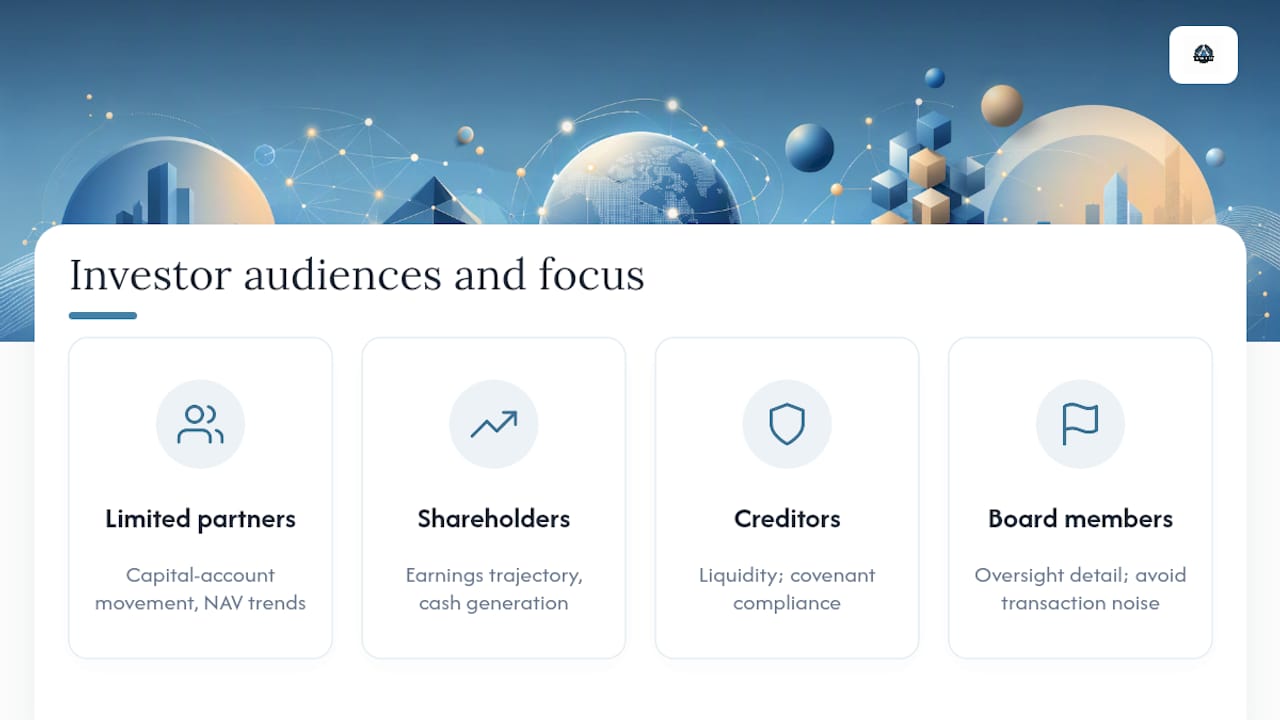
Each audience reads a report differently. Limited partners in a fund care about capital account movement, called and distributed capital, and how NAV is trending against prior marks. Shareholders in an operating company care about earnings trajectory and cash generation. Creditors focus on liquidity and covenant compliance. Board members sit somewhere in between, needing enough detail to exercise oversight without drowning in transaction-level noise.
The strategic function goes beyond compliance. Reporting is how you demonstrate fiduciary discipline, and it's often the single biggest input into whether an investor writes a bigger check next round. The SEC's Beginners' Guide to Financial Statements frames this well: audited statements combined with narrative context let investors see results "through the eyes of management," not just as a spreadsheet of outputs. That combination, numbers plus context, is what separates investor reporting from a bookkeeping export.
The Core Financial Components Every Investor Report Needs
Every investor package, regardless of entity type, is built on four statements. The SEC's Financial Reporting Manual treats these as the backbone of standard financial disclosure, and investors expect all four, not a subset.
- Balance sheet: a snapshot of assets, liabilities, and equity at a point in time, showing solvency and capital structure.
- Income statement: revenue, expenses, and profitability over the period, showing operating trajectory.
- Cash flow statement: how cash actually moved across operating, investing, and financing activities, often the statement investors trust most because it's harder to dress up than earnings.
- Statement of shareholders' or partners' equity: how ownership value changed, including contributions, distributions, and retained earnings.
For funds and pooled investment vehicles, two supporting schedules do most of the heavy lifting: the partner capital account statement (PCAP), which tracks each investor's contributions, distributions, and allocated gains or losses, and the schedule of investments (SOI), which itemizes each portfolio holding at cost and fair value. Reconciliations tying these schedules back to the core statements are what let a sophisticated LP verify a reported IRR or NAV change without a phone call.
Pro Tip: State your accounting basis explicitly in the first page of every report. Investors increasingly expect full accrual accounting under GAAP rather than cash basis, since accrual figures hold up better under audit and make period-over-period comparisons meaningful. If you're not yet audited, say so and give a timeline.
Which KPIs Do Investors Actually Look For?
Investors don't read every line of a financial statement first. They jump to a handful of metrics that answer one question: is this investment working? Which KPIs matter depends heavily on structure, fund versus operating company, but a few show up across nearly every investor package.
- IRR (internal rate of return): annualized return accounting for the timing of cash flows, the headline number most LPs ask for first.
- TVPI (total value to paid-in capital): total value returned plus unrealized value, divided by capital contributed, a snapshot of overall multiple.
- DPI (distributions to paid-in capital): how much cash has actually been returned, as opposed to paper gains.
- PME (public market equivalent): how the fund's performance stacks up against a public benchmark over the same period.
- NAV change: period-over-period movement in net asset value, often the fastest signal of directional performance.
- Revenue growth, gross margin, and free cash flow: the operating-company equivalents that show whether the underlying business is actually improving.
A reconciliation note matters as much as the KPI itself. If you report a net IRR, show (even briefly) how that ties back to called capital, distributions, and the current NAV mark, so a reader can rebuild the number rather than take it on faith.
The CFA Institute's research on investor perspectives makes a point worth internalizing: investors want reporting that helps them understand why a figure moved, not just the figure itself. A KPI dashboard with no context is a number without a story, and sophisticated investors will ask for the story anyway. Save yourself the follow-up email and label your bases clearly, gross versus net IRR, since inception versus trailing twelve months, and benchmark against a stated comparator rather than leaving it implied.

Why Qualitative Disclosures and MD&A Matter as Much as the Numbers
Numbers tell you what happened. MD&A tells you why, and increasingly, that's the section sophisticated investors read first. The SEC's guidance on MD&A requires disclosure of trends, events, or uncertainties known to management that could materially affect reported results, and that standard is a useful bar even for reports that aren't SEC-filed.
A strong MD&A section covers:
- Risk factors that changed materially since the last report, not a static boilerplate list
- Significant transactions: acquisitions, exits, refinancings, or major customer wins and losses
- Operational milestones against the plan you previously communicated
- Management's own read on strategy progress, including where results diverged from expectations and why
Raw historical numbers only tell you where you've been. MD&A is where management explains where things are headed and what could knock that trajectory off course, which is precisely why investors weight it so heavily when a quarter comes in soft.
Pro Tip: Keep MD&A to one tight page per quarter. Lead with the single sentence that best explains the period's biggest driver, then support it with two or three specifics. A dense five-page narrative gets skimmed; a focused one gets read and remembered.
How Should You Structure a Complete Investor Report?
A report that wanders loses readers before they hit the numbers that matter. The structure below works for quarterly packages and scales down cleanly for a lighter annual summary or a one-page dashboard.
- Cover and executive summary — one page, top-line results, and the single most important sentence of the period (a fund close, a covenant event, a major win).
- Performance highlights — period-over-period comparison against plan or prior period, in plain language before the tables.
- KPI dashboard — the five or six metrics that matter most for this audience, visualized, not buried in a table of forty numbers.
- Financial statements and reconciliations — the four core statements plus any reconciliation tying KPIs back to the underlying figures.
- Portfolio highlights or company spotlights — for funds, a short update per holding; for operating companies, a segment or product-line breakdown.
- Capital accounts and schedules — PCAP, SOI, and any allocation detail relevant to the reporting period.
- Risks and outlook — MD&A content, forward-looking commentary, and any material uncertainties.
- Appendices and audit disclosures — methodology notes, valuation policy, auditor status, and definitions for any non-GAAP metrics used.
For quarterly packages, keep sections 1 through 3 tight and push detail into the appendices. Annual packages carry more weight in sections 4 and 8, since that's where the audited statements and full disclosures live.
Before distribution, run a short verification pass:
- Do KPI figures in the dashboard match the numbers in the financial statements exactly?
- Has every material event since the last report been addressed in MD&A?
- Are capital account balances reconciled to the fund administrator's records?
- Is the accounting basis and audit status stated clearly on the cover page?
Decide upfront whether you're sending a single integrated PDF or a packaged set of attachments (statements, PCAP, SOI as separate files). Larger LPs with their own portfolio management systems generally prefer separated files they can ingest programmatically; smaller investors usually prefer one clean document. Carta's guide to private fund investor reporting notes that quarterly reporting paired with annual audited statements has become the de facto standard for private funds, which makes it a safe default if you're building a cadence from scratch.
How Often Should You Report, and What Regulatory Rules Apply?
Cadence depends on structure. Most private funds run monthly internal dashboards, quarterly investor packages, and an annual audited financial statement paired with K-1 tax packages for partnerships. Operating companies with outside equity investors typically settle into a quarterly rhythm as well, tightening to monthly during a fundraise or a turnaround.
- Monthly: internal dashboards, sometimes shared with board members or lead investors only.
- Quarterly: the standard investor package, statements plus MD&A plus KPIs.
- Annual: audited financial statements, K-1s for partnerships, and a fuller strategic review.
Public companies carry additional obligations, SEC filing forms and formal MD&A disclosure requirements that don't apply to private funds but shape investor expectations even at private companies with sophisticated LPs. If your cap table includes institutional investors who also hold public securities, they'll benchmark your MD&A quality against what they see in public filings, whether that's fair or not.
A workable internal timeline: close the books within 10 business days of period end, complete internal review by day 15, finalize any audit procedures by day 20, and distribute to investors by day 25 to 30. Slower than that, and quarterly reporting starts to feel stale by the time investors receive it. When in doubt about whether a disclosure crosses into securities law territory, loop in legal or compliance before the report goes out, not after.
Best Practices That Build Investor Trust Over Time
Consistency beats sophistication. An investor who gets the same clean structure every quarter trusts it more than one who gets a beautifully designed report that changes format every cycle.
- Single source of truth: every number in the report should trace back to the general ledger, not a side spreadsheet someone maintains separately.
- Documented reconciliations: keep a standing reconciliation file linking KPIs to statement line items, so you're not rebuilding logic every quarter.
- Standardized templates and naming: consistent file names, consistent metric definitions, consistent section order.
- Version control: track who approved what before it goes out, especially when multiple team members touch the same report.
On visualization, three chart types do most of the work in an investor package: a waterfall showing how returns built up from cost to current value, a NAV bridge showing period-over-period movement broken into contributions, distributions, and valuation changes, and a cash flow waterfall for liquidity. Annotate every chart with the basis and time period directly on the visual, not in a footnote three pages later, so it can't be misread out of context.
Personalization has limits. You can tailor the emphasis and level of detail for an LP versus a board member, but the underlying audited facts have to be identical across every version. The CFA Institute's Comprehensive Business Reporting Model puts timeliness, transparency, comparability, and consistency at the center of good reporting, and those four virtues don't bend based on who's reading.
Pro Tip: Build one master report and generate audience-specific views from it, rather than maintaining separate reports for LPs and the board. Divergent source files are how numbers quietly drift apart.
Common Reporting Problems and How to Fix Them
Most weak investor reports trace back to the same handful of root causes, and none of them require a total system overhaul to fix.
The most frequent issues: KPIs calculated inconsistently from quarter to quarter, statements built on a different accounting basis than what was disclosed, data arriving from multiple disconnected sources, and missing audit trails that make it impossible to verify a number after the fact.
- Set a close calendar with hard internal deadlines for each step, from GL close to final distribution.
- Centralize GL posting rules so every team member records transactions the same way, eliminating the biggest source of quarter-to-quarter KPI drift.
- Build a standing KPI reconciliation sheet that ties every reported metric back to its source line items.
- Automate recurring schedules like PCAP and SOI updates so they're not rebuilt manually each cycle.
Before your next distribution, run a quick triage: pull last quarter's report next to this quarter's, check that every KPI definition matches, confirm the accounting basis hasn't shifted, and verify that any manual adjustments are documented and explainable.
How Automation Changes Investor Reporting Workflows
Reporting platforms won't fix bad data, but they eliminate a lot of the manual rework that introduces errors in the first place. The realistic wins are data connectors that pull directly from your general ledger and fund administrator, automatic KPI calculations that apply the same formula every period, templated exports that keep formatting consistent, audit trails showing who changed what, and role-based access so investors see only what they're entitled to see.
When evaluating a platform, run through this checklist:
- Security and auditability: can you produce a full change log for any number in the report?
- Reconciliation support: does it link KPIs back to source statements automatically, or is that still manual?
- Custom KPI engine: can you define fund-specific or company-specific metrics, not just out-of-the-box templates?
- Output formats: does it export to PDF, Excel, and a portal view without rebuilding the report three times?
- Investor portal options: can LPs self-serve historical reports without emailing your team?
Weigh scalability, integration effort against your current systems, and total cost of ownership against what a fractional CFO or outsourced accounting team would cost to produce the same output manually. Whatever tool you're considering, run a trial dataset through it before committing. A platform that looks clean in a demo can fall apart the moment it hits your actual chart of accounts.
What Belongs in an Audit-Ready Quarterly Package?
A quarterly investor package that survives scrutiny needs a specific, checkable set of files, not a general sense that "the numbers are in there somewhere."
Standard checklist:
- Executive summary (one page)
- KPI dashboard with clearly labeled bases and time periods
- Financial statements: balance sheet, income statement, cash flow statement, statement of equity
- Audited financials when available, or a clear note on audit status and timeline
- PCAP for each investor, where applicable
- Schedule of investments with cost and fair value
- Reconciliation workpapers linking KPIs to statements
- MD&A section covering the quarter's key drivers, risks, and outlook
On format: final reports go out as PDF for a clean, non-editable read. Reconciliation workpapers and supporting schedules work better as Excel files, since sophisticated LPs often want to rebuild a calculation themselves. If you're feeding an investor portal, plan for a structured data extract (CSV or API feed) alongside the polished PDF.
Suggested internal timeline for a quarterly package:
- Days 1 to 10: close the books, reconcile the GL, finalize the trial balance.
- Days 11 to 15: internal review with the CFO or fund manager, resolve variances against the prior period.
- Days 16 to 20: draft MD&A, build KPI dashboard, run reconciliations against the statements.
- Days 21 to 25: final review, formatting, and any legal or compliance sign-off.
- Days 26 to 30: distribute to investors through your chosen channel.
A fractional CFO typically owns days 11 through 25 of that timeline: reviewing variances, drafting the narrative, and making sure the KPI dashboard reconciles cleanly before it reaches an LP's inbox. Building that review step into your calendar, rather than treating it as an afterthought, is usually the difference between a report that gets questions and one that doesn't.
Guidelines for Delivering Investor Reports Effectively
Timing and channel matter almost as much as content. A report that's technically complete but arrives late, or lands in an inbox with no context, still damages trust.
Distribute on a fixed schedule investors can plan around, the same day of the month or quarter, every cycle. If you're consistently late, tell investors in advance rather than letting them notice the drift themselves. Most funds and companies now use a dedicated investor portal for document delivery, which gives you a clean audit trail of who accessed what and when, alongside email for a shorter cover note pointing to the highlights.
Keep the cover note short: two or three sentences on the headline result, then a link or attachment to the full package. Don't bury the most important fact of the quarter in page four of an appendix. If there's a material event, a covenant issue, a major exit, a leadership change, send a separate, timely communication rather than waiting for the next scheduled report. Investors forgive bad news delivered promptly far more readily than bad news they discover was sitting in a report for six weeks before anyone flagged it.
Confidential or sensitive information (customer names, specific valuation methodologies, terms tied to a single investor) should be handled through redaction or a tiered access model in your portal, not by omitting it entirely. Transparency and confidentiality aren't opposites; they just require different investors to see different levels of detail on the same underlying facts.
Increasingly, investors also expect a line or two on ESG-relevant factors, workforce metrics, governance changes, environmental compliance, where they're material to the business. You don't need a standalone ESG report to address this. A short paragraph in MD&A noting material developments is often sufficient unless investors have specifically requested a fuller framework.
Why Reporting Discipline Pays Off at Fundraising Time
The funds and companies that raise their next round smoothly are almost never the ones with the flashiest metrics. They're the ones whose existing investors already trust the numbers, because every prior report reconciled cleanly and every hard quarter got explained honestly instead of buried.
I've seen reporting treated as a compliance chore turn into a genuine strategic asset once a management team started sending the same clean package, on the same schedule, every quarter, without exception. LP questions dropped off almost entirely after the second or third cycle, not because performance improved, but because the reporting stopped raising doubts about whether the numbers could be trusted.
That discipline compounds. Faster closes free up time for the narrative that actually shapes an investor's decision to reinvest. Fewer follow-up questions mean your team spends less time defending numbers and more time explaining strategy. That's the real payoff of doing this well.
How Amcfo Supports Investor-Ready Reporting
Building the checklist above every quarter, on time, with clean reconciliations, is exactly the kind of work that pulls internal teams away from running the business. Amcfo's fractional CFO services exist to take that off your plate: KPI design, MD&A drafting support, and capital account reconciliations handled by people who do this across multiple funds and companies, not once a quarter for the first time.

Pairing that with accounting and bookkeeping support means your general ledger stays audit-ready year round instead of scrambling in the two weeks before a distribution deadline. The combination shows up in three places: faster closes because the GL is clean going in, fewer audit findings because reconciliations happen monthly instead of quarterly, and clearer KPI governance because the same team owns the calculation logic every period.
If your current reporting process still runs on spreadsheets stitched together the week before an investor deadline, request a review of your current package and see what a standardized quarterly workflow would look like for your fund or company.
Frequently Asked Questions
What is investor financial reporting, in one sentence?
Investor financial reporting is the structured, recurring disclosure of financial and operational results, financial statements plus KPIs plus narrative, delivered to the capital providers who need it to make decisions.
How is investor reporting different from regular financial reporting?
Regular or internal financial reporting serves operational management. Investor reporting serves an external, often less operationally involved audience and typically carries higher standards for reconciliation, auditability, and narrative context because that audience can't ask follow-up questions in the hallway.
What financial statements do investors always expect to see?
The balance sheet, income statement, cash flow statement, and statement of shareholders' or partners' equity, plus supporting schedules like the PCAP and SOI for fund structures.
How often should investor reports go out?
Most funds and companies with outside investors settle into quarterly packages, backed by an annual audited statement. Some add lighter monthly dashboards for lead investors or board members during active fundraising or turnaround periods.
Do private companies need to follow SEC reporting rules?
Only public companies face direct SEC filing obligations. Private companies and funds aren't bound by those specific forms, but the underlying disclosure principles, particularly around MD&A and material event reporting, are a reasonable standard to follow voluntarily since sophisticated investors expect it anyway.
This article is general information, not a substitute for advice from a qualified financial advisor. Consult a qualified financial professional about your own circumstances before acting on anything here.
Sources
- SEC — Beginners' Guide to Financial Statements
- CFA Institute — Investor perspectives on quarterly reporting (2026)