

What is financial transparency?
Financial transparency is the open, accurate disclosure of an organization's financial health, covering revenues, expenses, assets, liabilities, and performance, to the people who depend on that information. It is the opposite of hidden budgets and opaque reporting that leave stakeholders guessing.
A few core elements define it in practice:
- Revenues and expenses: What money comes in, what goes out, and why
- Assets and liabilities: What the organization owns and owes
- Performance context: Explanations behind the numbers, not just the numbers themselves
- Stakeholder scope: Investors, employees, customers, and regulators all have a stake
One distinction worth drawing early: financial disclosure and financial transparency are not the same thing. Disclosure is the legal minimum, releasing what regulators require. Transparency goes further, reflecting a genuine willingness to help stakeholders understand what the data actually means.
Why financial transparency matters for organizations and markets
Transparent reporting reduces a firm's cost of capital by lowering the information risk investors assign to opaque structures. When investors cannot assess a company's true financial position, they demand a higher return to compensate for that uncertainty.
The importance of financial transparency extends well beyond cost of capital:
- Investor confidence: Clear financials allow accurate risk assessment and support more stable valuations
- Market integrity: Transparent markets function more efficiently because prices reflect real information
- Regulatory trust: Bodies like the SEC actively encourage disclosure as a market protection mechanism
- Organizational credibility: Companies that share financial context build reputations that attract capital and talent
Transparency is also a trust mechanism, not just a compliance exercise. A company that explains why margins dropped in a given quarter, rather than burying the figure in a footnote, signals that leadership is accountable.
Legal and public disclosure requirements underpinning financial transparency

The SEC requires publicly traded companies to file quarterly 10-Q reports and annual 10-K reports, with 8-K filings required for material financial developments. These filings form the legal floor of financial transparency for public companies.
Key disclosure obligations by entity type:
- Public companies: 10-K (annual), 10-Q (quarterly), 8-K (material events), all filed with the SEC
- Nonprofits: Must publicly disclose certain financial data upon request, including Form 990 filings, which the IRS makes available to the public
- Government entities: Subject to open records laws, mandatory audits, and standardized reporting frameworks
Compliance with these requirements is necessary, but it does not equal genuine transparency. A 10-K filed on time but written in dense legal language serves the regulator, not the reader. The gap between what the law requires and what stakeholders can actually use is exactly where meaningful transparency lives.
Benefits of financial transparency for organizations and stakeholders
Transparent financial statements reduce investment risk and enhance company value by making financial health clear and preventing surprises. When debt levels and growth prospects are visible, investors can price risk accurately rather than building in a penalty for uncertainty.
The benefits stack up across the organization:
- Improved valuation: Investors reward clarity with lower risk premiums
- Reduced volatility: Fewer surprises mean fewer sharp stock price swings
- Better fundamental analysis: Analysts can model a business accurately when the data is clean and contextualized
- Accountability: Transparent books make it harder for financial problems to hide until they become crises
- Strategic clarity: Leaders who share financials internally tend to make faster, better-aligned decisions
Transparency also serves as a preventive mechanism. Many high-profile financial scandals trace back to deliberate opacity, where problems were obscured until they became unmanageable. Open financial reporting practices create natural checkpoints that make that kind of concealment harder.
How financial transparency strengthens stakeholder relations and trust
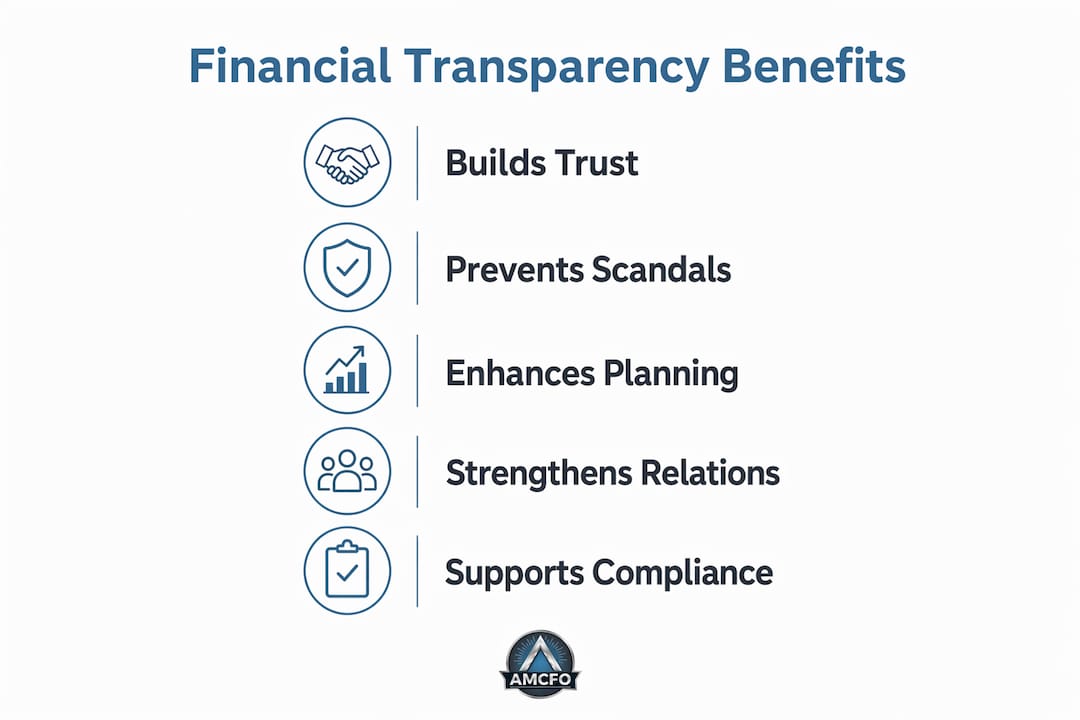
Clear financial information builds confidence across every stakeholder group, but the mechanism differs by audience. Investors use it to assess risk. Employees use it to gauge job security and company direction. Customers and partners use it to decide whether a business is stable enough to rely on.
Stakeholder trust factors supported by transparency:
- Employees: Seeing real financial data reduces anxiety and increases engagement with company goals
- Investors: Regular, honest updates reduce the uncertainty premium they attach to the stock
- Regulators: Proactive disclosure signals good governance and reduces scrutiny
- Customers and vendors: Financial stability signals reduce the perceived risk of long-term contracts
Transparency builds trust with employees and investors by providing clear updates that promote planning confidence. A team that understands why the company is tightening budgets responds very differently than one that hears rumors and fills in the blanks themselves.
Expert insights on balancing transparency effectively
Financial transparency is a strategic trade-off: too little disclosure raises the cost of capital, while too much can expose proprietary information or overwhelm stakeholders with data they cannot interpret. The goal is calibrated clarity, not maximum volume.
Best practices for getting the balance right:
- Contextualize every key figure: A revenue drop means something different if it follows a deliberate product exit versus a market loss
- Segment by audience: Board members need granular data; customers need a summary of financial health
- Use plain language: Dense accounting jargon in a shareholder letter defeats the purpose
- Be consistent: Changing how you report metrics quarter to quarter erodes trust faster than a bad number does
Pro Tip: The most effective financial transparency is storytelling, not data dumping. When you explain the "why" behind a number, you give stakeholders the context to trust your judgment, not just your math.
At Amcfo, the fractional CFO advisory work with clients consistently shows that companies struggle less with what to disclose and more with how to present it in a way that actually lands with their audience.
Examples of financial transparency in practice
Real-world transparency looks different depending on the organization. A publicly traded company posts its 10-K on its investor relations page with a plain-language earnings summary alongside the GAAP financials. A nonprofit publishes its Form 990 on its website before anyone asks for it. A private startup shares monthly burn rate and runway figures with its board and key investors, even when the numbers are uncomfortable.
Internally, a small business practicing transparency might hold a monthly all-hands meeting where leadership walks through revenue, expenses, and cash position. That kind of openness, even at a small scale, tends to reduce turnover and improve decision-making at every level of the organization.
Challenges and risks associated with financial transparency
The biggest practical challenge is competitive sensitivity. Detailed cost structures, margin data, and forward-looking projections can hand competitors an advantage if disclosed too broadly. Public companies navigate this by disclosing what the SEC requires while being careful about forward guidance that could be used against them.
Other real risks include information overload, where stakeholders receive so much data that the signal gets lost in the noise, and misinterpretation, where a figure taken out of context triggers unwarranted concern. Maintaining sound financial governance helps organizations structure disclosures that inform rather than confuse.
Best practices and tools for achieving financial transparency
Achieving genuine transparency starts with clean, accurate books. You cannot communicate financial health clearly if the underlying data is unreliable. From there, the process involves choosing the right reporting cadence, the right format for each audience, and the right level of detail.
Practical steps that work:
- Standardize on GAAP or a consistent framework so reports are comparable over time
- Use accounting software like QuickBooks to maintain real-time accuracy
- Produce regular management reports that go beyond the income statement to include cash flow and balance sheet context
- Engage a fractional CFO to translate financial data into narrative that non-finance stakeholders can act on
How financial transparency differs from disclosure and accountability
These three terms are related but distinct. Financial disclosure is the act of releasing specific data, often because the law requires it. Financial transparency is the broader commitment to making that data understandable and accessible, going beyond the legal minimum. Financial accountability is what happens when transparency is in place and someone is responsible for the outcomes the data reveals.
Think of it this way: a company can be fully compliant with disclosure rules and still be opaque. Transparency requires intent, not just paperwork. Accountability requires that the information disclosed actually leads to consequences, whether that means rewarding good performance or correcting poor decisions. All three work together, but confusing them leads organizations to check the compliance box and assume the job is done.
Amcfo helps businesses build the financial clarity their stakeholders need. From accounting and bookkeeping to ongoing fractional CFO support, the team translates accurate numbers into the kind of transparent reporting that builds real trust.

Key Takeaways
Financial transparency goes beyond legal disclosure: it requires context, consistency, and a genuine commitment to helping stakeholders understand what the numbers mean.
| Point | Details |
|---|---|
| Transparency vs. disclosure | Disclosure meets legal requirements; transparency adds context so stakeholders can actually use the information. |
| Cost of capital impact | Transparent reporting lowers information risk, which reduces the premium investors demand for uncertainty. |
| Legal baseline | Public companies must file 10-K, 10-Q, and 8-K reports with the SEC; nonprofits must make Form 990 publicly available. |
| Stakeholder trust | Employees, investors, and regulators all respond to clear financial communication with greater confidence and engagement. |
| Balance is required | Too little disclosure raises investor risk; too much can expose proprietary data or overwhelm the audience. |