

Most small business owners assume a CFO is just an expensive accountant with a fancier title. That misconception costs them dearly. The role of a CFO in small business is fundamentally strategic: a skilled CFO shapes how your company allocates capital, manages risk, and positions itself for sustainable growth. They are not the person who closes your books. They are the person who tells you what your books mean and what to do about it. This article breaks down what CFOs actually do, how the role has evolved, and how you can access that expertise without hiring a full-time executive.
Table of Contents
- Key takeaways
- The real role of a CFO in small business
- How the modern CFO role has changed
- Full-time vs. fractional vs. outsourced CFO
- How to put CFO expertise to work in your business
- My take on why small businesses underinvest here
- Ready to add CFO-level thinking to your business?
- FAQ
Key takeaways
| Point | Details |
|---|---|
| CFOs go beyond accounting | A CFO drives financial strategy, risk modeling, and growth planning, not just bookkeeping. |
| Fractional CFOs save money | Businesses save $180,000–$280,000 annually by hiring fractional CFOs instead of full-time executives. |
| Timing your CFO hire matters | Engaging a CFO 6 to 9 months before fundraising improves valuation and deal closure rates significantly. |
| Technology has expanded the CFO role | Modern CFOs use AI and real-time analytics to compress reporting cycles and sharpen decisions. |
| Small firms can access CFO expertise now | Outsourced and fractional CFO services give small businesses senior financial leadership at flexible cost. |
The real role of a CFO in small business
If you ask most owners what a CFO does, they will say something like "manages the finances." That answer is technically true and almost entirely useless. CFO responsibilities in small business span strategy, risk, capital allocation, and organizational accountability. Understanding each one changes how you think about your own financial leadership.
Here is what a CFO actually owns:
- Financial strategy and planning. A CFO translates your business goals into a financial model. That means budgets tied to strategy, not just last year's numbers plus ten percent.
- Cash flow forecasting. CFOs build rolling 13-week cash forecasts so you never wake up surprised by a zero balance. They spot shortfalls weeks before they become crises.
- Risk modeling and early warning systems. Skilled CFOs build "what if" models that identify early trip wires before problems escalate into real damage.
- Capital structure decisions. Should you take on debt or raise equity? A CFO models both scenarios and tells you which path preserves the most ownership and cash.
- Financial rhythm and accountability. This is the piece most small businesses miss entirely. A CFO establishes a monthly cadence of reporting, review, and action so decisions are based on current data, not gut feeling.
One of the biggest operational problems in small businesses is stale data. Most small businesses close books 3 to 4 weeks after month-end, making the numbers obsolete before leadership even sees them. A CFO fixes that by compressing the reporting cycle so you are always working with information that is actually current.
Pro Tip: Before hiring any financial help, ask this question: "Are we making decisions based on last month's numbers or last quarter's?" If the answer is last quarter, you need CFO-level thinking applied to your reporting process immediately.
The distinction between a CFO and an accountant is not a matter of seniority. It is a matter of purpose. Your accountant ensures compliance. Your CFO drives performance. Effective CFOs add multiples to company valuation by reducing risk and improving profitability in ways a bookkeeper or tax preparer is simply not structured to do.
How the modern CFO role has changed
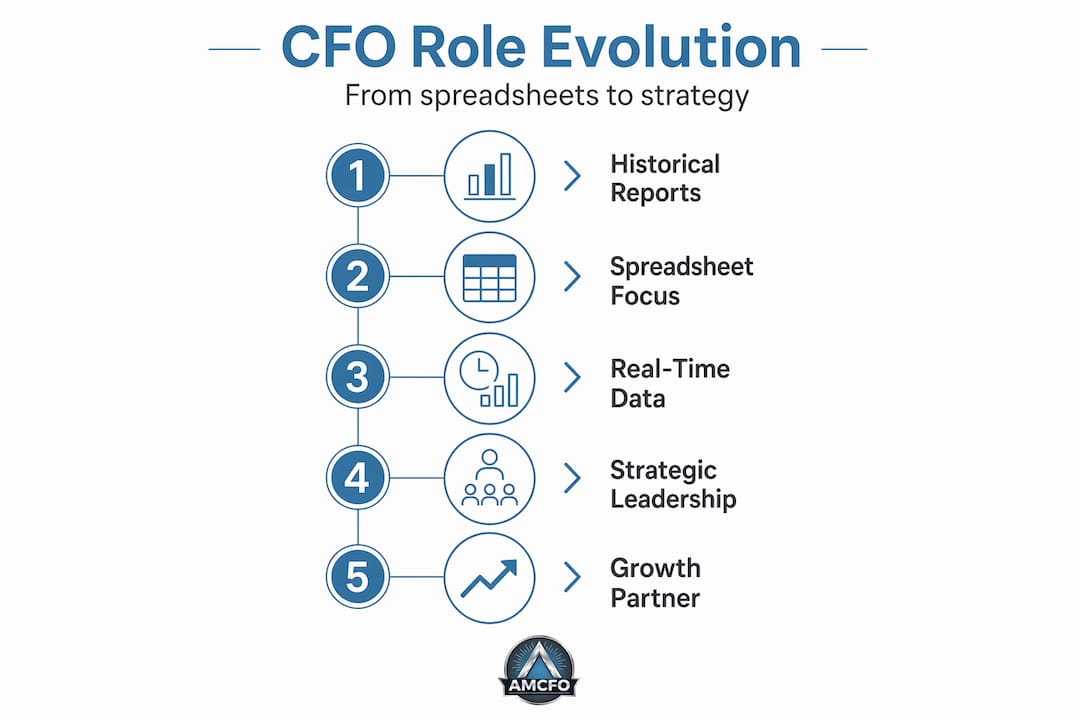
The CFO of ten years ago worked primarily with spreadsheets and historical reports. Today, the role looks significantly different, and that shift directly benefits small businesses that engage CFO-level talent.

Modern CFOs integrate emerging technology including AI-powered analytics and real-time financial dashboards into daily financial leadership. Instead of waiting for a month-end close, you get live visibility into margins, cash, and performance. That speed changes how decisions get made.
Beyond technology, the modern CFO has become a true strategic partner to the CEO and leadership team. Here is where that shows up practically:
- Data-driven decision making. CFOs translate financial data into clear recommendations. Should you hire two salespeople or invest in automation? A CFO models the payback period on both.
- Cross-functional collaboration. A CFO works with operations, sales, and HR to align spending with results. Financial management in small business is not a back-office function anymore.
- Organizational change and culture. Modern CFOs act as catalysts for change, connecting financial discipline with operational behavior across teams.
- Investor and lender communication. A CFO frames your financial story for external audiences, whether that is a bank, a private equity firm, or an angel investor.
"The CFO's most valuable contribution is not the report itself. It is the conversation it creates between finance and every other part of the business."
This evolution matters for small business owners because it means the CFO role in startups and growing firms is no longer just about keeping score. It is about building the financial infrastructure that makes growth sustainable and fundable.
Full-time vs. fractional vs. outsourced CFO
For most small businesses, the question is not whether to get CFO expertise. The question is how to structure that engagement. The three main options each fit different stages and budgets.
| CFO Type | Annual Cost | Best For | Scope |
|---|---|---|---|
| Full-time CFO | $200,000–$400,000+ | $10M+ revenue businesses | All financial leadership functions |
| Fractional CFO | $30,000–$80,000 | $1M–$10M revenue businesses | Strategic finance, part-time hours |
| Outsourced CFO | $15,000–$50,000 | Startups and lean growth stage | Project-based or monthly retainer |
The numbers tell a clear story. Fractional CFOs save businesses $180,000 to $280,000 annually compared to full-time hires, while delivering the same level of strategic expertise. For a business doing $2M to $5M in revenue, that savings funds an entire marketing campaign or product development cycle.
Outsourced CFO services deliver improved cash flow, better margin management, and disciplined growth planning at a fraction of full-time cost. The flexibility is the real advantage. You get senior expertise on the problems that matter most, without carrying a six-figure salary through slower quarters.
Timing also matters significantly for fundraising. Hiring a fractional CFO between $1.5M and $3M ARR dramatically improves fundraising outcomes. Proactive engagement 6 to 9 months before a round improves valuation and deal closure by 30 to 40 percent. That is not a trivial number when you are negotiating with investors.
Pro Tip: If you are approaching a fundraising round, a major loan, or a significant acquisition, engage a fractional CFO at least two quarters in advance. Read our fractional CFO hiring guide to understand the right timing for your stage.
For a deeper look at how these service models compare, explore what outsourced CFO services can offer your business specifically.
How to put CFO expertise to work in your business
You do not need to hire a CFO tomorrow to start benefiting from CFO-level thinking. Here is a practical sequence that moves you from financial confusion to financial clarity.
- Diagnose your reporting lag. How long after month-end do you get a P&L? If it is more than ten business days, your first priority is fixing the close process before anything else.
- Build a 13-week cash flow forecast. This single tool eliminates most small business cash crises. A CFO creates it; your bookkeeper or controller maintains it.
- Identify your three biggest financial risks. Not hypothetical ones. Real risks: a client that represents 40 percent of revenue, a debt covenant with thin headroom, a payroll cycle that strains your account every two weeks.
- Clean up your financial systems before engagement. A CFO cannot do strategic work on top of messy books. Accurate financial reporting is the foundation any CFO needs before they can build a financial strategy.
- Assess fundraising readiness. If you plan to raise capital in the next 12 to 18 months, a CFO should structure your financials, KPIs, and projections now so investors see a credible story rather than a rough estimate.
The CFO impact on profitability becomes visible quickly once these systems are in place. Owners often report that within 90 days of engaging a CFO, they understand their margins for the first time, identify at least one major cost leak, and feel confident walking into their next banker or investor meeting. That shift from uncertainty to confidence is what strategic financial guidance actually produces in practice.
Signs you likely need CFO involvement now: you are growing but not becoming more profitable, your cash flow does not match your revenue, you are making major decisions based on your bank balance rather than a financial model, or you are planning to raise money in the next two years.
My take on why small businesses underinvest here
I have worked with dozens of small business owners over the years, and the pattern is almost always the same. They invest heavily in marketing, sales, and product while treating financial leadership as an afterthought. The mindset is usually something like "we will get a real CFO when we are bigger." That thinking gets the sequence exactly backwards.
In my experience, the businesses that scale well almost always had rigorous financial discipline before the growth happened, not after. A CFO does not just manage money. They protect decisions. And hiring is often more cost-effective than financial mismanagement by less-qualified leaders. I have seen owners lose more in one bad capital allocation decision than a fractional CFO would have cost them for three years of service.
The other thing I have learned is that CFO duties for small firms are not just about the numbers. They are about giving the owner confidence. When you know your runway, understand your margins, and have a model for the next 12 months, you make better decisions in every part of the business. That clarity is what I think most owners are actually looking for when they say they want to "get control of their finances."
Start before you think you are ready. The financial infrastructure a CFO builds becomes more valuable the longer it is in place.
— Angelica
Ready to add CFO-level thinking to your business?
At Amcfo, we work with small businesses that are tired of flying blind financially. Whether you need help getting your books clean, building a cash flow forecast, or preparing for your next funding round, our team brings senior financial expertise to the table without the full-time price tag.

Explore our fractional CFO services to see how we tailor financial leadership to businesses at your stage. We also offer accounting and bookkeeping and financial management and planning for owners who want a complete financial foundation. If you are ready to stop guessing and start growing with real financial clarity, we would love to talk.
FAQ
What does a CFO do in a small business?
A CFO in a small business manages financial strategy, cash flow forecasting, risk modeling, and capital structure decisions. Unlike a bookkeeper or accountant, the CFO's focus is on using financial data to drive better business decisions and growth outcomes.
When should a small business hire a CFO?
Most small businesses benefit from CFO expertise between $1M and $3M in annual revenue, and especially 6 to 9 months before a fundraising round. Fractional or outsourced CFOs make this accessible at early stages without requiring a full-time hire.
What is the difference between a fractional and a full-time CFO?
A fractional CFO provides the same strategic expertise as a full-time CFO but works part-time or on retainer, at a fraction of the cost. Businesses typically save $180,000 to $280,000 per year by choosing fractional over full-time.
How does a CFO improve profitability?
A CFO improves profitability by identifying cost leaks, improving pricing strategy, analyzing margin by product or service line, and ensuring capital is allocated to the highest-return activities. Most owners see clearer margin visibility within the first 90 days of CFO engagement.
Can a small business afford a CFO?
Yes. Fractional and outsourced CFO services start well below the cost of a full-time hire, with annual costs often ranging from $15,000 to $80,000 depending on engagement scope. For most small businesses, the return on that investment through better decisions and avoided mistakes is substantial.