

Sales tax nexus exists the moment your business has enough connection to a state, either through revenue and transaction volume or through a physical footprint, that the state can legally require you to collect its sales tax. Two triggers matter most: crossing an economic threshold (commonly $100,000 in sales) or having a physical presence like an office, employee, or warehoused inventory. Once either happens, track your sales by ship-to state immediately and prepare to register before the state notices first.
TL;DR:
- Most states use a $100,000 annual sales threshold for economic nexus, but California, New York, and Texas set it at $500,000, while Alabama and Mississippi are at $250,000.
- Physical nexus can occur instantly through inventory in third-party warehouses, remote employees, trade shows, or leased spaces, regardless of revenue size.
- States increasingly rely solely on dollar thresholds, with some removing transaction count requirements and varying measurement periods (rolling, calendar, or current year).
- Marketplace sales count toward nexus in some states like California, Hawaii, and Michigan, even if platforms collect sales tax on behalf of sellers.
- Regular, rolling 12-month ship-to-level sales reports and proactive registration help prevent retroactive tax assessments and penalties.
Table of Contents
- What Is Sales Tax Nexus and What Are the Main Types?
- How Do Economic Nexus Thresholds Vary by State?
- How Does Physical Presence Create Nexus?
- What Should You Do After Crossing a Nexus Threshold?
- What Mistakes Cause the Most Nexus Compliance Problems?
- How Do Sourcing Rules Affect Sales Tax Once Nexus Applies?
- Are There Any Nexus Exceptions or Safe Harbors?
- What Are the Penalties for Ignoring Sales Tax Nexus?
- How AmCFO Helps Businesses Manage Multistate Nexus Risk
- Get a Nexus Review Before a State Finds You First
- Where to Verify State-Specific Nexus Rules
- The Case for Treating Nexus as an Ongoing Process, Not a One-Time Check
- Sources
- FAQ
What Is Sales Tax Nexus and What Are the Main Types?
Sales tax nexus is the legal threshold that lets a state force an out-of-state business to collect and remit its sales tax. Before 2018, nexus required a physical foothold in a state. That changed with South Dakota v. Wayfair, the Supreme Court decision that let states impose tax-collection duties on sellers based purely on economic activity, even with zero physical presence. Every state's economic nexus law traces back to that ruling.
Nexus shows up in a few distinct flavors, and mixing them up is where most compliance gaps start.
- Economic nexus kicks in once you cross a state's dollar or transaction threshold, typically $100,000 in sales measured over a rolling or annual period, sometimes paired with a transaction count.
- Physical nexus is triggered by a tangible presence: a leased office, inventory sitting in a warehouse, an employee working remotely from that state, or even a temporary trade show booth.
- Affiliate nexus applies when a related business entity in a state (a subsidiary, a commonly owned company) performs activities that benefit your sales there.
- Click-through nexus covers referral arrangements, where an in-state website or affiliate sends traffic to your store in exchange for a commission, and the volume of that referred business crosses a state-set threshold.
- Marketplace facilitator nexus shifts the collection duty to platforms like Amazon or Etsy for sales made through their marketplace, though it does not always erase your own registration obligations as a seller.
A Stripe guide to nexus puts it plainly: physical presence, whether it is a warehouse lease or a single W-2 employee, usually creates an immediate registration duty regardless of how much you actually sold in that state. Economic nexus is about volume. Physical nexus is about footprint. You can trigger either one independently, and plenty of growing businesses trip both at once without realizing it.
How Do Economic Nexus Thresholds Vary by State?
Most states settled on the same rough number: $100,000 in annual sales into that state. That figure has become the de facto national baseline, largely because it is the threshold South Dakota itself used in the law the Supreme Court upheld. But "most states" is not "all states," and the exceptions matter more than they get credit for.
The high-threshold outliers. California, New York, and Texas set their bar at $500,000, a five-fold jump from the baseline that lets mid-size sellers do meaningful business in those states without tripping nexus. New York adds a second condition: you need both $500,000 in sales and 100 separate transactions to register, according to the state's own tax guidance. Miss either prong and you are not yet obligated, even if you clear the other by a wide margin.
Alabama and Mississippi sit in the middle at $250,000, according to Stripe's state-by-state nexus guide. And then there is the group of states where none of this applies at all: New Hampshire, Oregon, Montana, Alaska, and Delaware, often nicknamed the NOMAD states, have no statewide sales tax to trigger in the first place. Alaska is a partial exception since some local jurisdictions there do impose sales tax independently.
Threshold snapshot: $100,000 is the most common economic nexus trigger nationally, but California, New York, and Texas set it at $500,000, while Alabama and Mississippi land at $250,000, based on Stripe's nexus research.
Transaction counts are disappearing. Many states originally paired the dollar threshold with a 200-transaction test, meaning you could trigger nexus by volume alone even with modest revenue. That is changing. Several states have quietly dropped the transaction prong in recent years, leaving the dollar figure as the sole trigger, according to Nexus Rules' threshold tracker. If you are relying on an old spreadsheet of state rules from a few years back, this is exactly the kind of change that slips through.
Measurement periods change everything. States do not agree on how to count the clock:
- Some use a rolling 12-month window, meaning any trailing year could trigger nexus, checked continuously rather than on a fixed date.
- Others use the prior calendar year, so this year's obligation is set by last year's sales.
- A few use the current calendar year, tracking January through December in real time.
This distinction sounds technical until it costs you money. A business using calendar-year totals might report "we're under $100,000 for 2026" while a rolling 12-month calculation, spanning say July 2025 through June 2026, already cleared the threshold months earlier. States that use rolling windows do not care what your fiscal calendar says.
Marketplace sales add another wrinkle. Most states exclude marketplace-facilitated sales (Amazon, Walmart Marketplace, Etsy) from your own threshold count, since the platform is already collecting on those transactions. But not every state plays by that rule. California, Hawaii, and Michigan are examples where marketplace sales still count toward your seller-level threshold, per Avalara's nexus law guide. A seller doing $80,000 in direct sales and $40,000 through Amazon could be well under the radar in most states but already over the line in one of these three.
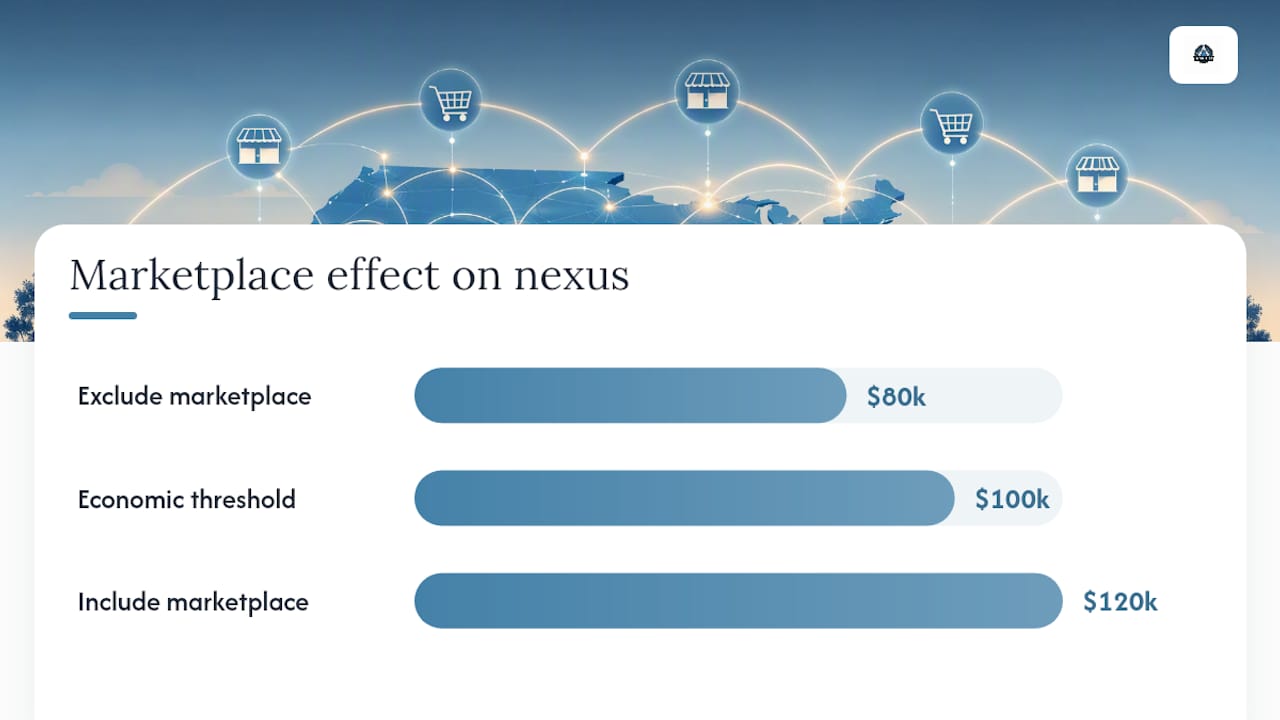
Sellers with meaningful revenue running through fulfillment networks should treat this as a live monitoring item, not a one-time check. Growing retailers should watch both ends of the threshold spectrum as expansion shifts which states matter most.
How Does Physical Presence Create Nexus?
Physical nexus does not care about revenue. A single qualifying connection to a state, no matter how small, can trigger an obligation to register on day one.
- Inventory in a third-party warehouse. If you use Fulfillment by Amazon or any 3PL provider, your inventory sitting in their warehouse usually counts as your physical presence in that state, according to Stripe's nexus guide. Amazon has fulfillment centers in dozens of states, and sellers using FBA's automated inventory placement often have stock scattered across states they have never visited.
- Remote employees and contractors. One employee working from their home in another state can be enough. This is increasingly common with distributed teams, and it intersects directly with payroll obligations in that state as well, since a single remote hire can create both tax nexus and payroll registration duties simultaneously.
- Trade shows and temporary events. A few days at a convention booth can qualify as physical presence in some states, particularly if you take orders or make sales on-site. States vary in how many days of activity they consider "temporary" versus nexus-creating, so a recurring annual trade show circuit deserves its own review.
- Leased offices, showrooms, or storage. The obvious case, but worth stating: any leased or owned space used for business operations counts, even a small satellite office or a shared workspace membership.
Quick self-test for finance teams: do you have inventory stored outside your home state through any fulfillment partner? Do you have any remote employee or 1099 contractor working from a different state? Have you attended a trade show or pop-up event outside your home state in the last 12 months? A "yes" to any of these means you likely have physical nexus somewhere, independent of what your revenue reports show.
What Should You Do After Crossing a Nexus Threshold?
The sequence matters. Skipping ahead (collecting before you register, for instance) creates its own compliance headaches, so work through these in order.
- Detect. Run rolling 12-month reports broken out by ship-to state, not billing address, and fold marketplace sales into the count where the state requires it. This is the single control most likely to catch a nexus event before the state does.
- Register. Most states expect timely registration after crossing a threshold. Wait longer than that and you risk the state treating your obligation as retroactive to the actual crossing date, not your registration date. Register directly through the state's Department of Revenue portal; New York's process, for example, is detailed on the state's own DTF nexus page.
- Collect. Once registered, apply the combined state and local rate based on the customer's ship-to address, and start collection at checkout from your effective registration date forward, not retroactively on old orders.
- File. Filing frequency (monthly, quarterly, or annual) is usually assigned by the state based on your sales volume at registration. Miss a filing deadline and most states apply interest immediately, with penalties layering on for sustained late remittance.
That buffer gives you time to register before you are legally required to, instead of scrambling after the fact.*
The registration window is the part sellers underestimate most. A state does not need you to have registered late to assess back tax; it only needs proof you crossed the threshold on a specific date. That is why detection has to happen continuously, not annually.
What Mistakes Cause the Most Nexus Compliance Problems?
The same handful of errors show up again and again in multistate sales tax reviews, and nearly all of them trace back to how the business tracks' data, not a lack of tax knowledge.
- Calendar-year-only tracking. Businesses that only check thresholds each December miss the mid-year crossings that rolling windows catch. By the time the calendar year ends, months of taxable sales may have gone uncollected.
- Ignoring marketplace sales in states that count them. As covered above, California, Hawaii, and Michigan count marketplace revenue toward your seller threshold. Facilitator collection doesn't always remove your own exposure, and this exact gap causes a large share of nexus surprises for sellers who assume Amazon "handles it."
- Skipping exempt-sale documentation. Some states require you to count exempt or wholesale sales toward the threshold calculation even though you never collected tax on them. Leaving those out of your tracker understates your real exposure.
- No reconciliation between platforms. A business selling through its own site, Amazon, and Shopify needs one consolidated report, not three disconnected ones.
Building the right controls starts with a single rolling 12-month report broken out by ship-to state, refreshed monthly rather than annually. Layer in a transaction count log if any state you sell into still uses that prong, and reconcile marketplace statements against your internal sales data quarterly. Rate engines and tax-transaction logging tools can automate a lot of this, but someone inside the business, usually the controller or outsourced bookkeeper, needs to own the process end to end rather than leaving it to whoever remembers to check.
When the state count grows past four or five, or when 3PL expansion adds new warehouse states faster than your team can research them, that is usually the signal to bring in a dedicated accounting resource rather than trying to manage it with a shared spreadsheet.
How Do Sourcing Rules Affect Sales Tax Once Nexus Applies?
Once nexus exists, the next question is which tax rate applies, and that comes down to sourcing rules. Most states use destination sourcing, meaning you charge the rate that applies at your customer's ship-to address, combining the state rate with any applicable county, city, or special district rates. A handful of states still use origin sourcing, where the rate is based on where the sale originates from within your business, but destination sourcing is now the dominant model nationally.
This distinction matters most for businesses selling into states with heavy local-rate variation, like Texas or Colorado, where the same state-level rate can produce a very different total once city and district add-ons stack on top. A ship-to address in one zip code might carry a materially different combined rate than a neighboring one just a few miles away.
Digital products and services complicate sourcing further. Many states tax physical goods but treat software-as-a-service, digital downloads, or streaming access differently, sometimes taxing them fully, sometimes partially, and sometimes not at all. A business selling both physical inventory and a digital subscription product needs to check sourcing and taxability separately for each category rather than assuming one rate applies across the board. There is no substitute here for checking the specific state's guidance on your exact product type before you configure your checkout tax settings.
Are There Any Nexus Exceptions or Safe Harbors?
A few states build in relief valves for smaller or occasional sellers, though they are narrower than most people assume.
Small-seller exceptions typically apply only below a state's stated economic threshold in the first place, meaning a business under $100,000 (or whatever that state's figure is) simply never triggers economic nexus and needs no exception at all. Some states also offer a limited safe harbor for occasional or isolated sales, such as a single one-off transaction or infrequent sales unconnected to regular business activity, though the bar for qualifying is narrow and state-specific.
Trade show and temporary-presence rules sometimes function as a soft safe harbor too. A handful of states will not treat a few days of trade show attendance as nexus-creating if no in-state inventory or ongoing presence follows, though the exact day count and conditions vary by state and are not something to assume without checking that state's own guidance directly.
The more reliable path is not hunting for exceptions but understanding your state's specific threshold and measurement window well enough to know you are genuinely under it. Safe harbors exist, but they cover edge cases, not general relief for growing multistate sellers. If your sales are climbing, plan for eventual nexus rather than banking on an exception to keep you clear indefinitely.
What Are the Penalties for Ignoring Sales Tax Nexus?
States do not wait for you to notice you owe them money. Once a state determines you crossed its threshold on a specific date, back taxes can be assessed retroactive to that date, not the date you eventually registered, according to Nexus Rules' compliance research. That gap, sometimes stretching back a year or more, is where the real financial damage happens.
Interest accrues on unpaid amounts from the original due date forward, and most states layer penalties on top for late filing and late payment separately, meaning a single missed registration can generate two distinct penalty categories before interest is even calculated. Audit risk climbs the longer a business operates unregistered in a state where it clearly has nexus, since marketplace facilitator reporting and third-party data sharing between states have made it easier for revenue departments to spot sellers who should have registered but didn't.
The businesses that get hit hardest are usually not the ones evading tax deliberately. They are the ones that grew fast, expanded into a few new fulfillment states, and simply never built a system to track it. Reconciling marketplace statements against your own sales records and running rolling reports monthly, rather than annually, is the single most effective way to catch a crossing before the state does. Catching it late still means paying what you owe. Catching it early means paying it without the interest and penalty stack on top.
How AmCFO Helps Businesses Manage Multistate Nexus Risk
Nexus risk rarely announces itself. It shows up quietly, an FBA inventory expansion into a new state, a remote hire in a state you have never registered in, or a sales quarter that quietly crossed $100,000 without anyone checking. Bookkeeping and QuickBooks cleanup work provides finance teams the clean, ship-to-level sales data that rolling nexus tracking actually requires, since messy books make threshold detection nearly impossible.
For businesses expanding into new fulfillment regions, adding remote payroll, or facing a state inquiry after years of unregistered sales, Tax coordination and fractional CFO consulting bring the same structure that larger companies use to manage multistate exposure. That includes coordinating registration timing, reconciling marketplace statements, and building the reporting cadence that catches a crossing months before a state notices it.
Get a Nexus Review Before a State Finds You First
Growing businesses gain more than a spreadsheet can offer: a bookkeeping and tax coordination system built specifically to catch nexus crossings before they turn into back-tax bills. Instead of discovering a multistate obligation from a state notice, you get rolling sales visibility and a clear path to registration, collection, and filing, handled by people who do this daily rather than once a year at tax time.

If your business ships to multiple states, sells through a marketplace, or has added any remote hires or 3PL inventory in the past year, that is the moment to check your exposure rather than wait for a letter from a state Department of Revenue. Amcfo's accounting and bookkeeping services build the ship-to-level reporting nexus tracking depends on, while the fractional CFO services team can walk through registration timing and multistate filing cadence with you directly. Businesses that have already crossed a threshold without registering may also want a closer look through forensic accounting to quantify exposure before a state does it for you.
Once you've registered in a new state, entity and formation questions often follow. Bright Capital America covers the incorporation side if your growth requires a new entity structure alongside your expanded nexus footprint.
Book a nexus review to get a clear answer on where you stand before your next filing deadline arrives.
Where to Verify State-Specific Nexus Rules
Thresholds, measurement periods, and marketplace counting rules change by state and by year, so treat any third-party summary, including this one, as a starting point rather than a final answer.
- New York State Department of Taxation and Finance for that state's specific registration steps and dual $500,000/100-transaction test.
- Stripe's nexus and sales tax law guides for a state-by-state threshold comparison and physical-presence definitions.
- Nexus Rules' threshold chart for measurement-period details and recent legislative changes across all 50 states.
- Avalara's nexus law guide for marketplace facilitator counting rules by state.
Always confirm the current threshold and measurement window directly on the relevant state Department of Revenue site before making a registration decision, since these figures do get revised.
The Case for Treating Nexus as an Ongoing Process, Not a One-Time Check
Most advice on sales tax nexus treats it like a single research task: look up your thresholds, confirm you are under them, move on. That framing is outdated the moment your sales channels or fulfillment footprint change, which for most growing businesses happens more often than annual tax planning accounts for.
The businesses that get burned are rarely ignoring the law. They are running calendar-year totals against a rolling-window requirement, or trusting that Amazon's marketplace collection means their own exposure is zero in every state, when three states explicitly say otherwise. Both mistakes come from treating nexus as a static fact rather than a moving number that needs monthly attention.
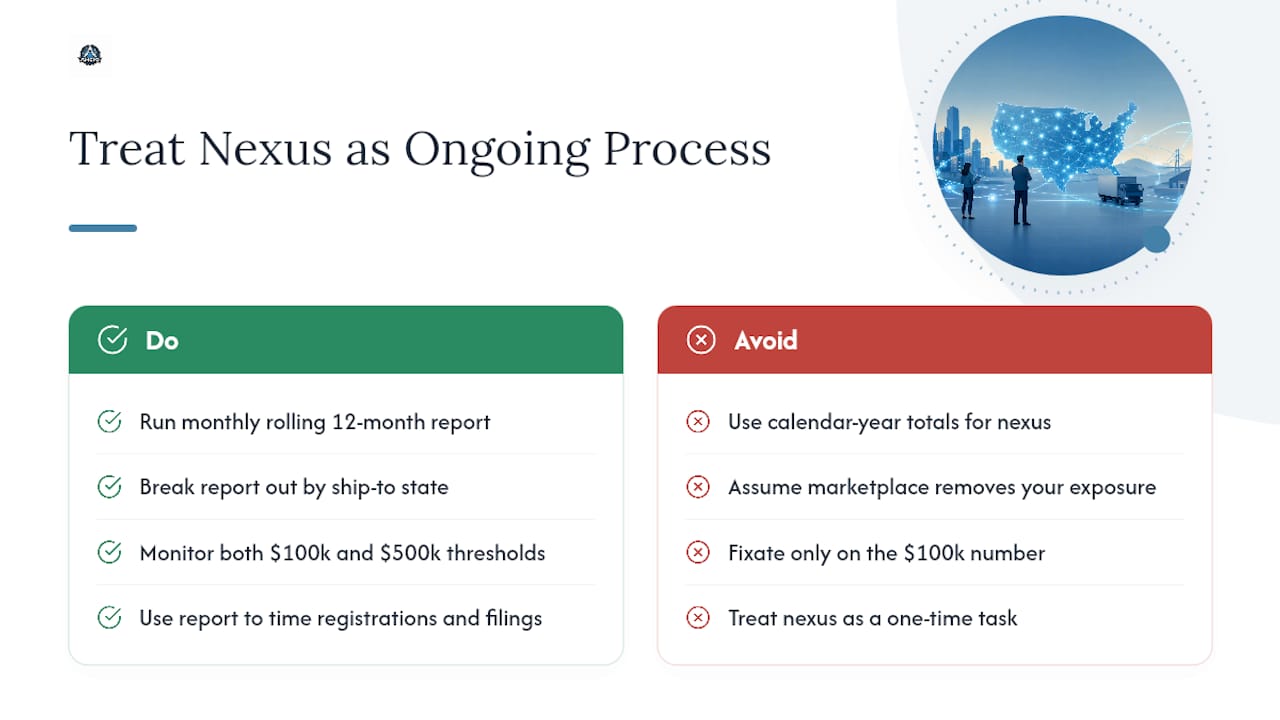
There is also a strange asymmetry in how sellers approach the $100,000 baseline versus the $500,000 outliers. Businesses fixate on the common threshold because it is the one everyone quotes, while the higher-threshold states get treated as an afterthought, exactly the states where a mid-size seller doing real volume is most likely to eventually cross the line without noticing. Watching both ends of that spectrum, not just the number everyone else talks about, is what separates businesses that register on time from the ones that get a retroactive assessment two years later.
If there is one habit worth building before anything else, it is the rolling 12-month report broken out by ship-to state. Everything else, registration timing, collection setup, filing cadence, follows naturally once that single number is trustworthy.
— Angelica
This article is general information, not a substitute for advice from a qualified financial advisor. Consult a qualified financial professional about your own circumstances before acting on anything here.
Sources
- Sales Tax Nexus Laws: A State-by-State Guide | Stripe
- A Guide to Nexus and Sales Tax Nexus | Stripe
- Sales Tax Economic Nexus by State: 2026 Threshold Chart (All 50) | Nexus Rules
- Sales Tax Nexus Laws - Free State-by-State Guide - Avalara
- Registration requirement for businesses with no physical presence in New York State | NY.gov
FAQ
What Is Sales Tax Nexus in the U.S.?
Sales tax nexus is the connection between a business and a state, established through economic activity (sales or transaction volume) or physical presence (offices, inventory, employees), that gives the state legal authority to require tax collection.
What States Have Sales Tax Nexus Laws?
Every state that imposes a statewide sales tax has economic nexus laws following the South Dakota v. Wayfair precedent; only New Hampshire, Oregon, Montana, Alaska, and Delaware have no statewide sales tax to trigger.
What Are the Nexus Rules for Economic Thresholds?
Most states set the threshold at $100,000 in annual sales, though California, New York, and Texas require $500,000, and New York additionally requires 100 separate transactions alongside its dollar figure.
What Creates Nexus in a Transaction?
A single transaction rarely creates nexus on its own; nexus builds through cumulative sales crossing a state's economic threshold, or through a physical connection like inventory stored in that state or an employee working there.
Does Selling Through a Marketplace Remove My Nexus Obligations?
Not always. Marketplace facilitators collect tax on their platform sales in nearly every state, but California, Hawaii, and Michigan still count those marketplace sales toward your own seller-level threshold.