

If your company designs, builds, or improves a product, process, or piece of software and runs into technical uncertainty along the way, you likely qualify for the federal R&D tax credit. It's a dollar-for-dollar reduction of your federal tax bill, and if you're a qualified small business, you can apply a portion of it against payroll taxes instead. The immediate move: list the projects from the last year that involved real trial and error, then start pulling together the wage, contract, and supply records tied to them.
TL;DR:
- Most companies with engineering or operational teams conducting experimentation may qualify for the R&D tax credit, even if they overlook it.
- The best method for claiming the credit is usually the simplified option for younger or rapidly growing firms, avoiding complex historical calculations.
- Documented, systematic experimentation with clear hypotheses, test plans, and recorded results is essential for audit defense.
- Companies should review the impact of the 2026 expensing rules and their choice between basis reduction or reduced credit when claiming the credit.
- Coordinating federal and state R&D claims requires detailed project-level records and awareness of each state's specific qualification rules and caps.
Table of Contents
- What the R&D Tax Credit Covers and Who Qualifies
- The IRS Four-Part Test Explained
- What Counts as a Qualified Research Expense
- Regular Credit vs. Alternative Simplified Credit
- How to Claim the Credit: Form 6765 and the Payroll Election
- Documentation and Audit Readiness
- Recent Law Changes and the §280C Decision
- State R&D Credits and Coordinating Both Claims
- Common Mistakes and a Quick Pre-Filing Checklist
- How AmCFO Approaches R&D Credit Preparation for Clients
- What the Research Actually Supports
- Get Your R&D Documentation Audit Ready Before You File
- Where to Verify the Rules Yourself
- Sources
What the R&D Tax Credit Covers and Who Qualifies
The federal research and development tax credit lives in IRC §41 of the tax code, and it's worth understanding the distinction between a credit and a deduction before anything else. A deduction lowers taxable income. A credit lowers the tax bill itself, dollar for dollar. That difference is why the R&D credit tends to be worth far more than a similarly sized deduction, and why it's routinely one of the largest federal tax incentives a mid-size company can claim.
Most owners assume this credit belongs to pharmaceutical labs and chip designers. It doesn't. The eligible activities show up across a much wider swath of the economy:
- Software companies building new features, refactoring architecture, or solving performance bottlenecks
- Manufacturers developing new tooling, testing material substitutes, or improving a production line
- Food and beverage companies reformulating recipes for shelf stability, allergen removal, or new processing methods
- Professional and technical service firms building proprietary internal tools or automation
- Construction and engineering firms solving site-specific design or structural problems
A quick reality check: many businesses that write off R&D credits as "not for us" have qualifying work happening in their engineering or ops teams right now. It just doesn't get labeled "research" internally.
The credit also now interacts differently with expensing rules than it did a few years ago. Legislative changes restore immediate expensing of domestic research costs starting in 2026, a shift that the Congressional Research Service's analysis of the federal R&D credit walks through in detail. That means companies can once again deduct qualifying R&D costs in the year incurred rather than amortizing them over five years, which changes the math on how much net benefit the credit actually delivers when layered on top of the deduction. More on that trade-off later, because it affects a real election you'll need to make on your return.
The IRS Four-Part Test Explained
Every project, and really every business component within a project, has to clear four hurdles to generate qualified research expenses. The IRS lays these out plainly in the Form 6765 instructions, and they apply at the level of the specific product, process, formula, or software you're improving, not your company as a whole.
- Permitted purpose (business component test). The activity has to aim at creating or improving a product, process, technique, formula, invention, or software, and that improvement has to relate to function, performance, reliability, or quality, not just looks or ease of use.
- Technological in nature. The work has to rely on principles of physical science, biological science, engineering, or computer science. Marketing research, surveys, and management studies fail this test outright.
- Elimination of uncertainty. At the outset, you genuinely don't know whether you can achieve the result, or you don't know the right method or design to get there. If your engineers already know the answer and are just executing, there's no uncertainty to eliminate.
- Process of experimentation. You have to evaluate one or more alternatives through modeling, simulation, systematic trial and error, or other testing methods to resolve that uncertainty.
Here's where a lot of companies trip up: the IRS doesn't require every single task on a project to pass all four parts. It applies a "substantially all" standard, generally interpreted as 80% or more of the research activities measured by cost, and evaluates that at the business component level rather than across an entire department or product line.
Qualifying work tends to look like:
- Prototyping a new hardware design and testing multiple material configurations
- Writing and testing new algorithms where the outcome isn't a foregone conclusion
- Running failed and successful iterations of a manufacturing process to hit a tolerance spec
- Developing new formulations that require lab testing against a technical standard
Common exclusions include routine data collection, quality control testing after the design is finalized, market research, adapting an existing product for a specific customer with no technical uncertainty, and research conducted after commercial production has already begun.
Pro Tip: Practitioners consistently flag "process of experimentation" as the requirement companies misunderstand most. Informal trial and error doesn't cut it. You need a documented, systematic method: a hypothesis, a test plan, recorded results, and iteration based on those results. Write that process down as you go, not after the fact.
What Counts as a Qualified Research Expense
Once a project clears the four-part test, you need to know which costs actually count toward the credit. Qualified research expenses fall into three buckets, and the rules governing each one are more specific than most business owners expect.
- Wages. You can include W-2 wages for employees who directly perform, directly supervise, or directly support qualified research. The catch is allocation: if an engineer spends 60% of her time on qualifying development work, and 40% on client support calls, only that 60% counts. Time tracking, even a simple percentage estimate backed by project records, is what makes this defensible.
- Supplies. Tangible property used in the research counts, but it excludes capital items and anything subject to depreciation. A 3D-printed prototype part qualifies; the 3D printer itself does not.
- Cloud and computer costs. Revenue Procedure 2023-11 clarified that cloud computing and hosting costs used to run qualified research, think server time for training a model or testing software builds, can be treated as supply-like QREs when directly tied to the research.
- Contract research. Payments to a third party for research performed on your behalf count, but only at a percentage of the amount paid. Generally you can include 65% of contract research payments, rising to 75% for qualified research consortium payments, and only when your company retains substantial rights to the results and bears the financial risk if the research fails.
That contract research rule catches a lot of companies off guard. If you outsource development to a firm but the contract gives that firm ownership of what gets built, or if you only pay on successful delivery with no risk on your end, the payments may not qualify at all regardless of how technical the work was.
Getting the allocation right on wages is usually where the real credit value sits, since payroll tends to dwarf supply and contract costs for most claimants. That also means weak time-tracking is the single easiest way to lose credit value later, a point worth remembering before you get to the documentation section below.
Regular Credit vs. Alternative Simplified Credit
You have two ways to calculate the federal credit, and picking the wrong one leaves money on the table more often than people realize.
The regular research credit (RRC) is 20% of qualified research expenses above a base amount tied to your historical research spending as a percentage of gross receipts, going back to a fixed-base period. It can produce a larger credit for companies with a long history of R&D spending relative to revenue, but the base-period calculation gets complicated fast, especially for companies that have grown quickly or changed structure.
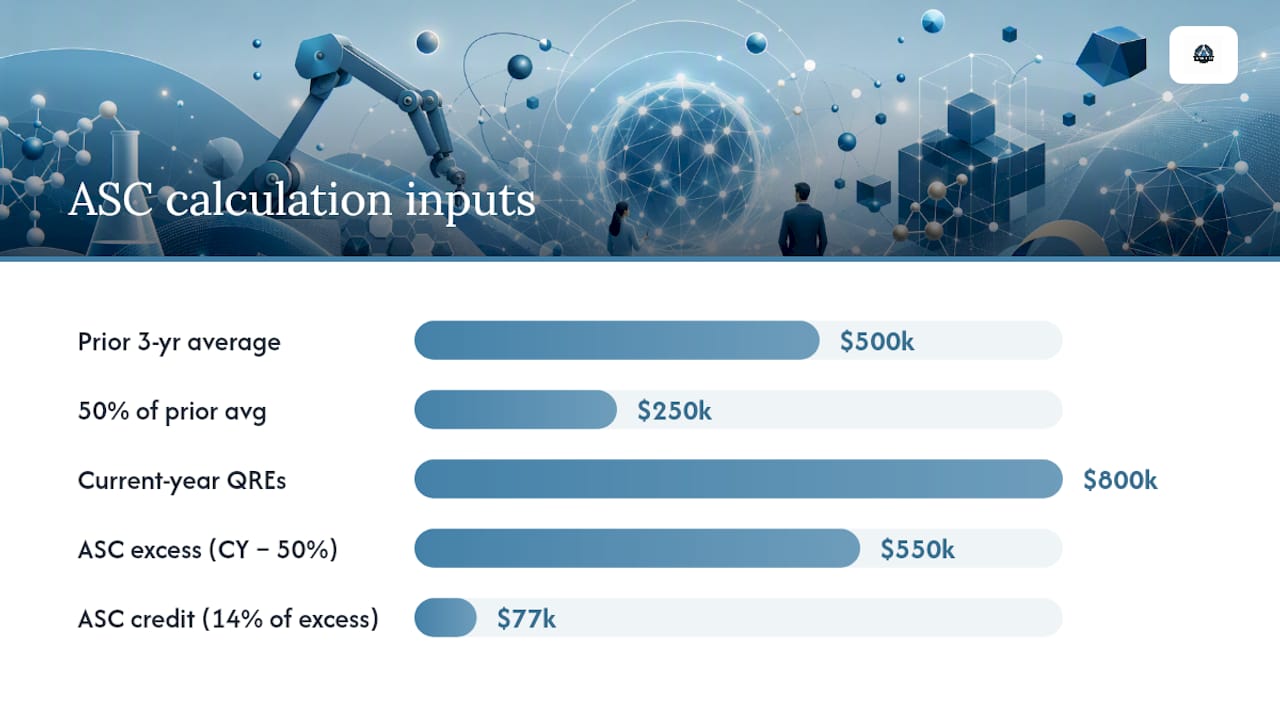
The alternative simplified credit (ASC) is 14% of the excess of current-year QREs over 50% of the average QREs for the prior three years. If you had no QREs in any of the prior three years, the ASC drops to a flat 6% of current-year QREs. IRC §41 governs both methods and the associated definitions.
| Factor | Regular credit (RRC) | Alternative simplified credit (ASC) |
|---|---|---|
| Rate | 20% of QREs over base amount | 14% of QREs over 50% of 3-year average (6% if no prior QREs) |
| Base calculation | Fixed-base percentage from historical data | Rolling 3-year average, no historical base-period math |
| Best fit | Long R&D history, stable revenue growth | Startups, fast-growing companies, first-time claimants |
| Complexity | Higher, requires historical gross receipts data | Lower, easier to compute and document |
Most first-time claimants and younger companies elect the ASC simply because it avoids reconstructing decades-old base-period figures that many companies never tracked in the first place. Practitioner guides on the credit note it's become the more commonly used method for exactly that reason.
Here's a simplified illustration. Say a software company spent $800,000 on QREs this year, with an average of $500,000 over the prior three years.
How to Claim the Credit: Form 6765 and the Payroll Election
Claiming the credit means filing Form 6765 with your federal return, and the form has gotten more detailed in recent years, particularly around Section G.
- Calculate your QREs and pick a method. Total your wage, supply, contract research, and cloud costs, then run the numbers under both the regular credit and the ASC to see which produces a larger benefit.
- Complete Section G if it applies. Section G asks for business component-level detail, and current instructions apply what's informally called the "80%/Top 50" rule: taxpayers generally list, in descending order of QRE size, the business components that together represent 80% of total QREs, up to a maximum of 50 components. This is where accurate project-level allocation from the four-part test analysis pays off.
- Attach supporting detail. Depending on your situation, that includes wage summaries by employee, contract research agreements, and a narrative tying each business component back to the technical uncertainty it resolved.
- File on time, or amend if you missed a prior year. The credit can be claimed on an original return or, in many cases, through an amended return or administrative adjustment request for open tax years.
For qualified small businesses (generally those with under $5 million in gross receipts and no gross receipts more than five years prior), there's a second path worth flagging separately: the payroll tax election. Instead of applying the credit against income tax you may not owe yet, qualified small businesses can elect to apply a portion of it annually against the employer share of Social Security tax.
- The election is made on Form 6765 and requires filing Form 8974 with your quarterly employment tax return.
- It's particularly valuable for pre-revenue or early-revenue startups that have real payroll tax liability but little or no income tax liability to offset.
- Unused regular credit amounts that aren't used against payroll tax carry forward up to 20 years, and can be carried back one year under general credit carryback rules, giving companies flexibility if a given year's credit outpaces that year's tax liability.
Documentation and Audit Readiness
The IRS's own audit techniques guide for the research credit is blunt about what examiners look for, and it's worth reading before you assume your existing records are sufficient. The guide emphasizes contemporaneous documentation created during the work, not reconstructed afterward, and it flags unsupported trial-and-error claims as a common weak point in denied claims.
Records that hold up under examination generally include:
- Project narratives written near the time the work happened, describing the technical uncertainty and how it was resolved
- Testing logs, design iteration records, and version history showing the experimentation process
- Time records or reasonable time allocation methodology tied to specific projects, not company-wide estimates
- Invoices and contracts for supplies and contract research, with language addressing risk and rights when contractors are involved
- A clear link between each technical narrative and the dollar figures claimed for that business component
That last point is where a lot of otherwise solid claims fall apart. It's not enough to have great engineering notes in one file and a spreadsheet of wages in another. An examiner wants to see the thread connecting a specific business component's technical story to the specific costs claimed against it.
Common audit red flags include vague, boilerplate project descriptions that could apply to any company; QRE totals that jump sharply year over year without a documented reason; and contract research claims where the underlying agreement doesn't clearly establish risk or retained rights. Building a tighter internal process for corporate tax planning around these records year-round, rather than scrambling each filing season, is the single biggest lever for reducing exposure.
Pro Tip: Set up a lightweight monthly habit: have technical leads write two or three sentences per project on what problem they were solving and what they tried. Six months of those notes is worth more in an audit than a single narrative written from memory the week before filing. For more on documenting technical methodology in a way examiners find credible, see this resource on how-to guides for technical documentation.

Recent Law Changes and the §280C Decision
The tax rules around R&D just shifted again, and the change affects how much net benefit you actually keep. According to the CRS report on the federal R&D credit, legislative changes restore immediate expensing of domestic research costs starting in 2026, reversing the five-year amortization requirement that had been in place. Basis adjustment rules tied to the credit are also restored starting in 2026.
Here's the practical effect: because you can't take a full deduction and a full credit on the same dollar of research spending, the tax code forces a choice.
- Option one: reduce your R&D deduction by the amount of the credit claimed (the standard basis adjustment under §280C), and take the full credit rate.
- Option two: make the §280C(c)(3) election to claim a reduced credit, calculated using the maximum corporate tax rate, and keep your full deduction intact.
Which option wins depends on your corporate tax rate and how large your QREs are relative to income. Companies with lower taxable income relative to R&D spend sometimes come out ahead accepting the deduction reduction; companies closer to the top corporate rate often prefer the reduced-credit election to simplify their return and avoid the basis adjustment mechanics altogether. Either way, this is a year-by-year election made on the return, not a permanent choice, so it deserves a fresh look each filing season, especially as the restored expensing rules change the baseline math starting in 2026. Working through the 2026 tax strategy considerations for your specific numbers before filing beats guessing which election is better.
State R&D Credits and Coordinating Both Claims
Most states with a corporate income tax also offer their own R&D credit, and treating the federal claim as the whole picture leaves real money unclaimed. State programs vary widely: some mirror the federal four-part test closely, others define qualifying activities more narrowly or broadly, and refundability differs a lot. Some states let a credit exceeding tax liability refund back to the company; others only allow carryforward against future liability.
Caps differ too. Several states apply annual caps on total credits issued statewide, meaning even a fully qualifying claim can get prorated if the state's allocation runs out.
To coordinate both claims without double-counting or creating inconsistent records:
- Use one master QRE workpaper that tags each expense by project and business component, then apply state-specific adjustments as a layer on top rather than starting from scratch
- Confirm whether your state requires a separate election form or certification, since some require pre-registration before the tax year even closes
- Check state-specific definitions of qualifying activities before assuming federal qualification guarantees state qualification
- Consult state tax authority guidance or local tax counsel for caps, refundability, and any credit transfer or sale provisions, since several states allow unused credits to be sold to other taxpayers
The bookkeeping discipline that supports a solid federal claim, clean project-level cost allocation, is exactly what makes layering a state claim on top manageable instead of a second full research effort.
Common Mistakes and a Quick Pre-Filing Checklist
The gap between a credit that survives an IRS review and one that gets challenged usually comes down to a handful of avoidable errors.
- Lumping non-qualifying work into a project's total. Including routine QA, post-launch bug fixes with no technical uncertainty, or administrative time inflates QREs and invites scrutiny on the whole claim, not just the inflated portion.
- Weak or after-the-fact time records. Reconstructing time allocation six months later from memory is far weaker evidence than contemporaneous logs, even simple ones.
- No clear link between technical narratives and dollar amounts. If your engineering docs and your cost spreadsheet don't reference the same business components by name, an examiner has no way to connect them.
- Ignoring the payroll election when it applies. Early-stage companies with real payroll tax liability but no income tax due sometimes skip the credit entirely, not realizing the QSB payroll offset exists specifically for their situation.
- Assuming a single year of eligibility. Startups sometimes discover R&D credit eligibility late. A lookback study covering the prior three open tax years can recover credits that were never claimed.
Pro Tip: If your qualifying activity is straightforward, one or two clearly defined engineering projects, in-house preparation with good records is often manageable. Once you're allocating costs across multiple business components, using contract researchers, or navigating the §280C election alongside restored expensing rules, bringing in outside tax and accounting support tends to pay for itself in both credit size and audit resilience.
How AmCFO Approaches R&D Credit Preparation for Clients
Turning the rules above into a defensible claim starts with mapping actual project work to specific business components, not guessing at categories after the fact. Amcfo works through a client's engineering and product timelines to identify which initiatives meet the four-part test, then builds the time-tracking structure needed to allocate wages accurately across qualifying and non-qualifying work.
From there, the work shifts to assembling the support Form 6765 actually requires: business component narratives, wage and contract research summaries, and the cost-to-narrative linkage examiners look for during a review. Clients typically see this play out in a few concrete ways: a larger federal refund than they expected because prior-year credits went unclaimed, meaningful payroll tax savings for a pre-revenue company electing the QSB offset, and a materially stronger position if the IRS ever asks questions about a filed year.
The fractional CFO services Amcfo provides fold R&D credit preparation into the broader picture of tax coordination and financial reporting, so the credit calculation isn't a once-a-year scramble disconnected from how the business tracks its numbers the rest of the year.
What the Research Actually Supports
Most advice on this topic treats the R&D credit as a math problem: pick a calculation method, apply a rate, done. That undersells the real risk, which is almost never the arithmetic. It's the documentation gap between what your team actually did and what your tax return claims they did. The IRS audit guide is explicit that trial-and-error without a documented method doesn't survive scrutiny, and that's precisely the part most companies skip.
The conventional advice also underweights timing. With expensing rules and basis adjustments both shifting starting in 2026, a §280C election that made sense last year may not make sense this year. Treating that election as a one-time decision rather than an annual recalculation is a quiet way to leave money on the table.
If you take one thing from this guide, make it this: build the documentation habit before you build the tax strategy. The credit calculation is the easy part once you have real records to calculate from.
— Angelica
Get Your R&D Documentation Audit Ready Before You File
A CPA can calculate your credit. What most firms can't do is fix the underlying bookkeeping that makes the calculation defensible in the first place, which is where a fractional CFO relationship pays for itself well beyond one filing season. Amcfo works alongside your existing tax preparer to clean up QuickBooks records, allocate wages accurately across projects, and build the cost-to-narrative documentation that holds up if the IRS ever asks questions.

Before a consult, pull together three things: a list of last year's technical or product projects, your payroll records by employee and project, and whatever informal notes your team already has on what problems each project solved. From there, Amcfo's accounting and bookkeeping team can clean up the financial data behind your claim, while the fractional CFO services team coordinates the credit strategy with your broader tax picture. If you suspect prior-year credits went unclaimed, a lookback review is worth a conversation. Get in touch with Amcfo to scope what a documentation-first R&D claim would look like for your business.
Where to Verify the Rules Yourself
Every figure and rule in this guide traces back to a primary source, and it's worth bookmarking these directly rather than relying on secondhand summaries:
- IRS Form 6765 instructions: the current filing requirements, including Section G's business component reporting rules.
- IRC §41, U.S. Code: the statutory definitions for qualified research, QREs, and both calculation methods.
- IRS Qualified Small Business payroll tax credit page: eligibility and mechanics for the $500,000 payroll offset.
- CRS report on the federal R&D tax credit: policy context, effective rates, and the 2026 expensing changes.
- IRS Audit Techniques Guide for the research credit: what examiners actually check during a review.
This article is general information, not a substitute for advice from a qualified financial advisor. Consult a qualified financial professional about your own circumstances before acting on anything here.
Sources
- Instructions for Form 6765 (12/2025) | Internal Revenue Service
- Qualified small business payroll tax credit for increasing research activities | Internal Revenue Service
- 26 USC 41: Credit for increasing research activities
- The Federal Research and Development (R&D) Tax Credit