

Setting financial goals for a business is the process of defining concrete, measurable objectives that guide your financial decisions and resource allocation. Without them, you are reacting to your finances instead of directing them. The industry term for this practice is business financial planning, and it covers everything from cash flow targets to profit margin benchmarks. Small and mid-sized business owners who treat goal setting as a formal process, not a mental note, make faster decisions, catch problems earlier, and grow with far less friction.
What are financial goals for a business and why should you set them?
Business financial goals are specific, measurable targets that define what your company needs to achieve financially within a set timeframe. They are not wishes or rough estimates. A goal like "grow revenue" is a wish. A goal like "increase monthly revenue by 15% by the end of Q4" is a financial objective you can track, assign, and act on.
Six core financial goal categories cover comprehensive business health: revenue growth, profit margin improvement, operational cost reduction, cash flow management, debt reduction, and growth investment. Each category addresses a different pressure point in your business. Covering all six prevents the common mistake of chasing revenue while ignoring margin erosion.

Financial goals matter because they force accountability. A deadline and a number create urgency. Without them, financial reviews become vague conversations about whether things feel better or worse. With them, you know exactly whether you hit the target or missed it, and by how much.
Here is what well-defined financial goals do for your business:
- Guide spending decisions. Every purchase or hire gets evaluated against your targets.
- Attract lenders and investors. Banks and investors want to see specific financial projections, not optimism.
- Motivate your team. Numbers give employees a concrete definition of success.
- Reveal problems early. Tracking against a goal surfaces a cash flow gap weeks before it becomes a crisis.
- Support tax and compliance planning. Profit targets inform estimated tax payments and year-end strategy.
What do you need before setting financial goals?
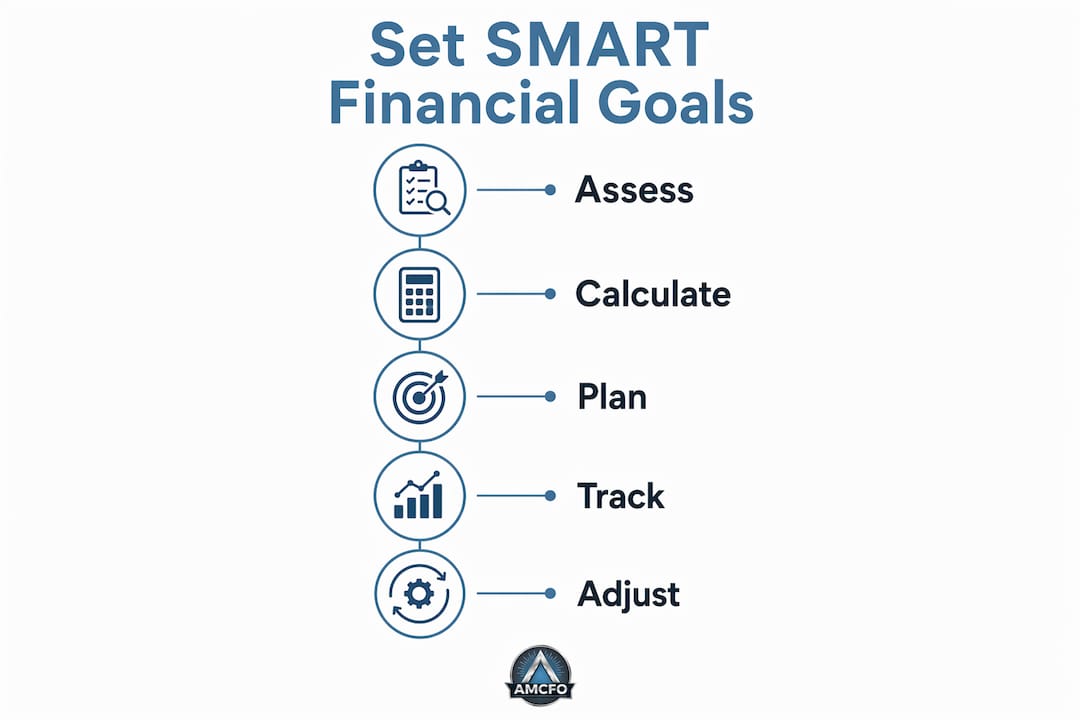
You cannot set realistic financial goals without knowing where you stand today. Start by pulling three core documents: your profit and loss statement, your balance sheet, and your cash flow statement. A solid financial plan requires all three, plus scenario analyses, to support accurate goal setting and forecasting. If any of these documents are missing or unreliable, fix your bookkeeping before you set a single target.
Next, calculate your key metrics. Know your net profit margin, your monthly burn rate, and your current cash reserve. These numbers tell you what is realistic. A business with a 5% net margin cannot responsibly set a goal of 20% margin in 90 days without a clear plan for cost reduction or pricing changes.
Pro Tip: Treat owner compensation as a fixed, pre-planned business cost before you set any other financial goal. Owner pay planned as a fixed expense creates sustainability and prevents the common trap of paying yourself whatever is left over at month end.
The table below shows the core financial documents and metrics you need before goal setting begins.
| Document or metric | What it tells you |
|---|---|
| Profit and loss statement | Revenue, expenses, and net profit over a period |
| Balance sheet | Assets, liabilities, and owner equity at a point in time |
| Cash flow statement | Actual cash moving in and out of the business |
| Net profit margin | How much of each revenue dollar becomes profit |
| Cash reserve level | How many months of expenses your current cash covers |
Once you have these numbers, you can set goals that are grounded in reality rather than ambition alone. Financial planning templates and tools like QuickBooks can help you organize this data and spot trends across months.
How to set SMART financial goals step by step
The SMART framework is the most widely used structure for turning vague financial intentions into clear objectives. SMART criteria stand for Specific, Measurable, Achievable, Relevant, and Time-bound. Each element removes a different source of ambiguity that causes goals to fail.
Follow these steps to build a SMART financial goal from scratch:
- Define the outcome. What exactly do you want to change? Revenue, margin, cash reserves, or debt balance?
- Attach a metric. Express the goal as a number. "Increase net profit margin from 12% to 18%."
- Set a deadline. Assign a specific date, not a quarter or a season. "By september 30, 2026."
- Assign an owner. A well-structured financial goal requires a designated owner for accountability. In a small business, that is often you, but it could be your bookkeeper or CFO.
- Check achievability. Compare the target against your historical performance. A 6-point margin improvement is aggressive but possible with the right cost controls. A 30-point improvement in 60 days is not.
- Confirm relevance. Does this goal support your broader business strategy? A goal to cut costs by 20% conflicts with a simultaneous goal to hire aggressively.
Pro Tip: Break your annual financial targets into quarterly milestones. A goal to increase revenue by $120,000 this year becomes a $30,000 quarterly target. That smaller number is easier to plan around and easier to course-correct when you miss a month.
The table below compares a vague financial goal with a SMART version of the same goal.
| Goal type | Example |
|---|---|
| Vague goal | Improve cash flow this year |
| SMART goal | Increase average monthly cash balance from $18,000 to $30,000 by december 31, 2026, by reducing accounts receivable days from 45 to 25 |
| Vague goal | Grow the business |
| SMART goal | Increase total revenue by 20% compared to 2025, measured monthly, with the owner reviewing progress every first Monday of the month |
The difference is not just clarity. The SMART version tells you exactly what to do, when to do it, and how to know if it worked.
How do you monitor and stay accountable to your financial goals?
Setting a goal is the easy part. Staying accountable to it over 6 or 12 months is where most small business owners fall short. Financial goal check-ins should happen monthly or quarterly at minimum. Monthly reviews catch problems while you still have time to adjust. Quarterly reviews are better suited for strategic pivots.
Build a simple dashboard that tracks your key performance indicators against your targets. You do not need expensive software. A spreadsheet with your actual revenue, margin, and cash balance plotted against your goals works well. The point is to make the gap between target and actual visible at a glance.
"The primary reason strategies fail is the absence of specific targets with clear accountability." This applies directly to financial goals. A goal without a review date is a goal without a deadline.
Stress-test your goals against worst-case scenarios. Testing financial goals against worst-case conditions strengthens your planning and reveals whether your targets are realistic when revenue drops 20% or a major client leaves. Build a version of your plan that assumes things go wrong. If your goals survive that version, they are solid.
Common pitfalls to avoid:
- Skipping the monthly review. One missed review becomes two, and suddenly you are six months off track.
- Setting too many goals at once. Three focused goals outperform ten scattered ones every time.
- Ignoring cash flow in favor of revenue. A business can be profitable on paper and still run out of cash.
- Failing to adjust goals when conditions change. A goal set in january may need revision by april if your market shifts. Rigidity is not discipline.
When your business conditions change, update your goals. Adjusting a target based on new data is not failure. It is good financial management.
What are the most important financial goals for small businesses?
Every small business needs a short list of non-negotiable financial targets. These are the goals that protect the business before you pursue growth.
Small businesses should maintain a cash reserve of 3–6 months of operating expenses. That buffer is the difference between surviving a slow quarter and closing your doors. If your monthly operating costs are $25,000, your target cash reserve is $75,000 to $150,000.
Service-based businesses should target a net profit margin of 15–25%. If your margin sits below 15%, your pricing, cost structure, or both need attention before you invest in growth.
| Financial goal | Target benchmark | Priority level |
|---|---|---|
| Cash reserve | 3–6 months of operating expenses | Critical |
| Net profit margin (service) | 15–25% | Critical |
| Owner compensation | Fixed monthly amount, pre-planned | High |
| Debt service coverage | Revenue covers all debt payments with buffer | High |
| Revenue growth | Set based on prior year performance and capacity | Medium |
Beyond these benchmarks, prioritize goals based on your business stage. A startup needs to focus on cash reserve and break-even first. A growing business can shift focus to margin improvement and financial forecasting. A mature business should focus on profitability per client or product line and building toward an exit or reinvestment strategy.
Use 12-month cash flow models and scenario analysis to pressure-test your growth goals before committing resources. These models show you whether your targets are funded by real projected cash or by optimism.
Key takeaways
Effective business financial planning requires specific, measurable goals built on accurate financial data, assigned to a clear owner, and reviewed on a fixed schedule.
| Point | Details |
|---|---|
| Start with your financials | Pull your P&L, balance sheet, and cash flow statement before setting any target. |
| Use the SMART framework | Every goal needs a metric, a deadline, and a designated owner to drive accountability. |
| Set non-negotiable benchmarks | Target 3–6 months cash reserve and a 15–25% net profit margin as your baseline. |
| Review monthly or quarterly | Regular financial check-ins catch problems early and keep goals relevant as conditions change. |
| Plan owner pay as a fixed cost | Treat your compensation as a business expense, not a leftover, to build long-term sustainability. |
What I have learned about financial goals in small businesses
The single most common mistake I see small business owners make is treating financial goals as a year-end exercise. They set targets in january, file them away, and check back in december to see how things went. That is not goal setting. That is wishful thinking with a spreadsheet.
The owners who actually hit their targets do one thing differently: they make their numbers visible every single week. Not in a complicated way. A simple one-page summary of revenue, margin, and cash balance, compared to the goal, reviewed every Monday morning. That habit alone changes how you make decisions throughout the week.
The second thing I push hard on is owner compensation. Most small business owners pay themselves whatever is left after expenses. That means in a bad month, they pay themselves nothing, and in a good month, they overspend. Planning your pay as a fixed cost, the same way you plan rent or payroll, forces your business model to actually work. If the business cannot support a fixed owner salary, that is critical information you need to know now, not after three years of inconsistent income.
Financial goals also need to be connected to your business growth strategy, not floating separately from it. I have seen businesses with aggressive revenue goals and no plan for how to fund the hiring or marketing required to reach them. The goal and the plan have to match.
Finally, give yourself permission to adjust. A goal you set in january with incomplete information is not sacred. Revising it in april based on real data is not weakness. It is exactly what good financial management looks like.
— Angelica
How Amcfo helps you build and reach your financial goals
Building financial goals is straightforward when your books are accurate and your reporting is current. When they are not, you are setting targets based on guesswork.

Amcfo provides bookkeeping and accounting services that keep your financial records clean and current, so your goals are grounded in real numbers. For business owners who need more than accurate books, Amcfo's fractional CFO services provide the strategic layer: budgeting, forecasting, cash flow planning, and ongoing goal tracking tailored to your business. You get CFO-level guidance without the full-time cost. Whether you are setting your first formal financial targets or rebuilding a plan that has drifted off course, Amcfo has the tools and expertise to get you there.
FAQ
What does it mean to set financial goals for a business?
Setting financial goals for a business means defining specific, measurable targets for revenue, profit, cash flow, or debt that guide your financial decisions over a set timeframe. These goals replace vague intentions with concrete numbers and deadlines.
How often should I review my business financial goals?
Financial goals should be reviewed monthly or quarterly. Monthly reviews catch problems early, while quarterly reviews are better suited for adjusting strategy based on broader business trends.
What is the SMART framework for business financial goals?
SMART stands for Specific, Measurable, Achievable, Relevant, and Time-bound. Applying these five criteria to any financial goal turns a vague target into a clear objective with a defined metric, deadline, and owner.
What cash reserve should a small business maintain?
Small businesses should maintain a cash reserve of 3–6 months of operating expenses. This buffer protects the business during slow periods or unexpected disruptions without requiring emergency debt.
What net profit margin should a service business target?
Service-based businesses should aim for a net profit margin between 15% and 25%. Margins below 15% typically signal a pricing or cost structure problem that needs to be addressed before pursuing growth.