

Financial controls are defined as the policies, procedures, and checks a company uses to prevent fraud, ensure accurate reporting, and protect its assets. Every business leader who wants to develop financial controls for their company needs a clear, step-by-step framework, not a generic checklist. The industry standard for that framework is the COSO Internal Control Integrated Framework, which identifies the control environment as the most critical element of any system. Over 50% of fraud cases are linked to either absent controls or management override. That single statistic tells you exactly what is at stake when controls are weak or ignored.
How to develop financial controls for your company
The first step is understanding what you are actually building. Internal controls, the recognized industry term, are not just audit tools. They are the operating rules that govern how money moves through your business every day. The goal is to design a system that catches problems before they become losses, not after.
Financial controls function as a company's immune system, built to engineer trust and reduce risk beyond basic compliance. That framing matters because it shifts the mindset from "checking boxes for auditors" to "protecting the business we built."

How do you map and assess your company's financial flows?
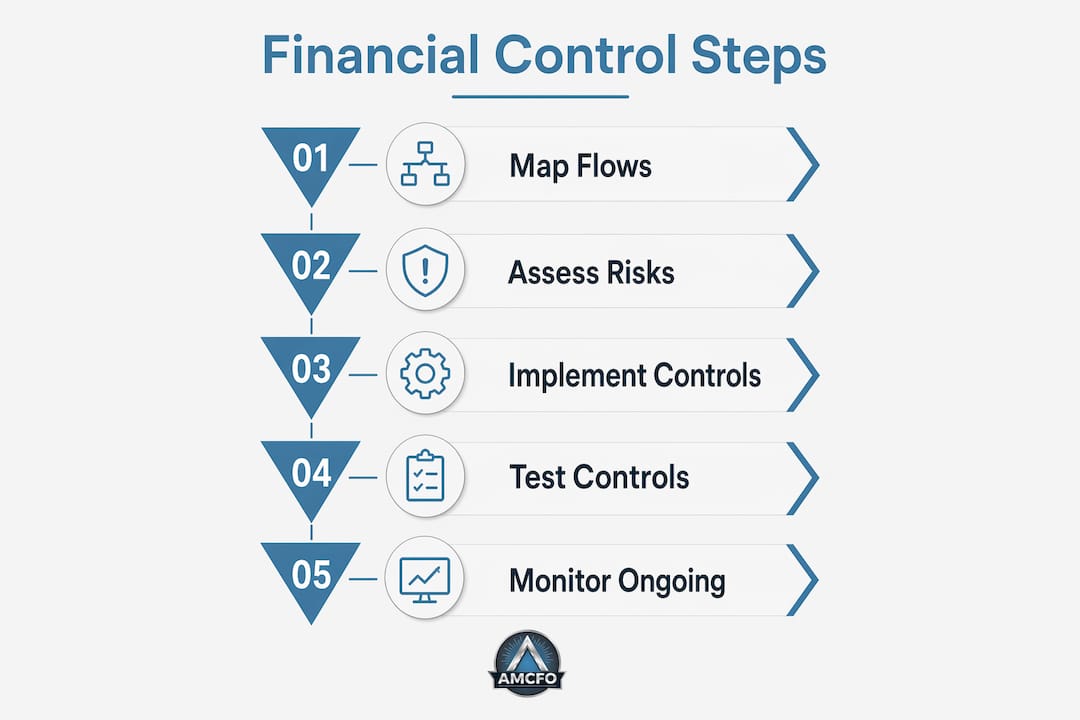
Mapping all money flows is the foundational step before any control can be effective. You cannot control what you have not documented. Start by listing every financial activity in your business across three categories.
Money flow categories to document:
- Cash inflows: customer payments, loans, investment receipts, refunds received
- Cash outflows: vendor payments, payroll, wire transfers, expense reimbursements, tax payments
- Reporting activities: bank reconciliations, financial statement preparation, budget variance reviews
Once you have the full map, rank each activity by two factors: the likelihood of an error or fraud occurring, and the financial impact if it does. Wire transfers and vendor master file changes consistently rank at the top of both lists. A single unauthorized wire transfer can cause more damage than a year of minor expense errors.
Pro Tip: Build your risk ranking in a simple spreadsheet with columns for activity, likelihood (1–3), impact (1–3), and a combined risk score. Sort by score and focus your control design on the top items first.
Financial risk management should be embedded into daily financial decision-making, treating payroll and compliance as material financial risks, not administrative tasks. That means your risk map is a living document, not a one-time exercise.
| Financial Activity | Risk Level | Primary Control Point |
|---|---|---|
| Wire transfers | High | Dual approval required |
| Vendor master changes | High | Segregation of duties |
| Payroll processing | High | Independent review before release |
| Expense reimbursements | Medium | Receipt documentation and manager approval |
| Bank reconciliations | Medium | Prepared and reviewed by different people |
What types of financial controls should you implement?
Controls fall into three categories: preventive, detective, and corrective. Each plays a different role, and the mix you choose determines how well your system actually works.
Preventive controls stop problems before they happen. Examples include approval thresholds that block payments above a set dollar amount, segregation of duties that prevents one person from both creating and approving a vendor, and system access restrictions that limit who can edit financial records.
Detective controls identify problems after they occur. Bank reconciliations, expense audits, and variance analysis between budget and actual results all fall here. They are necessary, but they catch losses after the fact.
Corrective controls fix problems once detected. These include fraud investigation procedures, clawback policies, and system patches after a control failure.
Strong preventive controls, such as hard approval limits, are more effective than multiple weak detective controls. One well-designed preventive control beats five detective controls that only tell you the money is already gone.
Pro Tip: For payment controls, set hard dollar thresholds in your accounting system, not just policy documents. A system-enforced limit cannot be bypassed by accident or convenience.
When you assign controls, every control needs an owner, a frequency, and a defined evidence standard. "The CFO reviews vendor payments" is not a control. "The CFO reviews and approves all vendor payments above $5,000 before release, documented by a signed approval log" is a control.
Control ownership checklist:
- Named individual responsible for performing the control
- Defined frequency: daily, weekly, monthly, or per transaction
- Clear evidence standard: what document or record proves the control ran
- Backup owner identified for coverage during absences
Preventive controls, especially hard thresholds for payments and access segregation, prevent losses more effectively than detective or corrective controls. Build your system around prevention first, then layer in detection.
How do you document, test, and monitor financial controls?
Documentation is what separates a real control from a good intention. Naming owners, frequency, and evidence for each control is the standard that makes controls operational and auditable. Without documentation, controls collapse the moment a key employee leaves or a process changes.
Steps to document and test your controls:
- Write a one-paragraph procedure for each control describing who does what, when, and how evidence is captured.
- Assign a primary owner and a backup owner for every control.
- Schedule quarterly testing: pull a sample of transactions and verify the control ran as documented.
- Collect and file evidence from each test, such as approval logs, reconciliation sign-offs, and system access reports.
- Record test results in a control register and flag any failures for immediate remediation.
A financial risk register is a dynamic tool that audit and risk teams use to update and manage risk treatments over time. Your control register serves the same purpose. It is not a filing cabinet. It is an active management tool.
| Control Testing Element | What to Document |
|---|---|
| Control name and owner | Specific individual, not a job title |
| Testing frequency | Quarterly, semi-annual, or annual |
| Sample size | Number of transactions reviewed |
| Evidence collected | Document type and storage location |
| Test result | Pass, fail, or exception noted |
Monitoring goes beyond periodic testing. Integrate control reviews into your regular financial calendar. Monthly close meetings should include a standing agenda item for control exceptions. Quarterly reviews should assess whether any business changes, such as new vendors, new payment methods, or staff turnover, require updating existing controls.
Frequent reassessment of financial risks triggered by business changes or material events keeps controls relevant and effective. A control designed for a 10-person company may be completely inadequate after a merger or a new product line launch.
What are the most common pitfalls in building financial controls?
Most control systems fail for predictable reasons. Knowing them in advance saves you from rebuilding from scratch after a loss.
Common pitfalls and how to avoid them:
- No clear ownership: Controls without named owners get skipped. Assign a specific person, not a department.
- Vague documentation: "Manager reviews expenses" is not a procedure. Write the exact steps, the evidence required, and the timeline.
- Over-engineering: A 200-control framework for a 30-person company creates compliance fatigue. Mid-market companies benefit most from focusing on their top 10–15 risks rather than building an exhaustive system.
- Ignoring cost: Every control has an operating cost in time and labor. Controls that cost more than the risk they address should be redesigned or eliminated.
- Leadership disengagement: When executives bypass controls for convenience, the entire system loses credibility.
Senior leadership routinely overriding controls undermines the control environment and invalidates otherwise effective controls. No policy document fixes a culture where the CEO approves their own expenses.
"The tone at the top, the control environment set by leadership, is more important than any individual control." — KPMG 2025 Handbook on Internal Control Over Financial Reporting
Control frameworks fail most often because no one owns the system and leadership does not prioritize controls. Fix the culture before you fix the spreadsheet.
Key Takeaways
Effective financial controls require documented ownership, preventive design, and active leadership commitment to function as a real safeguard rather than a paper exercise.
| Point | Details |
|---|---|
| Map money flows first | Document every cash inflow, outflow, and reporting activity before designing any control. |
| Prioritize preventive controls | Hard approval thresholds and segregation of duties stop losses before they occur. |
| Assign named owners | Every control needs a specific person, a frequency, and a defined evidence standard. |
| Test and monitor regularly | Quarterly sampling and a live control register keep the system functional over time. |
| Leadership sets the standard | Management override is a top fraud risk; executive commitment determines control effectiveness. |
What I have learned about financial controls that most guides skip
The most common mistake I see is companies treating financial controls as a compliance project rather than a management tool. They build a control list, file it with the auditors, and move on. Six months later, half the controls are not running because no one checked.
The Pareto principle applies directly here. Focus your energy on the 10–15 risks that could genuinely hurt your business. Wire transfers, payroll, vendor setup, and cash disbursements account for the vast majority of financial losses in small and mid-size companies. Get those right first.
I also think most business leaders underestimate how much CFO-level oversight changes the quality of a control environment. When a senior financial leader is actively reviewing results, asking hard questions, and holding owners accountable, controls run. When that oversight is absent, they drift. The control system is only as strong as the person paying attention to it.
Start small, assign real owners, test quarterly, and fix what breaks. That cycle, repeated consistently, builds a control environment that actually protects your business.
— Angelica
How Amcfo helps companies build and maintain financial controls
Building a control framework from scratch takes time, expertise, and consistent follow-through. Amcfo provides fractional CFO services that include designing, documenting, and monitoring financial controls tailored to your company's size and risk profile. The team also delivers accounting and bookkeeping support that keeps the underlying financial data accurate, which is the foundation every control system depends on.

Whether you are establishing controls for the first time or fixing gaps after a loss, Amcfo brings the financial management expertise to get the system right. The work covers everything from risk mapping and control design to quarterly testing and ongoing CFO-level review, so your controls stay current as your business grows.
FAQ
What does it mean to develop financial controls for a company?
Developing financial controls means creating documented policies and procedures that prevent fraud, catch errors, and protect company assets. The COSO Internal Control Integrated Framework is the recognized global standard for designing these systems.
What are the three types of financial controls?
The three types are preventive controls, which stop problems before they happen; detective controls, which identify problems after the fact; and corrective controls, which fix issues once discovered. Preventive controls deliver the most value because they stop losses rather than just reporting them.
How often should financial controls be tested?
Controls should be tested at least quarterly using transaction sampling and documented evidence collection. Reassessment should also occur whenever a material business change happens, such as new vendors, staff turnover, or a change in payment systems.
Why do financial control systems fail?
Control frameworks fail most often because no one owns the system and leadership does not prioritize it. Vague documentation and management override are the two most common causes of control breakdown.
How many controls does a small or mid-size company need?
Mid-size companies benefit most from building controls around their top 10–15 financial risks rather than creating an exhaustive system. Covering wire transfers, payroll, vendor management, and cash disbursements addresses the majority of real financial exposure for most businesses.