

Catch-up bookkeeping is the project that takes overdue accounting records and brings them current, so you end up with tax-ready financials instead of a shoebox of receipts. It covers everything from a few missed months to several years of unrecorded transactions. If you're behind, unreconciled, or facing a filing deadline, the right first move is a diagnostic review or a scoped quote, not another month of waiting.
TL;DR:
- The total time for catch-up bookkeeping varies greatly based on complexity, with simple three-month backlogs taking days and multi-year projects potentially lasting weeks.
- Costs depend primarily on transaction volume, payroll involvement, number of accounts, and missing records, ranging from a few hundred to several thousand dollars.
- A diagnostic review before quoting is essential to accurately scope the project, especially if payroll, multiple accounts, or document gaps are involved.
- After completion, expect to receive fully reconciled financial statements, reconciliation reports, and a full handoff package suitable for tax filing or lender review.
- DIY solutions work for short, simple backlogs; however, complex situations with payroll or unfiled tax years benefit from hiring professionals to avoid errors and legal risks.
Table of Contents
- What Catch-Up Bookkeeping Actually Covers
- How Do You Actually Catch Up Your Books?
- How Long Does Catching Up Take?
- What Does Catch-Up Bookkeeping Cost?
- Should You DIY, Hire a Pro, or Use AI Tools?
- How to Scope the Job Before You Hire Anyone
- What You Get When the Project Is Finished
- AmCFO's Diagnostic-First Approach to Catch-Up Work
- Catch Up Your Books Without Overpaying for the Wrong Fix
- Let AmCFO Handle the Backlog So You Don't Have To
- Sources
What Catch-Up Bookkeeping Actually Covers
Catch-up bookkeeping means recording and reconciling the transactions you never got to, whether that's three months or three years of backlog. Cleanup is a related but different job: it fixes existing errors, miscategorized entries, and duplicate transactions in books that were technically being kept, just kept badly. Many small businesses need both at once, because months of neglect almost always produce mistakes alongside the gaps.
A typical catch-up engagement includes:
- Importing bank and credit card transactions for every missing period
- Categorizing each transaction against your chart of accounts
- Reconciling every account to statement balances
- Checking payroll runs against tax filings and W-2 records
- Reviewing accounts receivable and payable for accuracy
If your existing entries are also riddled with miscoded expenses or mismatched vendor names, expect the provider to quote cleanup work as a separate line item, not a footnote.
How Do You Actually Catch Up Your Books?
The process runs in a set sequence, and skipping steps is how backlogs turn into audit headaches. Practitioner workflows generally follow the same core sequence: diagnose, gather, import, categorize, reconcile, verify, hand off.
- Diagnostic review. A bookkeeper scans your existing files, bank feeds, and prior tax returns to size the backlog: how many months, how many accounts, whether payroll is involved.
- Document gathering. You'll need bank and credit card statements, payment processor reports (Stripe, Square, PayPal), payroll summaries, and any prior-year tax filings. The IRS outlines exactly which records matter for substantiating income and deductions.
- Import. Bank feeds usually only pull the last 2 to 3 months automatically, so longer backlogs require downloading historical statements directly from your bank and importing them manually.
- Categorize. Every transaction gets mapped to an account. This is where import tools and templated rules save the most time.
- Reconcile. Every bank, credit card, and loan account gets matched to its statement balance, and the balance sheet gets corrected for old errors.
- Verify and hand off. Final reports get generated and checked against acceptance criteria before the file is delivered.
Pro Tip: Pull your bank statements before you call anyone. A bookkeeper can't quote accurately without knowing how many months and accounts are actually involved, and guessing on the phone almost always leads to a change order later.
How Long Does Catching Up Take?
Timing depends far more on complexity than on the calendar alone. A single business account with no payroll and three months behind might take a few days. A multi-entity business with payroll, several bank accounts, and two years of gaps can take several weeks, and that's assuming the records show up when promised.
Factors that stretch the timeline:
- Missing or unreadable bank statements that require bank requests
- Active payroll, since it has to tie back to filed tax forms
- Multiple entities or bank accounts running in parallel
- A software migration happening mid-project (QuickBooks Desktop to Online, for instance)
One workflow guide makes an honest point that most providers won't say outright: the real answer is "it depends", because backlog depth, transaction volume, and missing documents change the schedule enough that any flat estimate given before a diagnostic review is a guess. How fast you respond to document requests matters just as much as backlog size. A provider waiting two weeks for a bank statement loses two weeks, full stop.
What Does Catch-Up Bookkeeping Cost?
Pricing generally follows one of three models: a flat project fee for the whole backlog, hourly billing, or monthly backlog pricing that charges per month of catch-up work.
Published pricing guides put catch-up bookkeeping costs anywhere from a few hundred dollars for a short, simple backlog up to several thousand dollars for multi-year, high-transaction cleanups. Most small businesses with a 6 to 12 month backlog land somewhere in the middle of that range, not at either extreme.
What actually drives the number:
- Transaction volume. More monthly transactions means more categorization hours.
- Payroll. Reconciling payroll against filed tax forms adds real time.
- Number of accounts or entities. Each bank account, credit card, and legal entity multiplies the reconciliation work.
- Missing documents. Chasing down old statements or 1099 records is the single biggest hidden cost driver.
Ask for a written quote tied to a specific scope, not a vague hourly estimate with no cap.
Should You DIY, Hire a Pro, or Use AI Tools?
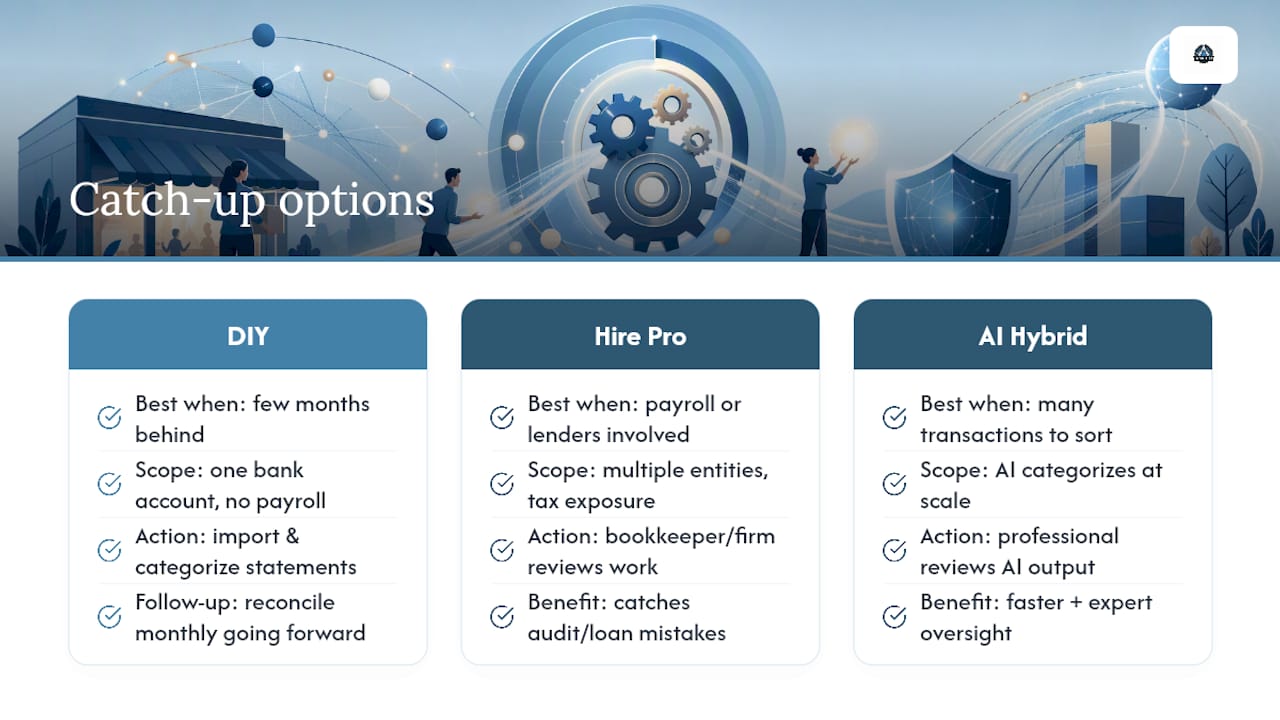
DIY catch-up makes sense when you're a few months behind, run one bank account, and have no payroll. Import your statements into your accounting software, categorize as you go, and reconcile monthly going forward.
Hire a professional once payroll, multiple entities, lender reporting, or real tax exposure enter the picture. A bookkeeper or firm catches the mistakes that don't show up until an audit or a loan application does. Given that unfiled tax years carry no statute of limitations, that risk is worth taking seriously rather than guessing at.
AI-assisted categorization tools speed up the grunt work of sorting thousands of transactions, but they still miss context: a personal expense run through a business card, a loan payment misclassified as an expense. The strongest setup for most small businesses is a hybrid: run transactions through categorization software, then have a professional review and reconcile before anything gets filed.
How to Scope the Job Before You Hire Anyone
Before you accept a quote, ask the provider these questions directly:
- How many months behind am I, and how many monthly transactions does that involve?
- Is payroll involved, and will you reconcile it against filed W-2 and 1099 forms?
- How many bank accounts, credit cards, or entities need reconciliation?
- What accounting software am I currently using, and can you work in it or migrate me?
- What triggers a change order if the scope grows mid-project?
- What does the final deliverable package include, and what counts as "done"?
Get the scope, timeline, and change-order terms in writing before work starts. Completion criteria should be explicit: every account reconciled and saved, a profit-and-loss statement and balance sheet for each period, and handoff notes explaining any judgment calls made along the way.
Pro Tip: Ask to see a sample reconciliation report and a sample cleanup summary from a past engagement before you sign anything. If a provider can't produce one, that's worth noting.
What You Get When the Project Is Finished
A completed catch-up project should hand you a reconciled profit-and-loss statement and balance sheet for every period covered, plus reconciliation reports showing each account matched to its statement balance. You should also get a cleanup summary listing what was fixed and why, and a full handoff package, meaning your accounting file, in a state a tax preparer or lender can use immediately.
These deliverables matter beyond the paperwork. Accurate books are also part of good corporate governance, since sloppy or absent records can expose owners to liability they assumed a legal entity protected them from. Once delivered, set up monthly reconciliation going forward so you never face a backlog like this again.
AmCFO's Diagnostic-First Approach to Catch-Up Work
Our recommended approach is to start every catch-up engagement with a diagnostic review before quoting a number, because backlog depth and payroll complexity change the real scope more than owners expect.. The most common pitfall Angelica sees: business owners assume a rough monthly estimate multiplied by months behind will match reality, when missing documents and payroll reconciliation usually add real time.
Catch Up Your Books Without Overpaying for the Wrong Fix
The advice you'll find most often treats catch-up bookkeeping like a commodity: pick a flat rate per month behind, multiply, done. That math ignores the two things that actually drive cost and time, which are payroll complexity and missing documents. A twelve-month backlog with clean statements and no payroll is a different job than a twelve-month backlog with three unreconciled accounts and a part-time employee.
What gets underrated is the diagnostic step itself. Owners want to skip straight to a quote, but a real diagnostic review is what keeps a project from ballooning into change orders halfway through. Ask for one before you ask for a price.
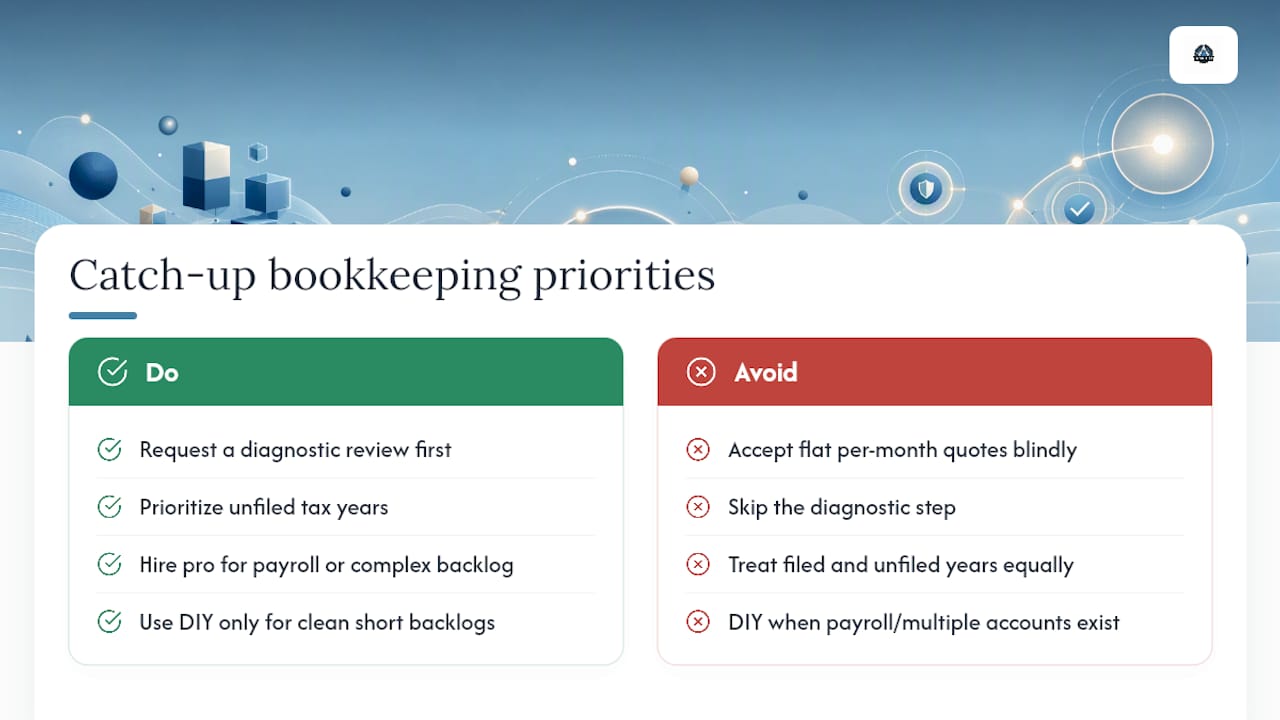
Prioritize unfiled tax years above everything else in your backlog. Filed years have standard retention windows, but unfiled returns carry open-ended exposure with no expiration date on the risk. If you're triaging what to fix first, that's it.
The DIY route works fine for a clean, short backlog. Once payroll, multiple accounts, or a looming tax deadline enter the picture, the math on hiring a professional stops being close.
— Angelica
Let AmCFO Handle the Backlog So You Don't Have To
Catching up months of books alone usually means late nights re-learning software you haven't opened since last tax season. Catch-up projects should run with a diagnostic-first process: scope the backlog first, quote against that scope, then deliver reconciled financials that can be handed straight to a tax preparer or lender.

A diagnostic call starts by walking through how many months you're behind, what accounts and payroll are involved, and what software you're using now. From there, the project scope should include a written timeline and defined deliverables, so there's no guessing about what "done" looks like. The bookkeeping and cleanup services page covers what's included, and if your backlog turns up questions that go beyond bookkeeping (undisclosed transactions, suspected fraud), AmCFO's forensic accounting team can take a closer look. Request a diagnostic review and get a real quote instead of a guess.
Sources
For the documentation side of catch-up work, the IRS explains which records to keep and how long to retain them. For budgeting, SD O'Connor CPA's cost guide breaks down typical pricing bands. For due-diligence-level reporting after cleanup, AddBack covers quality-of-earnings work relevant to buyers and lenders.