

Zero-based budgeting rebuilds a company's budget from zero every cycle, forcing every line item to earn its place instead of carrying forward last year's numbers. Its biggest payoff is aligning spending with current strategic priorities rather than historical habit, and it works best when overhead has quietly piled up or margins are under pressure. Bain & Company puts realistic savings at 15% to 25% for organizations that follow through on implementation.
TL;DR:
- Zero-based budgeting can deliver 15% to 25% savings when implemented thoroughly, especially in overhead-heavy or portfolio companies with overlapping vendor contracts.
- It is most effective when applied selectively to categories prone to cost accumulation, like SaaS, vendor contracts, and insurance, every three to five years.
- The process typically takes 4 to 6 weeks for a scoped cycle and requires clear scope rules, decision packages, and accountability to prevent reaccumulation of costs.
- Cost categories linked directly to revenue or production are less suitable for zero-based review, and it is recommended to focus on areas with inertia in spending.
- External support, such as fractional CFO services, can streamline the process, especially for lean teams lacking the capacity to handle clean financial data and facilitation.
Table of Contents
- What Is Zero-Based Budgeting and Why Do Companies Use It?
- When Does Zero-Based Budgeting Make Sense for Your Business?
- How Do You Run a Zero-Based Budgeting Process Step by Step?
- What Are the Biggest Pitfalls in a Zero-Based Budgeting Project?
- How Do You Know If Zero-Based Budgeting Actually Worked?
- How Does a Fractional CFO Support a Zero-Based Budgeting Project?
- How Do You Manage the People Side of a ZBB Rollout?
- How Does Zero-Based Budgeting Compare to Traditional Budgeting?
- What Do Real Zero-Based Budgeting Outcomes Look Like?
- The Real Case for Zero-Based Budgeting
- Get Help Running a Lightweight Zero-Based Budgeting Cycle
- Sources
- FAQ
What Is Zero-Based Budgeting and Why Do Companies Use It?
Traditional budgeting starts with last year's number and adjusts it up or down. Zero-based budgeting throws that number out and asks a harder question: if this expense didn't exist, would you approve it today? Every cost has to be rebuilt from a blank sheet and justified through a decision package rather than inherited through a roll-forward.
That shift changes behavior, not just numbers. Managers who have to defend a line item in writing think differently about it than managers who watch it auto-renew. Bain's research on management tools found that ZBB's real value is building an ownership culture and tying spend to strategic priorities, not simply slashing costs for the sake of a leaner income statement.
What ZBB delivers in practice:
- Visibility into costs that have accumulated through inertia rather than deliberate choice
- A documented rationale for every dollar spent, tied to a named owner
- A mechanism to redirect savings toward growth initiatives instead of just banking them
- Savings in the 15% to 25% range, according to Bain & Company, when the process is carried through to completion
When Does Zero-Based Budgeting Make Sense for Your Business?
ZBB isn't a universal fix, and running it on the wrong categories wastes time your team doesn't have. It earns its keep in specific situations, not as a default annual ritual.
Companies that gain the most are typically overhead-heavy, mid-market businesses, or portfolio companies under private equity ownership where multiple rounds of add-on acquisitions have left overlapping vendor contracts and duplicate software subscriptions, which is where West Valley Digital's strategy consulting can offer effective vendor consolidation examples supporting zero-based budgeting reviews. According to Glacier Lake Partners, PE-backed companies often capture 8% to 15% overhead reduction in their first cycle, largely from SaaS consolidation, insurance rebids, and vendor renegotiation.
ZBB makes less sense in a few situations:
- During a high-growth investment phase when the company is deliberately spending ahead of revenue
- When the finance and operations team is already stretched thin and can't absorb a multi-week review process
- On cost categories tightly linked to revenue or production capacity, where the spend isn't discretionary in the first place
The smarter play for most mid-market companies isn't a full annual rebuild. Onetribe's guidance on mid-market ZBB recommends a selective, periodic approach: apply the discipline to high-accumulation categories like SG&A, SaaS tools, and vendor contracts every three to five years, or whenever a trigger event (an acquisition, a margin squeeze, new ownership) calls for it.
How Do You Run a Zero-Based Budgeting Process Step by Step?
A ZBB cycle doesn't need a six-month consulting engagement to work. For most mid-market companies, a scoped process fits into a defined window with a clear owner at every step.
- Get executive sponsorship and set scope rules. Decide upfront which categories are in play (usually SG&A, software, professional services, and vendor contracts) and which are out of bounds (payroll for revenue-generating roles, contractual obligations you can't unwind quickly).
- Build a GL-mapped fact base. Pull actual spend by vendor and cost center from your general ledger. If your books aren't clean, this step stalls everything after it.
- Create cost packages for each spend category. Group related expenses (all marketing software, all facilities costs) so they can be evaluated together instead of line by line.
- Write decision packages for each package. Onetribe's template recommends capturing: activity purpose, deliverables, current cost, proposed cost, alternatives considered, consequence of elimination, and strategic alignment.
- Assign an owner to every package. No package moves forward without a named person accountable for the number.
- Run cross-functional ranking sessions. Score packages against objective criteria (revenue impact, risk, strategic fit) rather than seniority or tenure.
- Set a funding threshold and cut below it. Rank packages, draw the line where the budget runs out, and document what got cut and why.
- Lock the new baseline and log the decisions. The output isn't just a smaller number. It's a decision log you can point to later when someone asks why a line item changed.
A lightweight version of this process, scoped to discretionary categories, typically runs 4 to 6 weeks for a mid-market company, according to Glacier Lake Partners, and doesn't require outside consultants to complete.
Pro Tip: Don't try to zero-base your entire cost structure in the first cycle. Pick two or three categories where you suspect the most inertia (software subscriptions are almost always one) and prove the process works before expanding it.
On tools: a well-organized spreadsheet can run a scoped ZBB cycle for a single business unit without trouble. Once you're tracking dozens of decision packages across multiple departments or need scenario modeling for different funding thresholds, FP&A software starts to earn its cost. Sarah Schlott's implementation guide treats scenario-modeling technology as one of the ten non-negotiable steps for a serious FP&A-led process.
What Are the Biggest Pitfalls in a Zero-Based Budgeting Project?
The concept is simple. The execution is where most ZBB efforts either pay off or quietly stall out.
- Time and staffing burden. A full-scope ZBB review pulls managers away from their actual jobs for weeks. Limit scope to the categories most likely to have accumulated waste, and consider outside facilitation to keep the process moving.
- Underfunding long-term projects. A ranking process built around short-term cost visibility can starve investments that don't show returns for a year or two. Carve out a protected bucket for strategic initiatives before ranking begins.
- Managerial gaming. Managers who know the rules will pad requests or sandbag estimates to protect their turf. Objective ranking criteria and a written decision log make gaming harder to hide.
- Reaccumulation. Costs that get cut in year one tend to creep back without follow-through. Onetribe's mid-market research found that savings often reaccumulate within two to three years absent ongoing governance.
Pro Tip: Build the decision log as you go, not after the fact. Reconstructing why a package got cut six months later is nearly impossible, and that gap is exactly where reaccumulation starts.
How Do You Know If Zero-Based Budgeting Actually Worked?
A ZBB cycle that produces a one-time savings number and nothing else hasn't really worked. The point is to make the discipline stick.
Track a small set of metrics rather than a sprawling dashboard:
- Absolute savings realized against the baseline you locked at the start of the cycle
- SG&A as a percentage of revenue, tracked quarterly to catch drift early
- Cost-per-output by package, so you can compare efficiency across similar categories over time
Companies that skip governance after a ZBB cycle tend to see savings reaccumulate within two to three years, according to Onetribe, which erases most of the gain the process just delivered.
The decision log from your ZBB cycle isn't just an internal reference. It becomes the audit trail investors and due-diligence teams ask for when they want to understand how a company controls costs. Set a quarterly review cadence to check package-level spend against the approved baseline, and use targeted ZBB refreshes (not a full annual redo) whenever a category starts drifting back toward its old cost level.
How Does a Fractional CFO Support a Zero-Based Budgeting Project?
Most mid-market finance teams don't lack the will to run ZBB. They lack the hours. Pulling a clean, GL-mapped fact base, building decision-package templates, facilitating ranking sessions, and running variance analytics after the fact is a real workload on top of closing the books every month.
This is where a fractional CFO earns their retainer. Amcfo's fractional CFO services bring the templates and facilitation experience so your internal team isn't building the process from scratch. Before a ZBB cycle can even start, the books need to be reliable, which is why bookkeeping and QuickBooks cleanup often comes first for companies whose ledgers have drifted out of sync with reality. From there, efficiency analysis and ongoing forecasting turn a one-time budget rebuild into a repeatable discipline instead of a fire drill you dread every few years.
How Do You Manage the People Side of a ZBB Rollout?
The math of zero-based budgeting is the easy part. Getting managers to actually engage with it honestly, instead of treating it as a threat to their department, is where most rollouts run into friction.
Start with transparency about why the process exists. A ZBB cycle framed as "corporate wants to cut your budget" invites exactly the gaming that undermines the whole exercise. A ZBB cycle framed as "we're redirecting spend toward what's actually working" gets a very different reaction from department heads.
Sequence the communication deliberately. Tell managers what's being reviewed and why before you ask them to build decision packages, not after. Give them the ranking criteria in advance so nobody feels blindsided by how their package gets scored. And separate the review of the spend from the review of the person: a cut package doesn't mean a manager failed, it means the company found a better use for that dollar.
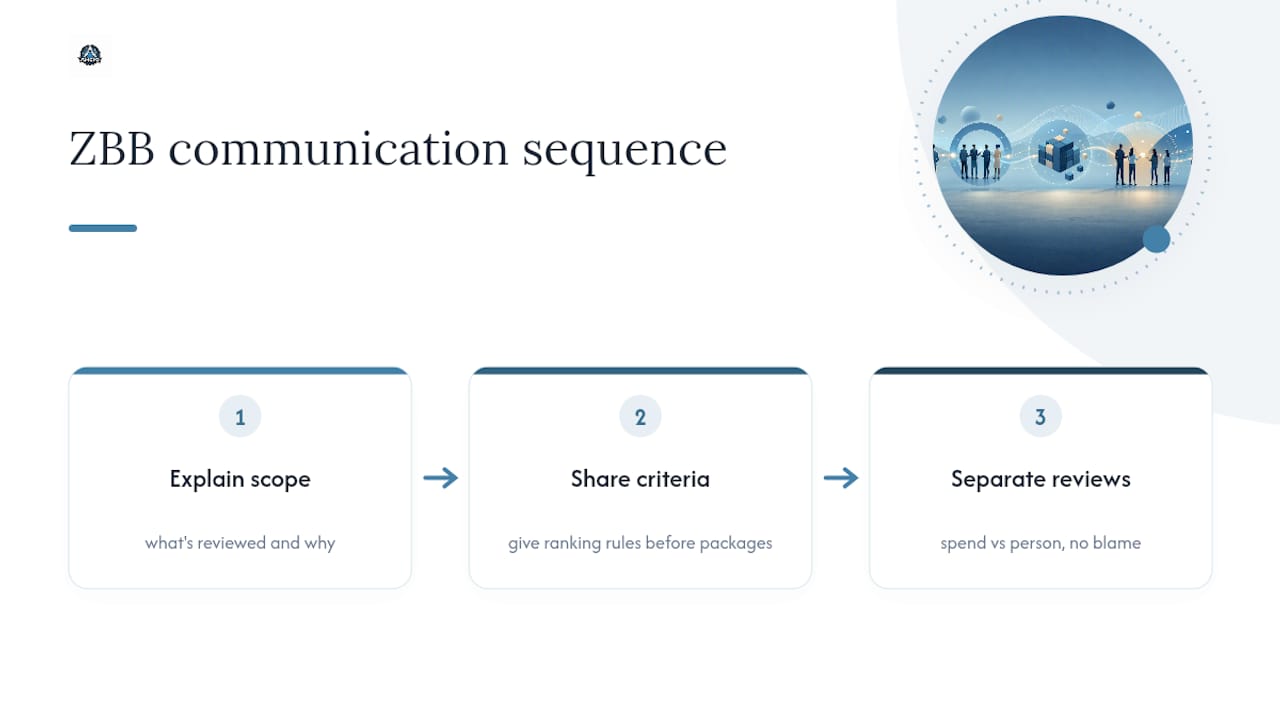
Middle managers often resist the process the hardest, since they're the ones filling out packages and defending them in ranking sessions. Give them a stake in the outcome by letting departments reinvest a portion of what they save into their own priorities. That single incentive does more to reduce gaming and passive resistance than any amount of top-down messaring about accountability. Pair that with clear executive sponsorship (visibly, not just on paper) and the rollout goes from adversarial to collaborative much faster than most finance leaders expect.
How Does Zero-Based Budgeting Compare to Traditional Budgeting?
Traditional, incremental budgeting takes last year's approved number and adjusts it by a percentage based on inflation, growth targets, or a flat department-wide cut. It's fast, it's predictable, and it requires almost no justification beyond "we spent this much last year." That speed is also its biggest flaw: costs that no longer make sense simply roll forward untouched, year after year, because nobody has to defend them.
Zero-based budgeting flips the default. Nothing carries forward automatically. Every expense gets rebuilt and justified through a decision package, which takes far more time and cross-functional effort but surfaces spend that incremental budgeting would never catch.
| Factor | Traditional (incremental) budgeting | Zero-based budgeting |
|---|---|---|
| Starting point | Prior year's approved budget | Zero; every line rebuilt |
| Time required | Days to a few weeks | 4 to 6 weeks for a scoped mid-market cycle |
| Justification burden | Minimal; variance from last year | High; decision package per cost item |
| Best suited for | Stable, low-inertia cost structures | Overhead-heavy, accumulation-prone categories |
| Risk | Costs roll forward unexamined | Time and staffing burden if scope is too broad |
Most mid-market companies don't need to choose one method permanently. A hybrid works well in practice: run incremental budgeting most years for stable cost centers, and trigger a scoped zero-based budgeting review every few years, or after an acquisition, ownership change, or margin squeeze, for the categories most prone to quiet accumulation.
What Do Real Zero-Based Budgeting Outcomes Look Like?
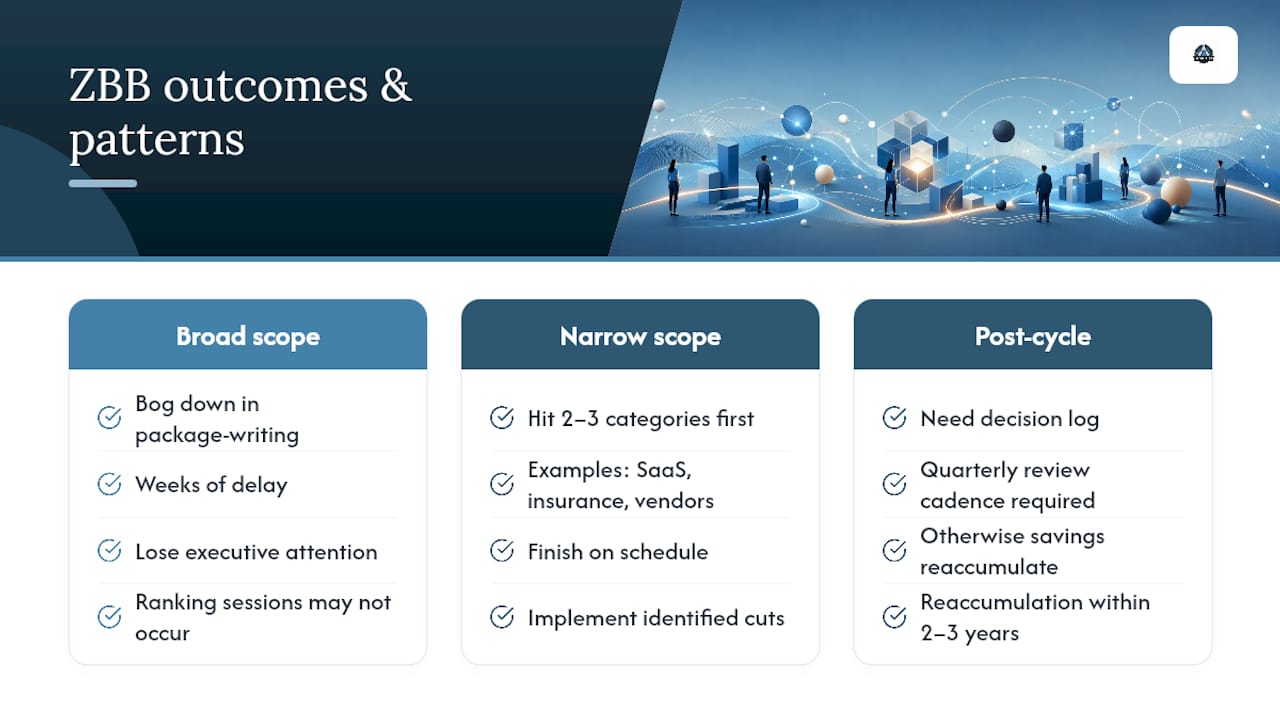
Private equity portfolio companies provide some of the clearest evidence of ZBB's impact, largely because sponsors track results closely and expect a return on the process itself. Glacier Lake Partners reports that portfolio companies commonly see 8% to 15% overhead reduction in their first ZBB cycle, with the biggest wins coming from SaaS tool consolidation, insurance rebids, and renegotiated vendor contracts, exactly the categories where cost accumulates through inertia rather than deliberate decisions.
The challenges show up just as consistently across industries. Companies that scope a ZBB review too broadly, trying to zero-base every department in one pass, tend to bog down in weeks of package-writing and lose executive attention before ranking sessions even happen. Companies that scope it narrowly, hitting two or three high-accumulation categories first, tend to finish on schedule and actually implement the cuts they identify.
The other consistent pattern is what happens after the cycle ends. Without a decision log and a quarterly review cadence, savings tend to reaccumulate within two to three years regardless of industry. That's not a flaw unique to any one sector. It's what happens whenever a one-time budget exercise isn't backed by ongoing governance.
The Real Case for Zero-Based Budgeting
The conventional pitch for ZBB is cost cutting, and that framing does the method a disservice. Companies that treat a ZBB cycle as a one-time austerity project usually get a short-term win and a slow slide back to where they started within a couple of years. That's not a failure of the method. It's a failure to treat it as governance instead of a diet.
What the evidence actually supports is narrower and more useful: apply zero-based discipline to the categories where cost accumulates through inertia, not everywhere at once. Trying to zero-base an entire P&L in one pass is how mid-market teams burn six weeks and lose executive buy-in before the ranking sessions even start.
If you take one thing from this, prioritize the decision log over the initial savings number. The spreadsheet showing what you cut feels like the win. The documented rationale for every decision is what actually prevents the same costs from creeping back in eighteen months, and it's the piece most companies skip because it feels like paperwork rather than progress.
— Angelica
Get Help Running a Lightweight Zero-Based Budgeting Cycle
You don't need to hire a full-time CFO to run a disciplined zero-based budgeting cycle. Amcfo's fractional CFO services give mid-market companies the modular option of engaging exactly what they need: a scoped ZBB project, an efficiency analysis of a specific cost category, or an ongoing retainer that keeps the governance in place after the first cycle ends.
A ZBB cycle only produces reliable decision packages when the underlying numbers are trustworthy, which is why cleanup work often comes first. Amcfo's accounting and bookkeeping services get your general ledger mapped and current before a single decision package gets written. From there, a fractional CFO can facilitate ranking sessions, build the decision log, and set the quarterly review cadence that keeps savings from quietly reaccumulating. If your budget hasn't been rebuilt from scratch in a few years, or you suspect SaaS and vendor spend has drifted, reach out through Amcfo's fractional CFO services page to scope a cycle sized to your business.
This article is general information, not a substitute for advice from a qualified financial advisor. Consult a qualified financial professional about your own circumstances before acting on anything here.
Sources
- What is Zero-Based Budgeting? | Bain & Company
- Zero-Based Budgeting for Middle Market Companies | Glacier Lake Partners
- Zero-Based Budgeting for Mid-Market Companies — A Practical Guide | Onetribe
- Implementing Zero-Based Budgeting in FP&A: A 10-Step Guide - Sarah Schlott
FAQ
What is zero-based budgeting in simple terms?
Zero-based budgeting is a corporate budgeting method that starts every budget cycle at zero, requiring every expense to be justified rather than carried forward from the prior year. Companies that follow through on implementation report savings in the 15% to 25% range.
How long does a zero-based budgeting process take?
A lightweight cycle scoped to discretionary categories typically takes 4 to 6 weeks for a mid-market company. A full-scope rebuild across every department takes considerably longer and often loses momentum before it finishes.
What are the main pros and cons of zero-based budgeting?
The advantages include tighter alignment between spending and strategic priorities and clear ownership of every cost line. The drawbacks are the time and staffing burden of writing decision packages, plus the risk that savings reaccumulate within two to three years without ongoing governance.
Which categories should a company zero-base first?
Start with categories prone to cost accumulation through inertia, such as software subscriptions, vendor contracts, and insurance, rather than costs tied directly to revenue or production capacity. This selective approach captures most of the available savings without the burden of a full-scope review.
Can a small finance team run zero-based budgeting without outside help?
A scoped, spreadsheet-based ZBB cycle is manageable for a lean team if the general ledger is clean and the scope stays narrow. For teams stretched thin or lacking clean financials, Amcfo's fractional CFO services provide the templates and facilitation to run the process without adding permanent headcount.