

Companies consolidate financial statements to present a parent company and all its subsidiaries as a single economic entity, giving investors, lenders, and executives one accurate picture of the group's true financial position. Without consolidation, separate subsidiary reports can hide over-leveraging, mask poor cash flow distribution, and make a healthy parent look weaker or stronger than it actually is.
The trigger for consolidation is control, typically defined as ownership of more than 50% of voting stock, though control through contractual arrangements can also apply. Three methods govern how ownership interests are reported:
- Full consolidation: Used when the parent controls a subsidiary (ownership above 50%). All assets, liabilities, income, and expenses are combined line by line, with minority interests shown separately.
- Equity method: Applied when a company holds significant influence but not control, typically ownership in a range that does not confer control. The investment is carried at cost and adjusted for the investor's share of earnings.
- Cost method: Used when the investor has little or no influence over the investee, typically with minimal ownership.
IFRS 10 defines control as the power to direct an investee's activities to affect variable returns, and it requires any parent meeting that threshold to prepare consolidated statements. Under U.S. GAAP, the Financial Accounting Standards Board sets parallel requirements through ASC 810.
Why companies consolidate financial statements: the core business case
Consolidation is not purely a compliance exercise. The business reasons behind it are concrete and directly tied to how executives manage performance and risk.
- Transparency for stakeholders: Consolidated statements give investors and creditors a complete view of corporate group financial health, eliminating the distortion that comes from reviewing isolated entity results. Lenders routinely require consolidated financials before extending credit.
- Regulatory compliance: Both GAAP and IFRS mandate consolidation for entities that meet the control threshold. Non-compliance carries regulatory penalties and can damage investor confidence.
- Tax optimization: Companies can balance profits and losses across subsidiaries within a consolidated group, reducing overall tax liability. Intercompany transactions that are eliminated for reporting purposes can also reduce taxable income at the group level. For a deeper look at how this works in practice, see Amcfo's guide on tax planning for companies.
- Risk management: Aggregating subsidiary data into a single view surfaces group-wide liabilities that individual books might obscure, such as concentrated debt or liquidity gaps in one entity dragging down the whole group.
- Strategic decision-making: Executives need consolidated performance data to allocate capital across business units, evaluate acquisitions, and set group-level targets. Fragmented subsidiary reports cannot support that kind of analysis.
What GAAP and IFRS actually require
Both frameworks share the same foundational logic: if you control an entity, you consolidate it. The differences are in the details.
- IFRS 10 establishes control as the basis for consolidation and requires uniform accounting policies across all entities in the group. Consolidation begins on the date control is obtained and ceases when control is lost.
- U.S. GAAP (ASC 810) uses a variable interest entity model alongside the voting interest model, which can require consolidation even without majority ownership when a company absorbs the majority of an entity's expected losses or residual returns.
- Disclosure obligations under both frameworks are extensive. Companies must disclose the basis for consolidation decisions, the nature of relationships with subsidiaries, and any restrictions on the parent's ability to access group assets. Boards and audit committees increasingly treat these disclosures as a governance accountability tool, not just a filing requirement.
The equity method applies when ownership falls in the 20%–50% range and significant influence exists. Proportionate consolidation, once permitted under older IFRS standards for joint ventures, has largely been replaced by the equity method under IFRS 11.
Pro Tip: If your group has entities in multiple jurisdictions, map each subsidiary to its applicable consolidation method before the close process begins. Discovering a misclassified entity mid-close is one of the most common causes of reporting delays.

Common challenges in the consolidation process
The mechanics of consolidation are where most finance teams lose time and introduce errors.
- Intercompany eliminations: Any sales, loans, dividends, or management fees between group entities must be eliminated. Unresolved intercompany transactions overstate revenues and can trigger audit concerns. Both sides of every transaction must match exactly before elimination entries are posted.
- Inconsistent accounting policies: When subsidiaries use different depreciation methods, revenue recognition approaches, or inventory valuation techniques, the consolidated result is unreliable. Transitioning from separate to consolidated reporting is significantly harder when policy alignment has not happened first.
- Currency translation: A U.S. parent with subsidiaries in Europe or Asia must translate each transaction at the exchange rate in effect at the time of the transaction, not the rate at close. This produces foreign currency gains or losses that require their own adjustment entries.
- Timing mismatches: Subsidiaries on different fiscal calendars require interim statements or accruals to align reporting periods before consolidation adjustments can be calculated.
- Manual process risk: Spreadsheet-based consolidation creates opaque workflows where a single formula error can cascade through the entire group result. Finance leaders consistently point to manual processes as the primary source of restatements and audit findings.
Pro Tip: Build your close calendar backward from the external reporting deadline. Assign each subsidiary a hard close date with buffer time built in for reconciliation issues. Subsidiaries that miss their close date should escalate immediately, not at the parent's consolidation step.
Best practices that make consolidation accurate and repeatable
Getting consolidation right is less about heroic effort at quarter-end and more about the systems and policies in place year-round.
- Standardize accounting policies early. Uniform policies across all subsidiaries are the single biggest factor in reducing audit delays. Depreciation methods, revenue recognition rules, and inventory valuation approaches should be documented in a group accounting manual and enforced consistently.
- Automate elimination entries. Integrated accounting or ERP systems flag intercompany transactions throughout the period, dramatically reducing the manual effort required at close. Automation also creates an auditable trail for every elimination entry.
- Standardize the chart of accounts. When subsidiary accounts map cleanly to parent accounts, the aggregation step is mechanical. When they do not, finance teams spend days on manual mapping instead of analysis. For practical guidance on building this infrastructure, Amcfo's financial reporting best practices guide covers the 2026 standards in detail.
- Establish clear ownership for each consolidation step. Ambiguity about who is responsible for currency translation, minority interest calculations, or goodwill impairment testing is how errors slip through. Assign named owners to each step in the close workflow.
- Train subsidiary finance teams on group requirements. The parent's consolidation team cannot fix what subsidiaries do not understand. Regular training on intercompany transaction coding, policy requirements, and close deadlines pays back in fewer reconciliation issues.
Pro Tip: Treat the intercompany reconciliation as a continuous process, not a month-end task. Finance teams that reconcile intercompany balances weekly close significantly faster than those that start from scratch at period end.
Amcfo brings CFO-level expertise to your consolidation process
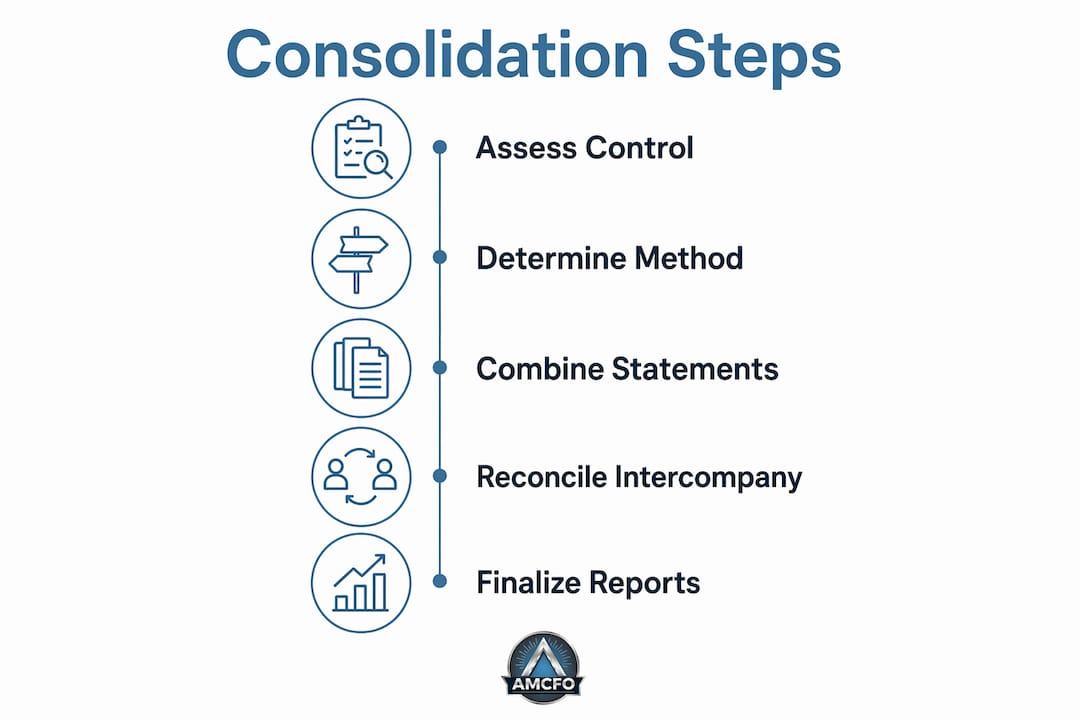

Multi-entity financial reporting is one of the most technically demanding areas in accounting, and most growing businesses do not need a full-time CFO to get it right. Amcfo's fractional CFO services give you senior-level oversight of your consolidation process, from intercompany elimination policies to regulatory compliance under GAAP and IFRS, without the cost of a full-time hire. The accounting and bookkeeping services Amcfo provides ensure that subsidiary-level data is clean, consistently coded, and ready to consolidate before the close process begins. For executives who need both the technical execution and the strategic read on what the consolidated numbers mean, Amcfo delivers both in one engagement.
Key takeaways
Companies consolidate financial statements because control over subsidiaries, typically defined as ownership above 50%, requires a unified view of the group's financial position under both GAAP and IFRS.
| Point | Details |
|---|---|
| Control triggers consolidation | Ownership above 50% of voting stock generally requires full consolidation under GAAP and IFRS 10. |
| Three reporting methods | Full consolidation, equity method (20%–50%), and cost method (below 20%) each apply based on ownership and influence. |
| Intercompany eliminations are critical | Unresolved intercompany transactions overstate revenues and create audit risk across the consolidated group. |
| Uniform policies prevent delays | Inconsistent accounting policies across subsidiaries are a leading cause of audit delays and restatement risk. |
| Amcfo supports the full process | Amcfo's fractional CFO and accounting services cover consolidation policy, compliance, and clean subsidiary-level reporting. |