

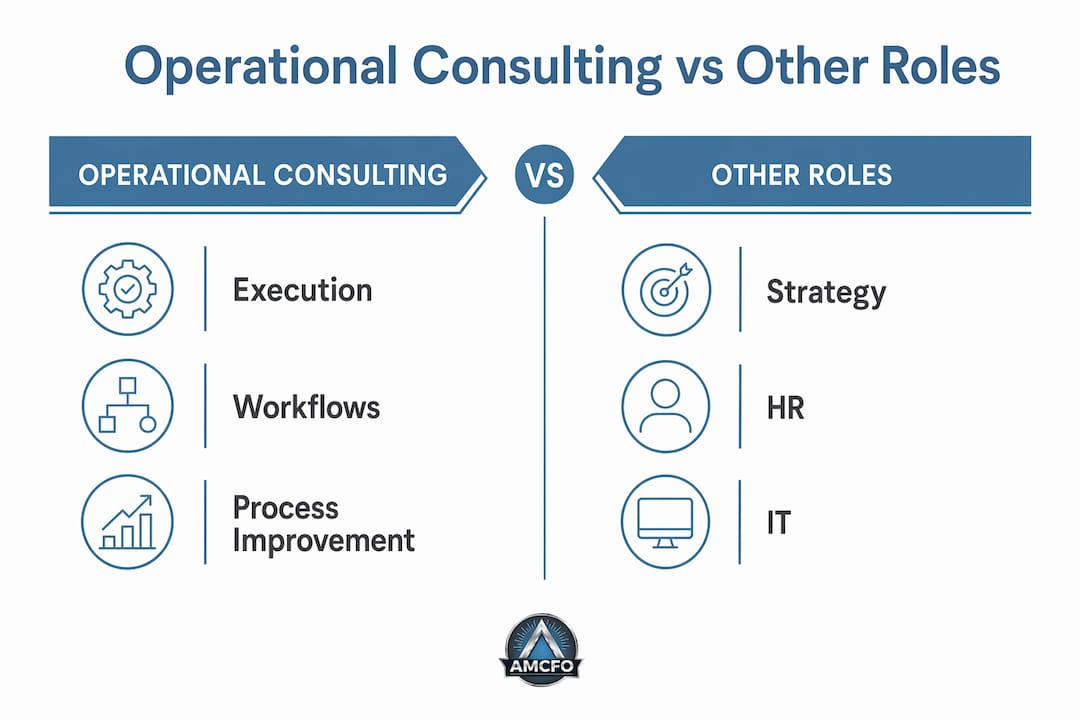
Operational consulting is the discipline of improving a business's internal operations by redesigning workflows, strengthening team coordination, and installing performance management systems that hold gains over time. Unlike strategy consulting, which focuses on market positioning, or HR consulting, which addresses compensation and talent, operational consulting targets execution: the daily work of running a company efficiently. Business leaders in small to mid-sized companies often discover that growth exposes operational gaps faster than leadership bandwidth can address them. Lean daily management, KPI dashboards, and operational readiness assessments are the tools that close those gaps systematically.
What does an operational consulting engagement look like?
A well-structured operational consulting engagement follows a phased approach that moves from diagnosis to implementation without losing momentum or expanding scope uncontrollably. Understanding the phases helps you evaluate proposals, set expectations with your team, and measure whether the engagement is delivering results.
Here is how a typical engagement unfolds:
- Scoping and discovery (week 1). The consultant defines the problem, identifies the target workflow or function, and establishes the metrics that will signal success. This phase produces a written scope document with acceptance criteria.
- Diagnosis (weeks 2 through 4). The consultant maps current-state processes, interviews team members, and analyzes performance data. The output is a gap analysis that connects operational problems to measurable business outcomes.
- Recommendations (weeks 4 through 6). The consultant presents redesigned processes, governance changes, and a measurement system. Discovery phases of 2 to 6 weeks followed by defined delivery phases are standard practice for controlling scope and cost.
- Implementation support (weeks 6 through 10). The consultant works alongside your team to install new processes, train leaders, and configure dashboards. This phase is where most engagements either succeed or stall.
- Handoff and governance. The final deliverable is a repeatable operating system: dashboards, playbooks, and operating cadences that your team runs independently after the consultant exits.
Pro Tip: Ask any prospective consultant to show you a sample scope document from a past engagement. If they cannot produce one, the engagement will likely drift. Defined acceptance criteria and weekly measurement reviews are the structural controls that separate disciplined engagements from open-ended retainers.
The diagnosis phase deserves special attention. Practitioners treat it as a data-to-decision process, defining KPIs and building dashboard artifacts early so that improvement discussions focus on deviations and decisions rather than status updates. That shift alone changes the quality of conversations your leadership team has every week.

How operational consulting differs from strategy, HR, IT, and fractional COO roles
Business leaders frequently conflate operational consulting with adjacent services. The distinctions matter because hiring the wrong type of advisor delays results and wastes budget.
| Consulting type | Primary focus | Typical deliverable |
|---|---|---|
| Operational consulting | Execution, workflows, performance systems | Process redesigns, dashboards, operating cadences |
| Strategy consulting | Market positioning, competitive advantage | Strategic plans, market analyses |
| HR consulting | Talent, compensation, culture | Job frameworks, hiring processes, engagement surveys |
| IT consulting | Technology selection and implementation | System configurations, integrations, tech roadmaps |
| Fractional COO | Embedded operational leadership | Ongoing management, team oversight, execution accountability |
Operational consulting focuses on execution and process improvement consulting rather than market strategy or compensation design. Technology appears in operational engagements as a tool, not the driver. A consultant might recommend a project management platform to support a new workflow, but the platform is secondary to the process design itself.
The fractional COO role is worth distinguishing carefully. A fractional COO embeds in your company and manages execution on an ongoing basis. An operational consultant diagnoses, designs, and transfers capability. If your company needs someone to run operations week to week, a fractional COO is the right hire. If you need to identify what is broken and build the systems to fix it, operational consulting is the right engagement.
What methodologies drive lasting operational improvements?
The frameworks that produce durable results share one characteristic: they embed improvement into daily work rather than treating it as a separate project. Lean daily management is the most widely applied system for achieving this, and its components are worth understanding in detail.
"Lean daily management works because it creates a continuous improvement rhythm embedded in daily activities, not as separate projects." — Mark Graban, Lean Blog
The core components of Lean daily management include:
- Visual boards. Physical or digital boards that display real-time status of key metrics, tasks, and issues. They make problems visible before they become crises.
- Daily huddles. Short standing meetings (10 to 15 minutes) where teams review the board, surface problems, and assign owners. The meeting structure prevents issues from aging.
- Leader standard work. A defined schedule of activities for managers, including observation time, coaching conversations, and metric reviews. Leader standard work and gemba walks are critical for sustaining standardized processes because they keep leadership connected to frontline reality.
- Gemba walks. Structured observations where leaders go to the place where work happens, ask questions, and coach without inspecting. The distinction between coaching and inspecting is significant: inspection creates defensiveness, coaching creates problem-solvers.
- Tiered escalation. Issues that cannot be resolved at the frontline level within a defined window escalate to the next tier. Tiered escalation with fast resolution windows solves problems at the closest level possible and escalates unresolved issues within hours, not days.
C-suite leaders expect measurable KPIs like throughput, quality, and cost-to-serve reviewed in ongoing operating cadences, not just short-term fixes. The operational excellence model connects daily management activity to the metrics your leadership team reviews monthly and quarterly. That vertical alignment is what separates companies that sustain improvements from those that revert to old habits six months after a consultant exits.
Failure to implement tiered escalation is one of the most common reasons operational improvements stop sticking. When problems are reported upward but not resolved locally, the daily management system becomes a reporting ritual rather than a problem-solving engine. The fix is structural: define resolution windows at each tier and hold leaders accountable to them.
How small to mid-sized companies can use operational consulting effectively
Engaging an operations management advisor without a clear plan for the engagement is the fastest way to overspend and underdeliver. The following practices give you the highest probability of a successful outcome.
- Start with a focused scope. Limit initial scope to a manageable workflow or function with clear outcomes and expand only after stabilization. Trying to fix everything at once produces shallow improvements across the board rather than deep, durable change in one area.
- Define outcome metrics before the engagement begins. If you cannot articulate what success looks like in measurable terms, the consultant cannot either. Metrics might include cycle time reduction, error rate, or cost per transaction.
- Set a weekly decision cadence. Weekly measurement reviews with a designated decision-maker prevent the engagement from stalling when recommendations require organizational choices. Delayed decisions are the primary cause of timeline overruns.
- Require capability transfer as a deliverable. The engagement should end with your team able to run the new system independently. If the consultant's value proposition depends on your ongoing reliance on them, that is a misaligned incentive.
- Avoid vague acceptance criteria. Vague scopes increase costs through scope creep; fixed monthly retainers with defined deliverables control this risk. Every phase should have a written definition of done.
Pro Tip: Before signing any consulting agreement, ask the consultant to walk you through how they transfer knowledge to your team. The answer reveals whether they are building your capability or their dependency. A strong operational consultant leaves behind templates, meeting structures, and self-audit tools your team can use without them.
One practical starting point for many small to mid-sized companies is an operational efficiency audit. This scoped assessment identifies the highest-impact gaps in your current operations before you commit to a full engagement. It also gives you the baseline data needed to define meaningful outcome metrics.
The governance question matters as much as the methodology. Clients often fail to sustain improvements because consulting frameworks are delivered without repeatable operational systems, including meeting structures, visual tools, leader standard work, and templates for self-auditing. Governance is not bureaucracy. It is the infrastructure that keeps improvements alive after the consultant leaves.
Key takeaways
Operational consulting produces lasting results when engagements are scoped tightly, structured around measurable outcomes, and designed to transfer capability to the client's own team.
| Point | Details |
|---|---|
| Scope before you sign | Limit the initial engagement to one workflow or function and expand only after results stabilize. |
| Phases drive accountability | A phased engagement with defined acceptance criteria prevents scope creep and keeps timelines honest. |
| Lean daily management sustains gains | Visual boards, daily huddles, and tiered escalation embed improvement into daily work rather than isolated projects. |
| Capability transfer is non-negotiable | The engagement must leave your team with templates, meeting structures, and self-audit tools they can run independently. |
| Metrics must be defined upfront | Outcome metrics set before the engagement begins are the only reliable way to evaluate whether the consultant delivered value. |
What I've learned about operational consulting in growing businesses
Most business leaders I work with arrive at operational consulting after a growth inflection point exposes a gap they cannot manage their way through. Revenue is up, headcount has grown, and suddenly no one is sure who owns what or why things keep falling through the cracks. The instinct is to hire more people. The actual fix is almost always a systems problem, not a staffing problem.
What surprises leaders most is how much operational capacity already exists in their organizations. The problem is not that their teams lack capability. The problem is that the work is organized in ways that make it hard for capable people to perform consistently. A well-designed operating cadence, a clear escalation path, and a visual board that makes problems visible before they become emergencies can unlock performance that was always there.
The mistake I see most often is treating operational consulting as a one-time fix rather than a capability-building investment. Companies bring in a consultant, get a set of recommendations, implement about 60 percent of them, and then wonder why the improvements faded. The missing piece is almost always governance: the meeting structures, the leader standard work, and the self-audit templates that keep the system running after the consultant is gone.
My honest recommendation for any business leader considering this path: start smaller than you think you need to. A focused engagement on one workflow, with clear metrics and a defined handoff, teaches your team how to improve operations. That learning compounds. The second engagement goes faster, the third faster still, and eventually your leadership team runs improvement cycles without outside help. That is the actual goal of good operational consulting, and it is the outcome worth paying for.
— Angelica
How Amcfo supports your operational and financial performance
Operational improvements produce their full value only when financial visibility keeps pace with them. Amcfo's business consulting services connect operational performance to financial outcomes, helping business leaders understand not just where their processes are breaking down but what those breakdowns cost. From efficiency analysis to fractional CFO support, Amcfo works with small to mid-sized companies to build the financial infrastructure that makes operational gains measurable and sustainable. If you are ready to see where your operations and finances can perform better, explore Amcfo's efficiency and cost analysis services as a practical starting point.
FAQ
What is operational consulting?
Operational consulting is a professional service focused on improving a company's internal execution by redesigning workflows, installing performance management systems, and building the governance structures that sustain those improvements over time.
How long does an operational consulting engagement take?
A typical engagement runs 6 to 10 weeks, with a discovery and scoping phase of 2 to 6 weeks followed by diagnosis, recommendations, and implementation support phases, each with defined deliverables and acceptance criteria.
How much does operational consulting cost?
Business consulting retainers range from $2,000 to $25,000 per month depending on firm size, project scope, and engagement length, with boutique firms and independent consultants generally charging less than large advisory firms.
How is operational consulting different from hiring a fractional COO?
An operational consultant diagnoses problems, designs systems, and transfers capability to your team within a defined engagement. A fractional COO embeds in your company and manages execution on an ongoing basis, which is the right choice when you need continuous operational leadership rather than a time-limited improvement project.
What makes operational improvements stick after a consultant leaves?
Improvements sustain when the engagement delivers repeatable operational systems, including meeting structures, visual management tools, leader standard work, and self-audit templates that the client team can run independently without continued consultant involvement.