

Most U.S. businesses pay between $3,000 and $12,000 per month for a fractional CFO, according to market benchmarks, with hourly rates running $150–$500 depending on seniority and a median market signal near $175–$179/hour. The four billing models you'll encounter are monthly retainer, hourly, project-based, and hybrid or value-based arrangements. Compare that to a full-time CFO whose loaded annual cost often lands between $250,000 and $500,000+, and the math for most SMBs is straightforward.
Quick decision guide:
- Under $5,000/month: Early-stage or cash-flow-focused support, 5–10 hours/month, basic reporting and budgeting
- $5,000–$10,000/month: Growth-stage advisory, 10–20 hours/month, forecasting, fundraising prep, KPI dashboards
- Hire full-time: When revenue consistently exceeds $25–50M, daily decision volume is high, or regulatory complexity demands a dedicated executive
Key Takeaways
Fractional CFO pricing in the U.S. typically runs $3,000–$12,000/month on a retainer, with the right model, scope, and contract terms determining whether that spend returns measurable financial impact.
| Point | Details |
|---|---|
| Core price range | Most U.S. engagements run $3,000–$12,000/month; senior strategic work reaches $15,000–$20,000/month. |
| Preferred billing model | Fixed monthly retainers align incentives to outcomes; avoid hourly billing for ongoing advisory work. |
| Selection red flags | Walk away from vague scope, no sample deliverables, no references, and unclear overage rules. |
| Contract negotiation | A 12-month commitment typically yields a 10–15% discount; always define overage rates in writing before signing. |
| Amcfo option | Amcfo offers scoped fractional CFO retainers with defined deliverables, clear overage rules, and integrated bookkeeping support. |
Table of Contents
- What does fractional CFO pricing actually look like?
- What drives a fractional CFO's price?
- Sample packages by business stage
- How do you calculate your total expected cost?
- How do you evaluate and choose a fractional CFO?
- When does a fractional CFO make more sense than a full-time hire?
- How to negotiate your contract and measure ROI
- How these ranges were derived
- A candid note on how Amcfo approaches this
- Amcfo's fractional CFO services: skip the shopping cycle
- Sources
What does fractional CFO pricing actually look like?
The four billing models each serve a different situation, and knowing which one you're being quoted matters as much as the number itself.
Monthly retainer (the standard model)
Fixed monthly retainers are the dominant structure for ongoing fractional CFO work, and for good reason. Pricing advisors consistently recommend retainers over hourly billing for ongoing engagements because they align the CFO's incentives with your outcomes rather than with the clock. You get strategic judgment, faster issue resolution, and predictable costs.

Typical U.S. retainer bands:
| Engagement type | Monthly range | Typical hours/month | Approx. effective hourly |
|---|---|---|---|
| Light advisory | $2,500–$4,000 | 5–8 hrs | $350–$500/hr |
| Standard/growth | $4,000–$8,000 | 10–20 hrs | $250–$400/hr |
| Strategic/pre-exit | $8,000–$15,000 | 20–40 hrs | $150–$500/hr |
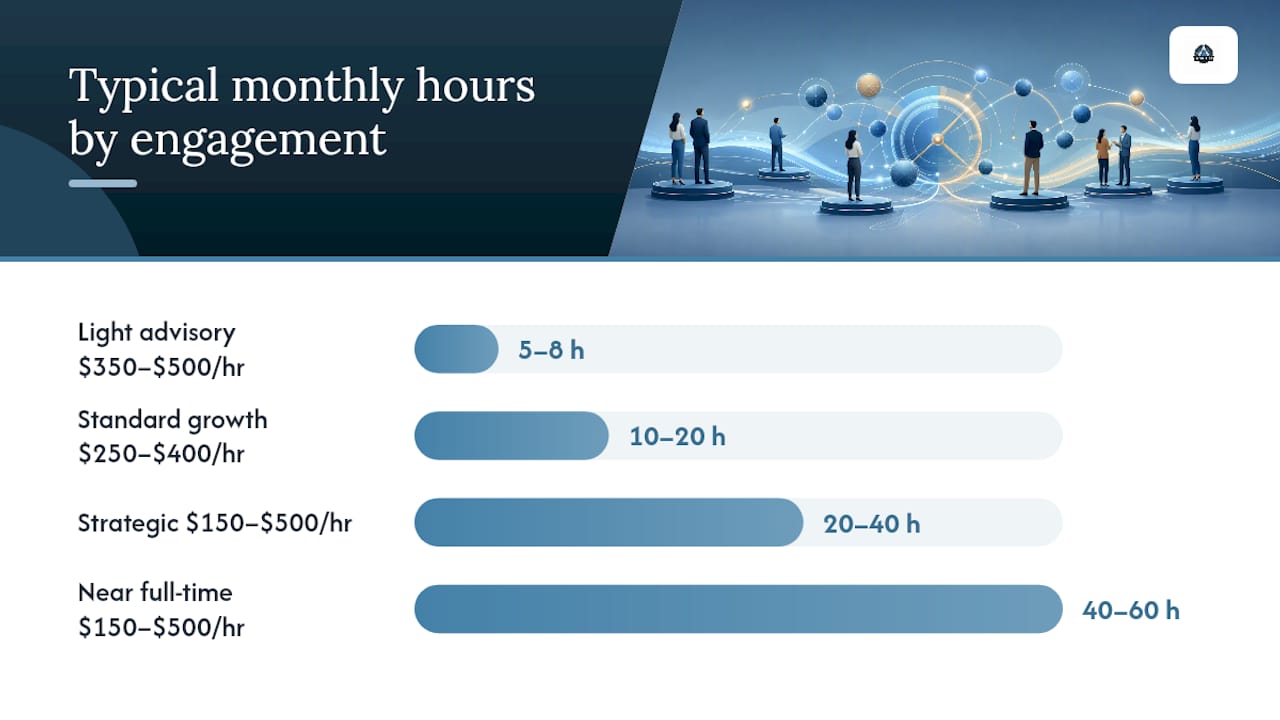
| Near full-time | $15,000–$20,000 | 40–60 hrs | $150–$500/hr |
Notice that the effective hourly rate on a retainer often runs lower than a standalone hourly quote, because the CFO is committed to your outcomes, not billing every email.
Hourly billing
Hourly rates for fractional CFOs typically run $200–$450/hour across the U.S. market, with seniority-based tiers ranging from $150–$250/hour for entry-level, $250–$350 for mid-level, and $350–$500 for senior strategic hires. Hourly works well for a one-time financial model, a specific audit prep task, or a short diagnostic. For ongoing advisory, it creates the wrong incentives on both sides.
Project-based fees
Defined-scope projects carry flat fees. Fundraising support or investor-readiness packages typically run $15,000–$40,000. A standalone financial model or three-year forecast might run $5,000–$15,000. M&A due diligence support sits at the higher end of that range or beyond, depending on deal complexity.
Equity and value-based arrangements
Value-based or success-fee structures tie a portion of compensation to a capital raise or a specific financial outcome. These arrangements are less common and require careful legal documentation, but they can work when cash is genuinely constrained and the CFO believes in the business.
Pro Tip: Before comparing quotes, convert every proposal to an effective hourly rate using the formula: monthly retainer ÷ committed hours. A $6,000 retainer for 15 hours works out to $400/hour. A $6,000 retainer for 25 hours is $240/hour. Those are very different engagements.
What drives a fractional CFO's price?
The spread between a $2,500/month and a $15,000/month engagement isn't random. Seven factors move the number.
- Scope of work: The single biggest driver. A CFO managing cash flow reporting and a monthly board pack costs less than one running fundraising, building a three-year model, and managing banking relationships simultaneously.
- Seniority and track record: A CFO who has taken three companies through Series B rounds commands a premium. Someone earlier in their career with solid controller experience costs less. The difference in hourly terms can be $150–$200/hour.
- Industry specialization: SaaS metrics, inventory accounting, healthcare regulatory reporting, and construction job costing all require specific expertise. Specialists charge for it.
- Company complexity: Multi-entity structures, international operations, complex revenue recognition, or a mix of product and service revenue all add scope and cost.
- Geography: Metro markets (New York, San Francisco, Chicago) carry a 10–20% premium over mid-market cities. Remote-first engagements have compressed this gap but not eliminated it.
- Urgency and timeline: A CFO brought in to close a funding round in 60 days costs more than one onboarded on a standard 90-day ramp.
- Agency or marketplace markup: Hiring through a staffing agency or fractional executive marketplace typically adds a 20–40% markup to the underlying rate. Direct hires or referrals skip that premium but require more diligence on your end.
One dynamic that surprises buyers: adding a single deliverable, like an investor-ready board package with variance analysis and a rolling 13-week cash forecast. Often, it moves an engagement from the light advisory band into the standard/growth band. That's a $1,500–$3,000/month jump for one additional output. Define deliverables precisely before signing.
Pro Tip: Start with a time-boxed onboarding scope: 60–90 days, defined deliverables, fixed fee. This gives both sides a low-risk way to calibrate fit before committing to a longer retainer. Many providers, including Amcfo, structure engagements this way.
A common and costly mistake: buyers frequently hire a fractional CFO when they actually need controller-level or bookkeeping support. A CFO sets strategy and interprets numbers. A controller produces them. Confusing the two means overpaying for a role that doesn't match the actual gap.
Sample packages by business stage
Here's what different price bands typically look like in practice, with deliverables spelled out.
Early-stage / small business ($2,500–$4,500/month)
Best for companies under $3M in revenue that need financial clarity, not a full finance function.
- 5–10 hours/month
- Monthly financial review and commentary
- Cash flow monitoring and 90-day forecast
- Budget vs. actual reporting
- Vendor or banking relationship support as needed
Typically excluded: Day-to-day bookkeeping, payroll processing, tax preparation, and accounts payable management. These belong in a separate bookkeeping engagement.
Standard / growth-stage ($4,500–$9,000/month)
For companies between $3M and $15M in revenue preparing to scale, raise capital, or manage increasing complexity.
- 10–20 hours/month
- Rolling 12-month financial model
- KPI dashboard design and monthly reporting
- Fundraising readiness and investor narrative support
- Banking covenant monitoring
- Scenario planning for hiring or expansion decisions
SaaS companies at this stage often need ARR, MRR, churn, and LTV/CAC metrics built into reporting. Inventory-heavy businesses need COGS and margin analysis by SKU. These specializations are included in well-scoped packages at this band but should be confirmed in writing.
Strategic / pre-exit ($9,000–$15,000/month)
For companies approaching a capital raise, acquisition, or significant operational restructuring.
- 20–40 hours/month
- Board-ready financial packages
- M&A preparation or due diligence support
- Lender or investor relationship management
- Cap table and dilution modeling
- Full three-year financial model with sensitivity analysis
Near full-time ($15,000–$20,000/month)
Senior strategic engagements at 1–2 days per week sit in this band. The CFO is effectively embedded, attending leadership meetings, managing the finance team, and owning the financial narrative. This is the right structure when you need executive presence without the full-time salary.
How do you calculate your total expected cost?
Use this formula before your first scoping call:
Total monthly cost = base retainer + average overage allowance + prorated project fees + tooling subscriptions + agency markup (if applicable)
- Establish your base retainer. Match your stage and scope to the bands above. If you're a $5M revenue company needing monthly reporting and a financial model, start at $5,000–$7,000/month.
- Add an overage buffer. Most retainers include a defined hour cap. Budget 10–15% above the base for months when a board meeting, a lender request, or a hiring decision generates extra work.
- Prorate project fees. If you expect a fundraising sprint in month 6, divide that $15,000–$25,000 project fee across 12 months and add roughly $1,250–$2,100/month to your annual budget.
- Include tooling. Financial planning tools like Jirav, Mosaic, or Fathom run $300–$800/month. QuickBooks or Xero subscriptions, if not already in place, add $50–$150/month.
- Account for agency markup. If hiring through a marketplace, add 20–40% to the underlying rate.
Worked example 1 — Early-stage company: Base retainer $4,000 + $400 overage buffer + $0 project fees + $150 tooling = $4,550/month, or roughly $54,600/year. Compare that to a full-time CFO's loaded annual cost of $250,000–$500,000+, and the savings are material.
Worked example 2 — Growth-stage company: Base retainer $9,000 + $900 overage buffer + $1,500 prorated fundraising support + $400 tooling = $11,800/month, or roughly $141,600/year. Still well below the loaded cost of a full-time hire, and the engagement can be scaled back or paused between fundraising cycles.
Hidden costs to track:
- Data cleanup or accounting remediation before the CFO can work effectively (often $2,000–$8,000 one-time)
- Expedited timelines for investor deliverables
- Travel for in-person board meetings (if required)
- Software licenses the CFO needs that aren't already in your stack
How do you evaluate and choose a fractional CFO?
The right fractional CFO is not the cheapest one or the most credentialed one. It's the one whose scope matches your actual problem.
Must-have capabilities to verify
- Financial modeling (three-statement model, scenario analysis)
- Cash flow forecasting and management
- KPI dashboard design and reporting cadence
- Familiarity with your accounting software (QuickBooks, Xero, NetSuite)
- Fundraising experience, if that's on your roadmap
- Industry-specific knowledge relevant to your revenue model
Questions to ask on the first call
- What does your typical engagement look like for a company at our stage?
- How many hours per month do you estimate this scope requires?
- What does success look like at 90 days, and how do we measure it?
- Can you share a sample deliverable (anonymized board pack, financial model)?
- What's your overage rate, and how do you handle scope creep?
- Can you provide two references from companies at a similar stage?
- What's your notice period, and how do you handle offboarding?
Red flags to walk away from
- Vague scope with no defined deliverables or hour commitment
- Hourly-only pricing for what is clearly an ongoing engagement
- No references, no case examples, no sample work product
- Unwillingness to sign a clear statement of work or retainer agreement
- Unclear or absent overage rules
Validating seniority claims takes 20 minutes. Ask for LinkedIn, check the companies they list, and call one reference directly. Ask the reference: "Did this person build the financial model themselves, or did they manage someone who did?" The answer tells you whether you're hiring a strategic CFO or a well-packaged controller.
For a practical hiring checklist that covers the full evaluation process, Amcfo's guide walks through each step in detail.
When does a fractional CFO make more sense than a full-time hire?
For most companies under $25M in revenue, the fractional model wins on cost and flexibility. Here's the side-by-side:
Built In salary data confirms CFO base salaries vary widely by company size and market, but the loaded cost calculation above reflects the realistic all-in number most private companies face.
The transition signals that suggest a full-time hire makes sense:
- Revenue consistently above $25–50M with complex, daily financial decisions
- A public offering, major acquisition, or regulatory filing that requires a permanent executive
- A finance team of 5+ people who need a dedicated leader
- Board or investor mandate for a full-time CFO as a condition of funding
Short of those thresholds, the fractional model gives you senior-level judgment at a fraction of the cost, with the flexibility to scale up or down as your needs change.
How to negotiate your contract and measure ROI
A well-negotiated fractional CFO contract protects both sides and sets the engagement up for measurable results.
Negotiation levers that actually move the number
- Commit to a longer term. A 12-month retainer versus month-to-month often yields a 10–15% discount. Providers price risk into short commitments.
- Define scope precisely. Every deliverable you add costs money. Every deliverable you remove saves it. Negotiate the list, not just the price.
- Clarify the overage rate upfront. Standard overage rates run $150–$300/hour above the retainer cap. Get this in writing before you sign.
- Ask about agency markup transparency. If you're hiring through a marketplace, ask what percentage goes to the platform. Some will negotiate the markup down for longer commitments.
- Negotiate IP and confidentiality terms. Any financial models, dashboards, or templates built during the engagement should belong to your company. Confirm this in the SOW.
- Set a notice period that works for you. Thirty days is standard; 60 days is reasonable for strategic engagements where transition risk is real.
Onboarding checklist
- Grant access to accounting software, bank feeds, and payroll data
- Complete any accounting cleanup or remediation before the CFO starts strategic work
- Agree on the KPIs to be delivered and the reporting cadence
- Set 30/60/90-day milestones in writing
- Schedule a weekly or biweekly check-in cadence
Measuring ROI in the first 6–12 months
Track these metrics to assess whether the engagement is delivering:
- Runway extension: Did cash management improve? By how many months?
- Cost savings identified: What inefficiencies or vendor overpayments did the CFO surface?
- Capital raised or debt secured: What was the CFO's direct contribution to a financing event?
- Revenue lift: Did pricing changes, margin improvements, or new contract structures add measurable revenue?
If you're at month 9 and can't point to a specific dollar outcome, the scope or the fit needs revisiting.
How these ranges were derived
The pricing bands in this article draw from several types of inputs:
- Published market benchmark reports and rate guides from fractional executive platforms
- Industry rate surveys covering U.S. fractional CFO engagements across company stages
- Provider package pages and publicly listed pricing structures
- Amcfo's own client engagement data across bookkeeping, accounting, and fractional CFO retainers
Geography matters.
These ranges are market signals, not guarantees. Your actual cost depends on your company's specific scope, complexity, and the seniority of the CFO you engage. Use these numbers as a starting point for budget planning, then get a scoped proposal from at least two providers before committing. A 30-minute scoping call will tell you more than any benchmark guide.
A candid note on how Amcfo approaches this
Most of the pricing confusion I see comes from buyers who haven't defined what they actually need before they start shopping. They get three quotes that look wildly different and don't know which one is right, because no two proposals are scoping the same work. At Amcfo, we start every engagement conversation with a scoping session, not a rate card. We want to know your revenue, your current accounting setup, your reporting gaps, and what decision you're trying to make better. From there, we build a retainer that covers exactly that scope, with defined deliverables and clear overage rules. Our fractional CFO services include budgeting, forecasting, financial analysis, QuickBooks cleanup, payroll support, and tax coordination, so we can handle the full financial picture rather than just the strategic layer. If you want to talk through what a scoped engagement would look like for your business, I'm happy to have that conversation.
Amcfo's fractional CFO services: skip the shopping cycle

Amcfo works with small and medium businesses that need CFO-level financial guidance without the cost or commitment of a full-time hire. The concrete difference: you get a scoped retainer with defined deliverables, clear overage rules, and a provider that also handles bookkeeping, QuickBooks cleanup, payroll, and tax coordination, so you're not managing three separate vendors to cover one finance function. Most clients are operational within two to four weeks. There's no long-term lock-in on initial engagements, and the scope adjusts as your business changes. If you're budgeting for fractional CFO support and want a proposal built around your actual numbers, book a discovery call with Amcfo and get a scoped quote within 48 hours.
Sources
- Fractionalcxo
- Fractional CFO Pricing: Retainer Ranges & How to Set Yours | DreamFirms
- Fractional CFO (2026): What It Is, When to Hire One, What to Pay | Treetop
- CFO (Chief Financial Officer) salaries | Built In